


Frequent travelers and rate of spread of epidemics
- PMID: 18252097
- PMCID: PMC2857283
- DOI: 10.3201/eid1309.070081
Frequent travelers and rate of spread of epidemics
Abstract
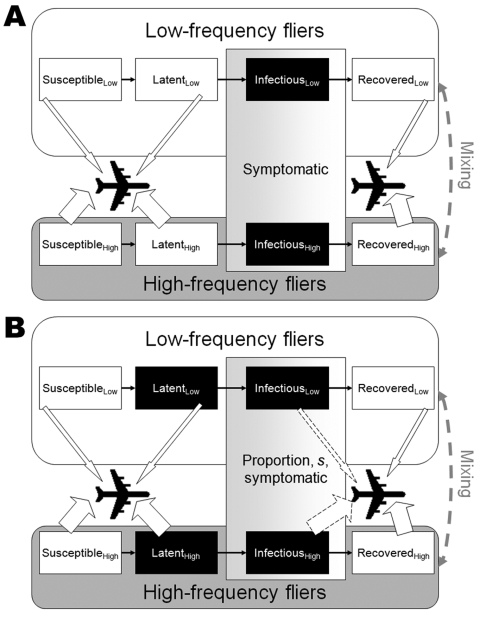
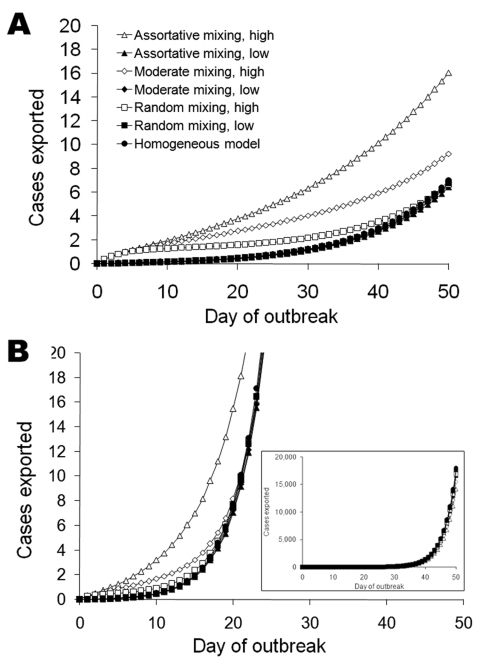
A small proportion of air travelers make disproportionately more journeys than the rest of travelers. They also tend to interact predominantly with other frequent travelers in hotels and airport lounges. This group has the potential to accelerate global spread of infectious respiratory diseases. Using an epidemiologic model, we simulated exportation of cases from severe acute respiratory syndrome-like and influenza-like epidemics in a population for which a small proportion travel more frequently than the rest. Our simulations show that frequent travelers accelerate international spread of epidemics only if they are infected early in an outbreak and the outbreak does not expand rapidly. If the epidemic growth rate is high, as is likely for pandemic influenza, heterogeneities in travel are frequently overwhelmed by the large number of infected persons in the majority population and the resulting high probability that some of these persons will take an international flight.
Figures
References
-
- Denstadli JM. Analysing air travel: a comparison of different survey methods and data collection procedures. J Travel Res. 2000;39:4–10. 10.1177/004728750003900102 - DOI
-
- Office for National Statistics. Travel trends 2004: a report on the international passenger survey. Basingstoke (UK): Palgrave Macmillan; 2005.
-
- Severe Acute Respiratory Syndrome (SARS) Expert Committee. SARS in Hong Kong: from experience to action: severe acute respiratory syndrome (SARS). Expert Committee of Hong Kong. 2003. [cited 2007 Jun 21]. Available from http://www.sars-expertcom.gov.hk/english/reports/reports.html