


Whole grain foods for the prevention of type 2 diabetes mellitus
- PMID: 18254091
- PMCID: PMC10384032
- DOI: 10.1002/14651858.CD006061.pub2
Whole grain foods for the prevention of type 2 diabetes mellitus
Abstract
Background: Diet as one aspect of lifestyle is thought to be one of the modifiable risk factors for the development of type 2 diabetes mellitus (T2DM). Information is needed as to which components of the diet could be protective for this disease.
Objectives: To asses the effects of whole-grain foods for the prevention of T2DM.
Search strategy: We searched CENTRAL, MEDLINE, EMBASE, CINAHL and AMED.
Selection criteria: We selected cohort studies with a minimum duration of five years that assessed the association between intake of whole-grain foods or cereal fibre and incidence of T2DM. Randomised controlled trials lasting at least six weeks were selected that assessed the effect of a diet rich in whole-grain foods compared to a diet rich in refined grain foods on T2DM and its major risk factors.
Data collection and analysis: Two authors independently selected the studies, assessed study quality and extracted data. Data of studies were not pooled because of methodological diversity.
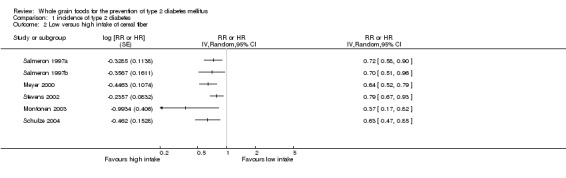
Main results: One randomised controlled trial and eleven prospective cohort studies were identified. The randomised controlled trial, which was of low methodological quality, reported the change in insulin sensitivity in 12 obese hyperinsulinemic participants after six-week long interventions. Intake of whole grain foods resulted in a slight improvement of insulin sensitivity and no adverse effects. Patient satisfaction, health related quality of life, total mortality and morbidity was not reported. Four of the eleven cohort studies measured cereal fibre intake, three studies whole grain intake and two studies both. Two studies measured the change in whole grain food intake and one of them also change in cereal fibre intake. The incidence of T2DM was assessed in nine studies and changes in weight gain in two studies. The prospective studies consistently showed a reduced risk for high intake of whole grain foods (27% to 30%) or cereal fibre (28% to 37%) on the development of T2DM.
Authors' conclusions: The evidence from only prospective cohort trials is considered to be too weak to be able to draw a definite conclusion about the preventive effect of whole grain foods on the development of T2DM. Properly designed long-term randomised controlled trials are needed. To facilitate this, further mechanistic research should focus on finding a set of relevant intermediate endpoints for T2DM and on identifying genetic subgroups of the population at risk that are most susceptible to dietary intervention.
Conflict of interest statement
None known
Figures


Update of
References
References to studies included in this review
Fung 2002 {published data only}
-
- Fung TT, Hu FB, Pereira MA, Liu S, Stampfer MJ, Colditz GA, et al. Whole‐grain intake and the risk of type 2 diabetes: a prospective study in men. American Journal of Clinical Nutrition 2002;76(3):535‐40. - PubMed
Koh‐Banerjee 2004 {published data only}
-
- Koh‐Banerjee P, Franz M, Sampson L, Liu S, Jacobs DR, Jr. , Spiegelman D et al. Changes in whole‐grain, bran, and cereal fiber consumption in relation to 8‐y weight gain among men. American Journal of Clinical Nutrition 2004;80(5):1237‐45. - PubMed
Liu 2000 {published data only}
Liu 2003 {published data only}
-
- Liu S. Whole‐grain foods, dietary fiber, and type 2 diabetes: searching for a kernel of truth. American Journal of Clinical Nutrition 2003;77(3):527‐9. - PubMed
Meyer 2000 {published data only}
-
- Meyer KA, Kushi LH, Jacobs DR Jr, Slavin J, Sellers TA, Folsom AR. Carbohydrates, dietary fiber, and incident type 2 diabetes in older women. American Journal of Clinical Nutrition 2000;71(4):921‐30. - PubMed
Montonen 2003 {published data only}
-
- Montonen J, Knekt P, Jarvinen R, Aromaa A, Reunanen A. Whole‐grain and fiber intake and the incidence of type 2 diabetes. American Journal of Clinical Nutrition 2003;77(3):622‐9. - PubMed
Pereira 2002 {published data only}
-
- Pereira MA, Jacobs DR, Jr. , Pins JJ, Raatz SK, Gross MD, Slavin JL et al. Effect of whole grains on insulin sensitivity in overweight hyperinsulinemic adults. American Journal of Clinical Nutrition 2002;75(5):848‐55. - PubMed
Salmeron 1997a {published data only}
-
- Salmeron J, Manson JE, Stampfer MJ, Colditz GA, Wing AL, Willett WC. Dietary fiber, glycemic load, and risk of non‐insulin‐dependent diabetes mellitus in women. JAMA: the journal of the American Medical Association 1997;277(6):472‐7. - PubMed
Salmeron 1997b {published data only}
-
- Salmeron J, Ascherio A, Rimm EB, Colditz GA, Spiegelman D, Jenkins DJ, et al. Dietary fiber, glycemic load, and risk of NIDDM in men. Diabetes Care 1997;20(4):545‐50. - PubMed
Schulze 2004 {published data only}
-
- Schulze MB, Liu S, Rimm EB, Manson JE, Willett WC, Hu FB. Glycemic index, glycemic load, and dietary fiber intake and incidence of type 2 diabetes in younger and middle‐aged women. American Journal of Clinical Nutrition 2004;80(2):348‐56. - PubMed
Stevens 2002 {published data only}
-
- Stevens J, Ahn K, Juhaeri, Houston D, Steffan L, Couper D. Dietary fiber intake and glycemic index and incidence of diabetes in African‐American and white adults: the ARIC study. Diabetes Care 2002;25(10):1715‐21. - PubMed
van Dam 2006 {published data only}
-
- Dam van R, Hu FB, Rosenberg L, Krishnan S, Palmer JR. Dietary Calcium and Magnesium, Major Food Sources, and Risk of Type 2 Diabetes in U.S. Black Women. Diabetes Care 2006;29 (10):2238‐43. - PubMed
References to studies excluded from this review
Bakker 1998 {published data only}
-
- Bakker SJ, Hoogeveen EK, Nijpels G, Kostense PJ, Dekker JM, Gans RO, et al. The association of dietary fibres with glucose tolerance is partly explained by concomitant intake of thiamine: the Hoorn Study. Diabetologia 1998;41(10):1168‐75. - PubMed
Feskens 1991 {published data only}
-
- Feskens EJ, Bowles CH, Kromhout D. Carbohydrate intake and body mass index in relation to the risk of glucose intolerance in an elderly population. American Journal of Clinical Nutrition 1991;54(1):136‐40. - PubMed
Hodge 1996 {published data only}
-
- Hodge AM, Montgomery J, Dowse GK, Mavo B, Watt T, Zimmet PZ. A case‐control study of diet in newly diagnosed NIDDM in the Wanigela people of Papua New Guinea. Diabetes Care 1996;19(5):457‐62. - PubMed
Juntunen 2003 {published data only}
-
- Juntunen KS, Laaksonen DE, Poutanen KS, Niskanen LK, Mykkanen HM. High‐fiber rye bread and insulin secretion and sensitivity in healthy postmenopausal women. American Journal of Clinical Nutrition 2003;77(2):385‐91. - PubMed
Liese 2003 {published data only}
-
- Liese AD, Roach AK, Sparks KC, Marquart L, D'Agostino RB, Jr, Mayer‐Davis EJ. Whole‐grain intake and insulin sensitivity: the Insulin Resistance Atherosclerosis Study. American Journal of Clinical Nutrition 2003;78(5):965‐71. - PubMed
Marshall 1993 {published data only}
-
- Marshall JA, Weiss NS, Hamman RF. The role of dietary fiber in the etiology of non‐insulin‐dependent diabetes mellitus. The San Luis Valley Diabetes Study. Annals of Epidemiology 1993;3(1):18‐26. - PubMed
Sloth 2004 {published data only}
-
- Sloth B, Krog‐Mikkelsen I, Flint A, Tetens I, Bjorck I, Vinoy S, et al. No difference in body weight decrease between a low‐glycemic‐index and a high‐glycemic‐index diet but reduced LDL cholesterol after 10‐wk ad libitum intake of the low‐glycemic‐index diet. American Journal of Clinical Nutrition 2004;80(2):337‐47. - PubMed
Vinceti 1994 {published data only}
-
- Vinceti M, Rovesti S, Pacchinoi C, Ropa G, Roncaia R, Benedetti P, et al. Diet as a risk factor for abnormal glucose tolerance in subjects with and without family history of diabetes mellitus. Diabetes, Nutrition and Metabolism 1994;7:21‐8.
Weickert 2006 {published data only}
-
- Weickert MO, Mohlig M, Schofl C, Arafat AM, Otto B, Viehoff H, et al. Cereal fiber improves whole‐body insulin sensitivity in overweight and obese women. Diabetes Care 2006;29:775‐80. - PubMed
Wolever 2002 {published data only}
-
- Wolever TM, Mehling C. High‐carbohydrate‐low‐glycaemic index dietary advice improves glucose disposition index in subjects with impaired glucose tolerance. British Journal of Nutrition 2002;87(5):477‐87. - PubMed
Wolever 2003 {published data only}
-
- Wolever TM, Mehling C. Long‐term effect of varying the source or amount of dietary carbohydrate on postprandial plasma glucose, insulin, triacylglycerol, and free fatty acid concentrations in subjects with impaired glucose tolerance. American Journal of Clinical Nutrition 2003;77(3):612‐21. - PubMed
Additional references
ADA 1997
-
- American Diabetic Association. Report of the Expert Committee on the Diagnosis and Classification of Diabetes Mellitus. Diabetes Care 1997;20:1183‐97. - PubMed
ADA 1999
-
- The Expert Committee on the Diagnosis, Classification of Diabetes Mellitus. Report of The Expert Committee on the Diagnosis and Classificatioi of Diabetes Mellitus. Diabetes Care 1999;22 (Suppl 1):S5‐19. - PubMed
Burkitt 1975
-
- Burkitt D. Refined carbohydrate foods and disease: some implications of dietary fiber. London: Academic Press, 1975.
Cohen 1960
-
- Cohen J. A coefficient of agreement for nominal scales. Educational and Psychological Measurement 1960;20:37‐46.
Dandona 2004
-
- Dandona P, Aljada A, Bandyopadhyay A. Inflammation: the link between insulin resistance, obesity and diabetes. Trends Immunol 2004;25(1):4‐7. - PubMed
Egger 1997
FAO 1998
-
- Food, Agricultural Organization of the United Nations. Carbohydrates in human nutrition: Report of a Joint FAO/WHO Expert consultation. Nutrition Paper no. 66. Rome: FAO, 1998. - PubMed
FAO/WHO 2003
-
- Food and acriculture organization of the United Nations/World Health Organisation. Diet, nutrition and the prevention of chronic disease: Report of a Joint WHO/FAO Expert consultation, WHO Technical Report Series No 916. Geneva: World Health Organisation, 2003. - PubMed
FDA 2005
-
- US Food, Drug Administration. Whole‐grain foods authoritative statement claim notification. Docket No.99P‐2209 2005.
FDA 2006
-
- US Food, Drug Administration. Whole‐grain label statements. Draft Guidelines.. www.cfsan.fda.gov/˜dms/flgragui.html 2006.
Fung 2002
-
- Fung TT, Hu FB, Pereira MA, Liu S, Stampfer MJ, Colditz GA, et al. Whole‐grain intake and the risk of type 2 diabetes: a prospective study in men. American Journal of Clinical Nutrition 2002;76(3):535‐40. - PubMed
Higgins 2003
Higgins 2005
-
- Higgins JPT, Green S, editors. Cochrane Handbook for Systematic Reviews of Interventions 4.2.5 [updated May 2005]. In: The Cochrane Library, Issue 3, 2005. Chichester, UK: John Wiley & Sons, Ltd.
Jacobs 1998
-
- Jacobs DR, Jr, Meyer KA, Kushi LH, Folsom AR. Whole‐grain intake may reduce the risk of ischemic heart disease death in postmenopausal women: the Iowa Women's Health Study. American Journal of Clinical Nutrition 1998;68(2):248‐57. - PubMed
Jadad 1996
-
- Jadad AR, Moore RA, Carroll D, Jenkinson C, Reynolds DJ, Gavaghan DJ. Assessing the quality of reports of randomized clinical trials: Is blinding necessary?. Controlled Clinical Trials 1996;17:1‐12. - PubMed
Koh‐Banerjee 2003
-
- Koh‐Banerjee P, Rimm EB. Whole grain consumption and weight gain: a review of the epidemiological evidence, potential mechanisms and opportunities for future research. Proceedings of the Nutrition Society 2003;62(1):25‐9. - PubMed
Lau 2006
Liu 1999
-
- Liu S, Stampfer MJ, Hu FB, Giovannucci E, Rimm E, Manson JE, et al. Whole‐grain consumption and risk of coronary heart disease: results from the Nurses' Health Study. American Journal of Clinical Nutrition 1999;70:412‐9. - PubMed
Liu 2002
-
- Liu S. Intake of refined carbohydrates and whole grain foods in relation to risk of type 2 diabetes mellitus and coronary heart disease. Journal of the American College of Nutrition 2002;21:298‐306. - PubMed
Liu 2003
-
- Liu S. Whole‐grain foods, dietary fiber, and type 2 diabetes: searching for a kernel of truth. American Journal of Clinical Nutrition 2003;77(3):527‐9. - PubMed
Ludwig 2002
-
- Ludwig DS. The glycemic index: physiological mechanisms relating to obesity, diabetes, and cardiovascular disease. Journal of the American Medical Association 2002;287(18):2414‐23. - PubMed
McKeown 2002
-
- McKeown NM, Meigs JB, Liu S, Wilson PW, Jacques PF. Whole‐grain intake is favorably associated with metabolic risk factors for type 2 diabetes and cardiovascular disease in the Framingham Offspring Study. American Journal of Clinical Nutrition 2002;76(2):390‐8. - PubMed
McKeown 2004
-
- McKeown NM, Meigs JB, Liu S, Saltzman E, Wilson PW, Jacques PF. Carbohydrate nutrition, insulin resistance, and the prevalence of the metabolic syndrome in the Framingham Offspring Cohort. Diabetes Care 2004;27(2):538‐46. - PubMed
Meyer 2000
-
- Meyer KA, Kushi LH, Jacobs DR Jr, Slavin J, Sellers TA, Folsom AR. Carbohydrates, dietary fiber, and incident type 2 diabetes in older women. American Journal of Clinical Nutrition 2000;71(4):921‐30. - PubMed
Montonen 2003
-
- Montonen J, Knekt P, Jarvinen R, Aromaa A, Reunanen A. Whole‐grain and fiber intake and the incidence of type 2 diabetes. American Journal of Clinical Nutrition 2003;77(3):622‐9. - PubMed
Monzillo 2003
-
- Monzillo LU, Hamdy O. Evaluation of insulin sensitivity in clinical practice and in research settings. Nutrion Reviews 2003;61(12):397‐412. - PubMed
Murtaugh 2003
-
- Murtaugh MA, Jacobs DR Jr, Jacob B, Steffen LM, Marquart L. Epidemiological support for the protection of whole grains against diabetes. Proceedings of the Nutrition Society 2003;62(1):143‐9. - PubMed
NDDG 1979
-
- National Diabetes Data Group. Classification and diagnosis of diabetes mellitus and other categories of glucose intolerance. Diabetes 1979;28:1039‐57. - PubMed
Robertson 2004
-
- Robertson RP, Harmon J, Tran PO, Poitout V. Beta‐cell glucose toxicity, lipotoxicity, and chronic oxidative stress in type 2 diabetes. Diabetes 2004;53 Suppl 1:S119‐24. - PubMed
Schulz 1995
-
- Schulz KF, Chalmers I. Hayes RJ, Altman DG. Empirical evidence of bias. Dimensions of methodological quality associated with estimates of treatment effects in controlled trials. JAMA: the journal of the American Medical Association 1995;273:408‐12. - PubMed
Sjoholm 2005
-
- Sjoholm A, Nystrom T. Endothelial inflammation in insulin resistance. Lancet 2005;365(9459):610‐2. - PubMed
Slavin 2003
-
- Slavin J. Why whole grains are protective: biological mechanisms. Proceedings of the Nutrition Society 2003;62(1):129‐34. - PubMed
Steffen 2003
-
- Steffen LM, Jacobs DR Jr, Murtaugh MA, Moran A, Steinberger J, Hong CP, et al. Whole grain intake is associated with lower body mass and greater insulin sensitivity among adolescents. American Journal of Epidemiology 2003;158(3):243‐50. - PubMed
Trowell 1975
-
- Trowell H. Dietary‐fiber hypothesis of the aetiology of diabetes mellitus. Diabetes 1975;24:762‐5. - PubMed
Unwin 2002
-
- Unwin N, Shaw J, Zimmet P, Alberti KG. Impaired glucose tolerance and impaired fasting glycaemia: the current status on definition and intervention. Diabetic Medicine 2002;19(9):708‐23. - PubMed
WHO 1980
-
- WHO Expert Committee on Diabetes Mellitus. Second report. Technical Report Series 646. Geneva: World Health Organisation, 1980. - PubMed
WHO 1985
-
- World Health Organisation. Diabetes Mellitus: Report of a WHO Study Group. Diabetes Mellitus: Report of a WHO Study Group. Technical Report Series No 727. Geneva: World Health Organisation, 1985. - PubMed
WHO 1999
-
- World Health Organization. Definition, Diagnosis and Classification of Diabetes Mellitus and its Complications. Report of a WHO Consultation. Part 1 : Diagnosis and Classification of Diabetes Mellitus. Geneva: World Health Organisation, 1999.
Willett 2002
-
- Willett W, Manson J, Liu S. Glycemic index, glycemic load, and risk of type 2 diabetes. American Journal of Clinical Nutrition 2002;76(1):274S‐80S. - PubMed
Publication types
MeSH terms
Substances
LinkOut - more resources
Full Text Sources
Other Literature Sources
Medical
