


Prophylactic oral betamimetics for preventing preterm labour in singleton pregnancies
- PMID: 18254101
- PMCID: PMC8923517
- DOI: 10.1002/14651858.CD006395.pub2
Prophylactic oral betamimetics for preventing preterm labour in singleton pregnancies
Abstract
Background: Preterm birth occurs in up to 6% to 10% of all births and is the major complication of pregnancy associated with perinatal mortality and morbidity. Previous preterm delivery is a strong predictor for preterm labour, and the earlier the birth, the more likely it is to be repeated at the same gestation. In the acute setting, betamimetics can decrease contraction frequency or delay preterm birth by 24 to 48 hours.
Objectives: To assess the effectiveness of prophylactic oral betamimetics for the prevention of preterm labour and birth for women with singleton pregnancies at high risk of preterm delivery.
Search strategy: We searched the Cochrane Pregnancy and Childbirth Group's Trials Register (October 2007), CENTRAL (The Cochrane Library 2006, Issue 3), MEDLINE (January 1966 to December 2006), EMBASE (January 1985 to December 2006), and reference lists.
Selection criteria: Randomised controlled trials in singleton pregnancies at high risk of preterm labour comparing prophylactic oral betamimetics with placebo or any intervention with the specific aim of preventing preterm birth.
Data collection and analysis: Two authors independently assessed trial quality and extracted data.
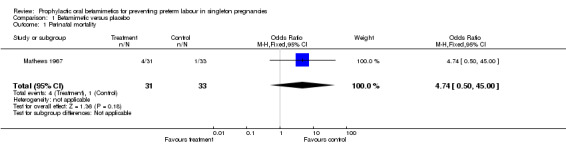
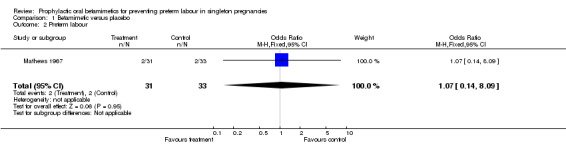
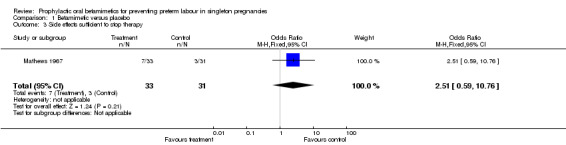
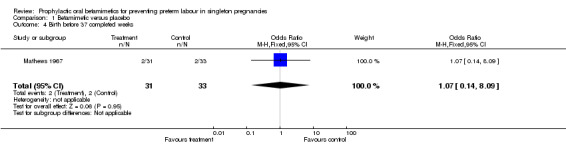
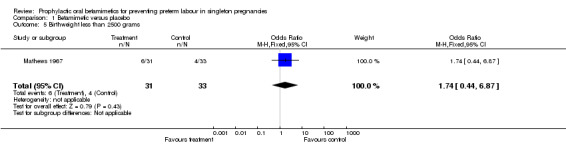
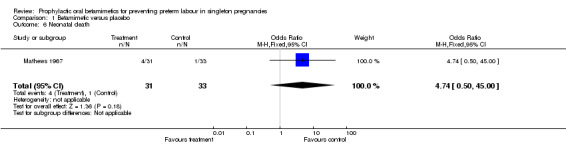
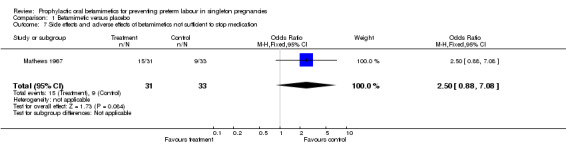
Main results: One trial (64 singleton pregnancies) was included. The trial compared the oral betamimetic agent isoxuprine with placebo. No difference was seen for perinatal mortality rate (relative risk (RR) 4.74, 95% confidence interval (CI) 0.50 to 45.00). There was no evidence of an effect of oral betamimetic agents in reduction of spontaneous onset of preterm labour (RR 1.07, 95% CI 0.14 to 8.09) or preterm birth, less than 37 weeks' gestation. There was no significant association between the use of oral betamimetics and side effects sufficient to stop therapy (RR 2.51, 95% CI 0.59 to 10.76). No differences were found for infant outcomes; birthweight less than 2500 grams (RR 1.74, 95% CI 0.44 to 6.87) or neonatal death (RR 4.74, 95% CI 0.50 to 45.00). This trial had adequate methodological quality; however the sample size was inappropriate to determine any significance in neonatal outcome differences between the treatment groups.
Authors' conclusions: There is insufficient evidence to support or refute the use of prophylactic oral betamimetics for preventing preterm birth in women at high risk of preterm labour with a singleton pregnancy.
Conflict of interest statement
None known.
Figures
Update of
References
References to studies included in this review
Mathews 1967 {published data only}
-
- Mathews DD, Friend JB, Michael CA. A double‐blind trial of oral isoxuprine in the prevention of premature labour. Journal of Obstetrics and Gynaecology of the British Commonwealth 1967;74:68‐70. - PubMed
References to studies excluded from this review
Alexander 1986 {published data only}
-
- Alexander S, Yudkin P. Betamimetic drugs in the prophylaxis of preterm labour: extent and rationale of their use. British Journal of Obstetrics and Gynaecology 1986;93:891‐2. - PubMed
Allen 1965 {published data only}
-
- Allen H, Short H, Fraleigh D. The use of isoxsuprine in the management of preterm labour. Applied Therapeutics 1965;7:544‐7. - PubMed
Briscoe 1966 {published data only}
-
- Briscoe CC. Failure of oral isoxsuprine to prevent prematurity. American Journal of Obstetrics and Gynecology 1966;95:885‐6. - PubMed
Hallak 1993 {published data only}
-
- Hallak M, Moise KJ, Lira N, Dorman K, O'Brian Smith E, Cotton DB. The effect of tocolytic agents (indomethacin and terbutaline) on fetal breathing (FBM) and body movements (FM): a prospective, randomized, double blind, placebo‐controlled clinical trial. American Journal of Obstetrics and Gynecology 1992;166:375. - PubMed
-
- Hallak M, Moise KJ, Lira N, Dorman KF, O'Brian Smith E, Cotton DB. The effect of tocolytic agents (indomethacin and terbutaline) on fetal breathing and body movements: a prospective, randomized, double‐blind, placebo‐controlled clinical trial. American Journal of Obstetrics and Gynecology 1992;167:1059‐63. - PubMed
-
- Hallak M, Moise KJ, O'Brian Smith E, Cotton DB. The effects of indomethacin and terbutaline on human fetal umbilical artery velocimetry: a randomized double‐blind study. American Journal of Obstetrics and Gynecology 1993;168:348. - PubMed
-
- Hallak M, Moise KJ, O'Brian Smith E, Cotton DB. The effects of indomethacin and terbutaline on human fetal umbilical artery velocimetry: a randomized, double‐blind study. American Journal of Obstetrics and Gynecology 1993;168:865‐8. - PubMed
Hendricks 1961 {published data only}
-
- Hendricks C, Cibils L, Pose S, Eskes T. The pharmacologic control of excessive uterine activity with isoxsuprine. American Journal of Obstetrics and Gynecology 1961;82(5):1064‐78. - PubMed
Matijevic 2006a {published data only}
Walters 1977 {published data only}
-
- Walters WAW, Wood C. A trial of oral ritodrine for the prevention of premature labour. British Journal of Obstetrics and Gynaecology 1977;84:26‐30. - PubMed
Additional references
Althuisius 1998
-
- Althuisius S, Dekker G, Hummel P, Bekedam D, Kuik D, Giejn HP. Cervical incompetence prevention randomisation cerclage trial (CIPRACT); effect of therapeutic cerclage with bed rest v bed rest only on cervical length. Ultrasound in Obstetrics & Gynecology 1998;12:312‐7. - PubMed
Anotayanonth 2004
-
- Anotayanonth S, Subhedar NV, Neilson JP, Harigopal S. Betamimetics for inhibiting preterm labour. Cochrane Database of Systematic Reviews 2004, Issue 4. [Art. No.: CD004352. DOI: 10.1002/14651858.CD004352.pub2] - PubMed
Barden 1980
-
- Barden TP. Ritodrine hydrochloride: an FDA‐approved tocolytic agent for use in the United States. Part I. Pharmacology, clinical history, administration, side effects and safety. Obstetrics & Gynecology 1980;56:1‐6. - PubMed
Bell 1978
Bienstock 2001
-
- Bienstock JL, Ural SH, Blakemore K, Pressman EK. University hospital‐based prenatal care decreases rate of preterm delivery and costs, when compared to managed care. Journal of Maternal‐Fetal Medicine 2001;10(2):127‐30. - PubMed
Bracci 2006
-
- Bracci R, Perrone S, Buonocore G. The timing of neonatal brain damage. Biology of the Neonate 2006;90(3):145‐55. - PubMed
Costeloe 2000
-
- Costeloe K, Hennessy E, Gibson AT, Marlow N, Wilkinson AR. The EPICure study: outcomes to discharge from hospital for infants born at the threshold of viability. Pediatrics 2000;106(4):659‐71. - PubMed
da Fonseca 2003
-
- Fonseca EB, Bittar RE, Carvalho MHB, Zugaib M. Prophylactic administration of progesterone by vaginal suppository to reduce the incidence of spontaneous preterm birth in women at increased risk: a randomized placebo‐controlled double‐blind study. American Journal of Obstetrics and Gynecology 2003;188(2):419‐24. - PubMed
Dodd 2006
Gabor 1982
-
- Gabor H, James MR. Biochemistry and pharmacology of the myometrium and labor: regulation at the cellular and molecular levels. American Journal of Obstetrics and Gynecology 1982;142:225‐37. - PubMed
Gyetvai 1999
-
- Gyetvai K, Hannah ME, Hodnett ED, Ohlsson A. Tocolytics for preterm labor: a systematic review. Obstetrics & Gynecology 1999;94:869‐77. - PubMed
Hack 1999
-
- Hack M. Consideration of the use of health status, functional outcome, and quality‐of‐life to monitor neonatal intensive care practice. Pediatrics 1999;103(1 Suppl E):319‐28. - PubMed
Higgins 2005
-
- Higgins JPT, Green S, editors. Cochrane Handbook for Systematic Reviews of Interventions 4.2.4 [updated March 2005]. In: The Cochrane Library, Issue 2, 2005. Chichester, UK: John Wiley & Sons, Ltd.
Hoffman 1984
-
- Hoffman HJ, Bakketeig lS. Risk factors associated with the occurrence of preterm birth. Clinical Obstetrics and Gynecology 1984;27(3):539‐52. - PubMed
ICROP 1984
-
- Anonymous. An international classification of retinopathy of prematurity. The committee for the classification of retinopathy of prematurity. Archives of Ophthalmology 1984;102(8):1130‐4. - PubMed
Kramer 2000
-
- Kramer M, Demissie K, Yang H, Platt RW, Sauve R, Liston R. The contribution of mild and moderate preterm birth to infant mortality. JAMA 2000;284:843‐9. - PubMed
Liggins 1972
-
- Liggins GC, Howie RN. A controlled trial of antepartum glucocorticoid treatment for prevention of the respiratory distress syndrome in premature infants. Pediatrics 1972;50(4):515‐25. - PubMed
Lumley 2003
-
- Lumley J. Defining the problem: epidemiology of preterm birth. BJOG: an international journal of obstetrics and gynaecology 2003;110(Suppl 20):3‐7. - PubMed
Meis 2003
-
- Meis PJ, Klebanoff M, Thom E, Dombrowski MP, Sibai B, Moawad AH, et al. Prevention of recurrent preterm delivery by 17 alpha‐hydroxyprogesterone caproate. New England Journal of Medicine 2003;384(24):2379‐85. - PubMed
Papile 1978
-
- Papile LA, Burstein J, Burstein R, Koffler H. Incidence and evolution of subependymal and intraventricular hemorrhage: a study of infants with birth weights less than 1,500 gm. Journal of Pediatrics 1978;92(4):529‐34. - PubMed
Petrou 2001
-
- Petrou S, Sach T, Davidson L. The long‐term costs of preterm birth and low birth weight: results of a systematic review. Child Care, Health and Development 2001;27:97‐115. - PubMed
RevMan 2003 [Computer program]
-
- The Cochrane Collaboration. Review Manager (RevMan). Version 4.2 for Windows. Oxford, England: The Cochrane Collaboration, 2003.
Sciscione 2003
-
- Sciscione AC, Ivester T, Largoza M, Manley J, Shlossman P, Colmogen GHC. Acute pulmonary edema in pregnancy. Obstetrics & Gynecology 2003;101:511‐5. - PubMed
Sosa 2004
-
- Sosa C, Althabe F, Belizán J, Bergel E. Bed rest in singleton pregnancies for preventing preterm birth. Cochrane Database of Systematic Reviews 2004, Issue 1. [Art. No.: CD003581. DOI: 10.1002/14651858.CD003581.pub2] - PubMed
Ugwumadu 2003
-
- Ugwumadu A, Manyonda I, Reid F, Hay P. Effect of early oral clindamycin on late miscarriage and preterm delivery in asymptomatic women with abnormal vaginal flora and bacterial vaginosis: a randomised controlled trial. Lancet 2003;361:983‐8. - PubMed
Wood 2005
-
- Wood NS, Costeloe K, Gibson AT, Hennessy EM, Marlow N, Wilkinson AR, EPICure Study Group. The EPICure study: associations and antecedents of neurological and developmental disability at 30 months of age following extremely preterm birth. Archives of Disease in Childhood. Fetal and Neonatal Edition 2005;90(2):F134‐F140. - PMC - PubMed
Yamasmit 2005
-
- Yamasmit W, Chaithongwongwatthana S, Tolosa JE, Limpongsanurak S, Pereira L, Lumbiganon P. Prophylactic oral betamimetics for reducing preterm birth in women with a twin pregnancy. Cochrane Database of Systematic Reviews 2005, Issue 3. [Art. No.: CD004733. DOI: 10.1002/14651858.CD004733.pub2] - PubMed
Publication types
MeSH terms
Substances
LinkOut - more resources
Full Text Sources
