. 2008 Apr;82(8):3894-902.
doi: 10.1128/JVI.01818-07. Epub 2008 Feb 6.

The E6 oncoproteins from human betapapillomaviruses differentially activate telomerase through an E6AP-dependent mechanism and prolong the lifespan of primary keratinocytes

Affiliations

The E6 oncoproteins from human betapapillomaviruses differentially activate telomerase through an E6AP-dependent mechanism and prolong the lifespan of primary keratinocytes

Kristin M Bedard et al. J Virol. 2008 Apr.

Abstract

Human papillomaviruses (HPVs) belonging to the Betapapillomavirus genus have recently been implicated in squamous cell carcinomas of the skin, though the mechanisms by which they initiate carcinogenesis are unclear. We show that human foreskin keratinocytes (HFKs) expressing several betapapillomavirus E6 (beta-E6) proteins display life span extension, but not to the extent seen in HFKs expressing HPV type 16 E6 (16E6). Additionally, we demonstrate that beta-E6 proteins can differentially activate telomerase. HFKs expressing 38E6 exhibit significant telomerase activity but to a lesser degree than that observed with 16E6; however, other beta-E6 proteins, including 5E6, 8E6, 20E6, and 22E6, exhibit low or background levels of telomerase activity. Utilizing glutathione S-transferase pull-down and coimmunoprecipitation experiments, the beta-E6 proteins were shown to interact with the cellular proteins E6-associated protein (E6AP) and NFX1-91, two proteins known to be important for telomerase activation by 16E6. Interestingly, the relative strength of the interaction between E6 and E6AP or NFX1-91 was proportionate to the activation of telomerase by each beta-E6 protein. To address the requirement for E6AP in telomerase activation by beta-E6 proteins, we utilized a shRNA to knock down endogenous levels of E6AP. Lysates with decreased levels of E6AP showed a reduced ability to activate telomerase, suggesting that E6AP is a necessary component. These data suggest that complex formation between E6, E6AP, and NFX1-91 is a critical step in mediating telomerase activation, which may be one contributing factor to cellular life span extension during human betapapillomavirus infection.


Figures

FIG. 1.
FIG. 1.
Expression of E6 proteins extends the life span of primary keratinocytes in culture. A. Primary keratinocytes expressing beta-E6 proteins were grown in culture to compare their growth properties to control cells containing an LXSN empty vector. Cells were passaged at 80% confluence and recorded for population doublings under normal cell growth conditions. Error bars were calculated using the standard deviation of three independent experiments. B. P values for each E6 cell line compared to each other and to an LXSN control are shown. The P values were calculated using a one-way analysis of variance with Bonferroni post hoc analysis. NS, not significant.
FIG. 2.
FIG. 2.
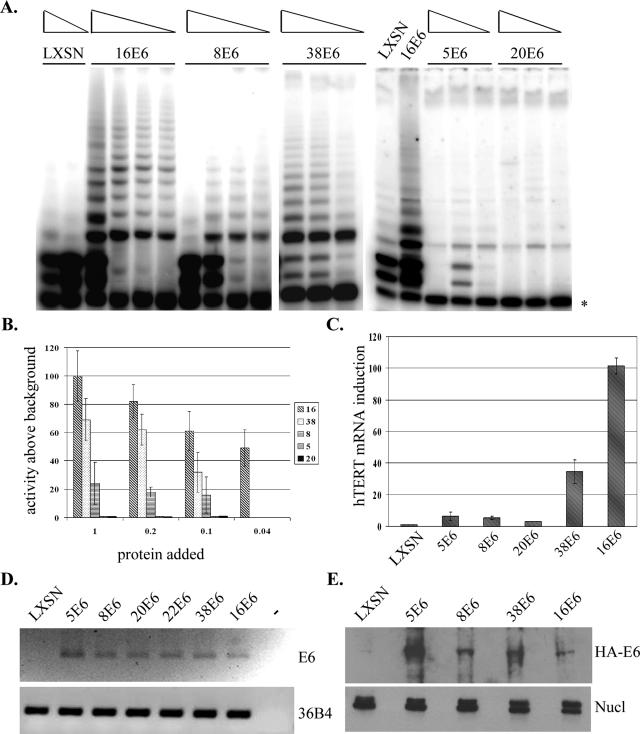
Primary keratinocytes expressing beta-E6 proteins displayed activated telomerase and induction of hTERT mRNA. A. Lysates from stable HFK cell lines expressing 16E6 or beta-E6 proteins or cells containing an empty LXSN expression vector (negative control) were analyzed in TRAP assays. The autoradiogram shows extension products from the [α-32P]ATP-labeled TS primer following incubation with various cell lysates. The band denoted by an asterisk denotes a control PCR product to show that all samples amplified to equal levels. Decreasing amounts of protein lysate (from 1 to 0.04 μg) were added to TRAP reaction mixtures. B. TRAP activity was quantitated from three independent experiments using Quantity One software. TRAP activity from 16E6 lysates was set to 100 to determine relative levels of telomerase activity in other E6-containing lysates. C. qPCR of hTERT mRNA in E6-expressing HFKs. hTERT levels in 16E6-expressing cells were set to 100 to compare the relative levels of hTERT expression in other E6 cell lines. D. Real-time PCR of E6 proteins stably expressed in HFKs. 36b4 was amplified as a loading control. The lane with a minus sign denotes a water-only control (no cDNA added). E. Western blot analysis of HA-tagged E6 proteins expressed in HFKs. Nucleolin was used as a loading control.
FIG. 3.
FIG. 3.
Beta-E6 proteins differentially interact with E6AP. A. HFKs expressing HA-tagged E6 proteins were immunoprecipitated with a monoclonal HA antibody (+) or mouse immunoglobulin G (-) as a negative control and immunoblotted with an E6AP antibody (αE6AP). B. Identical cell lysates were immunoprecipitated with an E6AP antibody (+) or preimmune rabbit serum as a negative control (-) and immunoblotted with an HA antibody (αHA). Input is equal to 5% of total protein lysate and is shown in the Western blot on the right hand side. C. GST pull-down assays with in vitro-translated E6AP. Input represents 20% of radiolabeled E6AP added to each reaction mixture. D. The interaction of each GST-E6 protein with E6AP was quantitated from five independent experiments. The level of interaction above the GST negative control was measured using Image J software. A one-sample two-tailed t test was used to calculate the significance of interactions. **, P < 0.0001; *, P < 0.04. E. A 0.5-μg aliquot of each GST fusion protein was analyzed with SDS-polyacrylamide gel electrophoresis and Coomassie staining. F. GST pull-down assays were repeated in an identical manner with in vitro-translated NFX1-91 protein. Input (I) represents 10% of radiolabeled NFX1-91 added to each reaction mixture, and a + denotes pull-down reactions.
FIG. 4.
FIG. 4.
Knockdown of E6AP reduces telomerase activity in 16E6-, 38E6-, and 8E6-expressing HFKs. A. shRNAs were stably expressed in E6-expressing HFKs. Knockdown was confirmed by Western blot analysis with E6AP antibody; GAPDH was used as a loading control. LXSN cells containing no shRNA were used as a positive control for E6AP expression. The shRNA- cells, containing an empty pBABE vector, show endogenous E6AP levels. B. 16E6, 8E6, and 38E6 cells expressing shRNA-, shRNA 1, or shRNA 2 were examined for TRAP activity and compared to LXSN cells as a negative control (lane 1). TRAP-postive lysates were used as a positive control in lane 11. The amplified extension products were quantitated using Quantity One software following phosphorimager scanning shown at the bottom of the gel. 16E6 with -shRNA, 8E6 with -shRNA, and 38E6 with -shRNA were set to 100 to compare the decrease in TRAP activity following E6AP shRNA treatment.

References

    1. Bartz, S. R., and M. A. Vodicka. 1997. Production of high-titer human immunodeficiency virus type 1 pseudotyped with vesicular stomatitis virus glycoprotein. Methods 12337-342. - PubMed
    1. Boyer, S. N., D. E. Wazer, and V. Band. 1996. E7 protein of human papilloma virus-16 induces degradation of retinoblastoma protein through the ubiquitin-proteasome pathway. Cancer Res. 564620-4624. - PubMed
    1. Caldeira, S., R. Filotico, R. Accardi, I. Zehbe, S. Franceschi, and M. Tommasino. 2004. p53 mutations are common in human papillomavirus type 38-positive non-melanoma skin cancers. Cancer Lett. 209119-124. - PubMed
    1. Caldeira, S., I. Zehbe, R. Accardi, I. Malanchi, W. Dong, M. Giarre, E. M. de Villiers, R. Filotico, P. Boukamp, and M. Tommasino. 2003. The E6 and E7 proteins of the cutaneous human papillomavirus type 38 display transforming properties. J. Virol. 772195-2206. - PMC - PubMed
    1. Chung, H. K., C. Cheong, J. Song, and H. W. Lee. 2005. Extratelomeric functions of telomerase. Curr. Mol. Med. 5233-241. - PubMed

Publication types

LinkOut - more resources