. 2008 Feb 12;105(6):2226-31.
doi: 10.1073/pnas.0711980105. Epub 2008 Feb 6.

Self-assembly of the plant cell wall requires an extensin scaffold

Affiliations

Self-assembly of the plant cell wall requires an extensin scaffold

Maura C Cannon et al. Proc Natl Acad Sci U S A. .

Abstract

Cytokinesis partitions the cell by a cleavage furrow in animals but by a new cross wall in plants. How this new wall assembles at the molecular level and connects with the mother cell wall remains unclear. A lethal Arabidopsis embryogenesis mutant designated root-, shoot-, hypocotyl-defective (rsh) provides some clues: RSH encodes extensin AtEXT3, a structural glycoprotein located in the nascent cross wall or "cell plate" and also in mature cell walls. Here we report that electron micrographs of rsh mutant cells lacking RSH extensin correspond to a wall phenotype typified by incomplete cross wall assembly. Biochemical characterization of the purified RSH glycoprotein isolated from wild-type Arabidopsis cell cultures confirmed its identity as AtEXT3: a (hydroxy)proline-rich glyco protein comprising 11 identical amphiphilic peptide repeats with a 28-residue periodicity: SOOOOKKHYVYKSOOOOVKHYSOOOVYH (O = Hyp), each repeat containing a hydrophobic isodityrosine cross-link motif (YVY, underlined). Atomic force microscopy of RSH glycoprotein imaged its propensity for self-assembly into a dendritic scaffold. Extensin peroxidase catalyzed in vitro formation of insoluble RSH gels with concomitant tyrosine cross-linking, hence this likelihood in muro. We conclude that self-assembling amphiphiles of lysine-rich RSH extensin form positively charged scaffolds in the cell plate. These react with negatively charged pectin to create an extensin pectate coacervate that may template further orderly deposition of the new cross wall at cytokinesis.


Conflict of interest statement

The authors declare no conflict of interest.

Figures
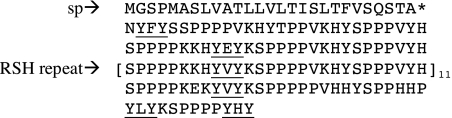
Fig. 1.
Fig. 1.
Wild-type, nonhydroxylated AtEXT3 (pre-RSH) deduced from genome sequence. The signal peptide (sp) cleavage site is marked by an asterisk, and the major RSH repeat module (28 aa) is in parentheses. RSH has 60 Tyr residues and 16 YXY (Idt) motifs (underlined).
Fig. 2.
Fig. 2.
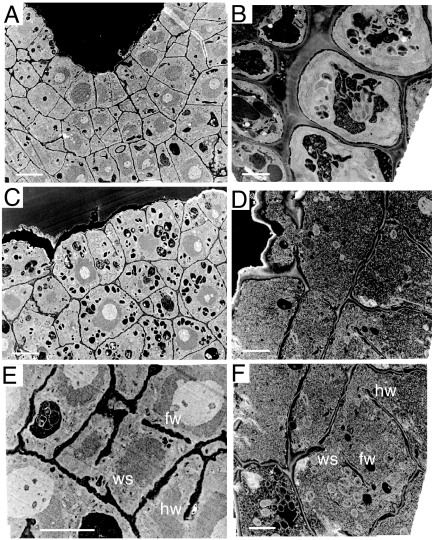
Electron micrographs showing defective cell walls in the rsh/rsh mutant. (A, C, and E) Images of heart-stage embryo sections. (B, D, and F) Images of 3-day-old root transverse sections. The mutant (C–F) compared with the wild type (A and B) has incomplete cell walls. fw, floating walls; hw, hanging walls; ws, wall stubs. [Scale bars: 10 μm (A, C, and E) and 4 μm (B, D, and F).]
Fig. 3.
Fig. 3.
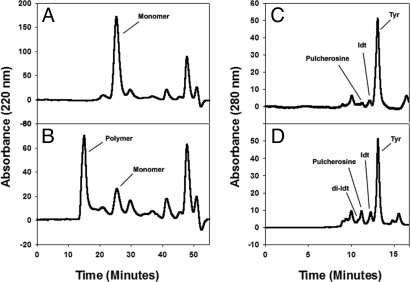
Cross-linking of purified RSH with extensin peroxidase produces di-Idt and pulcherosine. (A) Time 0 control. (B) Five-minute reaction. By 5 min most RSH monomers and oligomers were converted to the large-molecular-weight polymer that voided the column. One nanogram of enzyme was used in each reaction. (C) Acid hydrolysate of RSH monomers separated on a hydroxyethylaspartamide column in size-exclusion mode. (D) Acid hydrolysate of cross-linked RSH. Note that di-Idt appears not to resolve completely from the pulcherosine peak.
Fig. 4.
Fig. 4.
Alignments of the RSH 28-aa repetitive motif. (A) Head-to-head parallel alignment gives di-Idt motifs exclusively. (B) Staggered alignment gives pulcherosine motifs exclusively. This shows facile generation of pulcherosine cross-linking motifs. Offsetting the 28-residue canonical RSH motif by 12 residues realigns the Ser-Hyp4 glycomodule of one chain with another (underlined), thus switching from potential di-Idt to pulcherosine cross-links. Hydrophilic residues are shown in yellow, potential di-Idt and pulcherosine cross-links (hydrophobic) are in pink, and other hydrophobic residues are in gray. All motifs are presented in the N terminus (head) to C terminus (tail) direction.
Fig. 5.
Fig. 5.
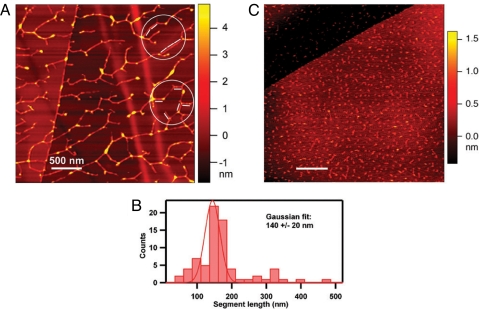
Self-assembled RSH network imaged by AFM. (A) A solution of RSH monomer (9 μg/ml water; see Fig. 3A) was dispersed on a highly ordered pyrolytic graphite (HOPG) surface, and the molecular contours were imaged by AFM. The molecular height of the segments, which ranged from 0.6 nm to 5 nm, was estimated by the colors corresponding to the nanometer ruler on the right. The white bars represent 127-nm lengths and correspond to the calculated length of RSH, assuming a strict polyproline II helical secondary structure (three residues per turn; pitch = 9.4 Å; 404 aa). The segments of the dendritic structure, here aligned with the 127-nm rods (circled), likely correspond to a relatively few overlapping RSH molecules aligned to produce rigid segments slightly longer than the RSH molecule, in keeping with its proposed staggered alignment. (B) Exhaustive analysis of all rigid segments in A yielded the histogram. (C) AFM imaging of (YK)20 (10 μg/ml water), an extensin analog produced through synthetic genes and expressed in BY-2 tobacco cells. (YK)20 contains 20 tandem repeats of the arabinosylated extensin sequence SO4SOSO4YYYK, also in a polyproline II helix. (Scale bars: 500 nm.)

References

    1. Lamport DTA. The protein component of primary cell walls. Adv Bot Res. 1965;2:151–218.
    1. Fry SC. Isodityrosine, a new cross-linking amino acid from plant cell-wall glycoprotein. Biochem J. 1982;204:449–455. - PMC - PubMed
    1. Epstein L, Lamport DTA. An intramolecular linkage involving isodityrosine in extensin. Phytochemistry. 1984;23:1241–1246.
    1. Buehler MJ. Nature designs tough collagen: Explaining the nanostructure of collagen fibrils. Proc Natl Acad Sci USA. 2006;103:12285–12290. - PMC - PubMed
    1. Hall Q, Cannon MC. The cell wall hydroxyproline-rich glycoprotein RSH is essential for normal embryo development in Arabidopsis. Plant Cell. 2002;14:1161–1172. - PMC - PubMed

Publication types

MeSH terms