


Mouse consomic strains: exploiting genetic divergence between Mus m. musculus and Mus m. domesticus subspecies
- PMID: 18256238
- PMCID: PMC2259115
- DOI: 10.1101/gr.7160508
Mouse consomic strains: exploiting genetic divergence between Mus m. musculus and Mus m. domesticus subspecies
Abstract
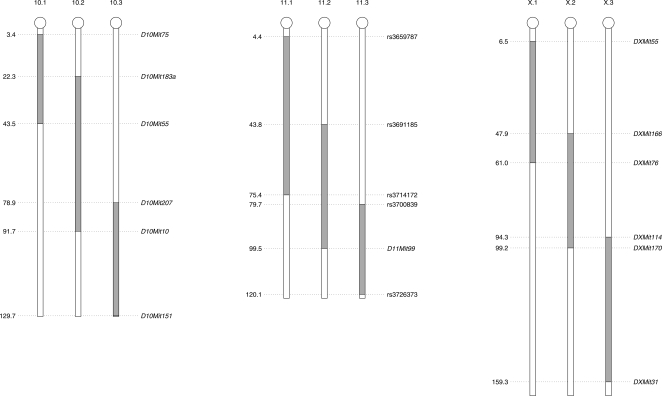
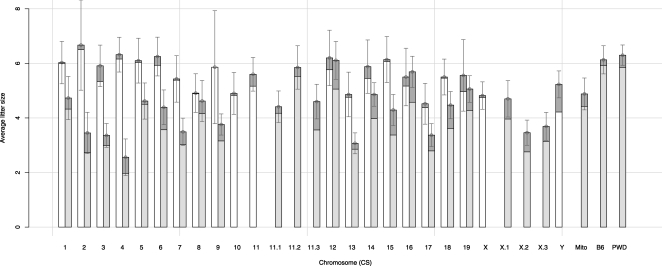
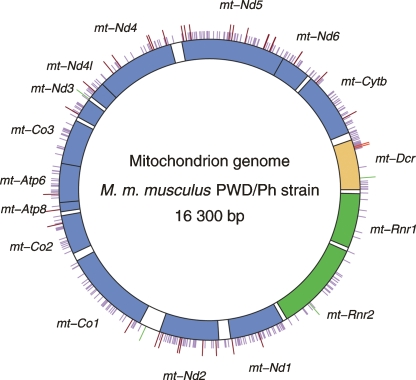
Consomic (chromosome substitution) strains (CSs) represent the most recent addition to the mouse genetic resources aimed to genetically analyze complex trait loci (QTLs). In this study, we report the development of a set of 28 mouse intersubspecific CSs. In each CS, we replaced a single chromosome of the C57BL/6J (B6) inbred strain (mostly Mus m. domesticus) with its homolog from the PWD/Ph inbred strain of the Mus m. musculus subspecies. These two progenitor subspecies diverged less than 1 million years ago and accumulated a large number of genetic differences that constitute a rich resource of genetic variation for QTL analyses. Altogether, the 18 consomic, nine subconsomic, and one conplastic strain covered all 19 autosomes, X and Y sex chromosomes, and mitochondrial DNA. Most CSs had significantly lower reproductive fitness compared with the progenitor strains. CSs homosomic for chromosomes 10 and 11, and the C57BL/6J-Chr X males, failed to reproduce and were substituted by less affected subconsomics carrying either a proximal, central, or distal part of the respective chromosome. A genome-wide scan of 965 DNA markers revealed 99.87% purity of the B6 genetic background. Thirty-three nonsynonymous substitutions were uncovered in the protein-coding regions of the mitochondrial DNA of the B6.PWD-mt conplastic strain. A pilot-phenotyping experiment project revealed a high number of variations among B6.PWD consomics.
Figures
References
-
- Abe K., Noguchi H., Tagawa K., Yuzuriha M., Toyoda A., Kojima T., Ezawa K., Saitou N., Hattori M., Sakaki Y., Noguchi H., Tagawa K., Yuzuriha M., Toyoda A., Kojima T., Ezawa K., Saitou N., Hattori M., Sakaki Y., Tagawa K., Yuzuriha M., Toyoda A., Kojima T., Ezawa K., Saitou N., Hattori M., Sakaki Y., Yuzuriha M., Toyoda A., Kojima T., Ezawa K., Saitou N., Hattori M., Sakaki Y., Toyoda A., Kojima T., Ezawa K., Saitou N., Hattori M., Sakaki Y., Kojima T., Ezawa K., Saitou N., Hattori M., Sakaki Y., Ezawa K., Saitou N., Hattori M., Sakaki Y., Saitou N., Hattori M., Sakaki Y., Hattori M., Sakaki Y., Sakaki Y., et al. Contribution of Asian mouse subspecies Mus musculus molossinus to genomic constitution of strain C57BL/6J, as defined by BAC-end sequence-SNP analysis. Genome Res. 2004;14:2439–2447. - PMC - PubMed
-
- Ackerman K.G., Huang H., Grasemann H., Puma C., Singer J.B., Hill A.E., Lander E., Nadeau J.H., Churchill G.A., Drazen J.M., Huang H., Grasemann H., Puma C., Singer J.B., Hill A.E., Lander E., Nadeau J.H., Churchill G.A., Drazen J.M., Grasemann H., Puma C., Singer J.B., Hill A.E., Lander E., Nadeau J.H., Churchill G.A., Drazen J.M., Puma C., Singer J.B., Hill A.E., Lander E., Nadeau J.H., Churchill G.A., Drazen J.M., Singer J.B., Hill A.E., Lander E., Nadeau J.H., Churchill G.A., Drazen J.M., Hill A.E., Lander E., Nadeau J.H., Churchill G.A., Drazen J.M., Lander E., Nadeau J.H., Churchill G.A., Drazen J.M., Nadeau J.H., Churchill G.A., Drazen J.M., Churchill G.A., Drazen J.M., Drazen J.M., et al. Interacting genetic loci cause airway hyperresponsiveness. Physiol. Genomics. 2005;21:105–111. - PubMed
-
- Agulnik S.I., Sabantsev I.D., Orlova G.V., Ruvinsky A.O., Sabantsev I.D., Orlova G.V., Ruvinsky A.O., Orlova G.V., Ruvinsky A.O., Ruvinsky A.O. Meiotic drive on aberrant chromosome 1 in the mouse is determined by a linked distorter. Genet. Res. 1993;61:91–96. - PubMed
-
- Bauer H., Veron N., Willert J., Herrmann B.G., Veron N., Willert J., Herrmann B.G., Willert J., Herrmann B.G., Herrmann B.G. The t-complex-encoded guanine nucleotide exchange factor Fgd2 reveals that two opposing signaling pathways promote transmission ratio distortion in the mouse. Genes & Dev. 2007;21:143–147. - PMC - PubMed
-
- Beck J., Lloyd S., Hafezparast M., Lennon-Pierce M., Eppig J., Festing M., Fisher E., Lloyd S., Hafezparast M., Lennon-Pierce M., Eppig J., Festing M., Fisher E., Hafezparast M., Lennon-Pierce M., Eppig J., Festing M., Fisher E., Lennon-Pierce M., Eppig J., Festing M., Fisher E., Eppig J., Festing M., Fisher E., Festing M., Fisher E., Fisher E. Genealogies of mouse inbred strains. Nat. Genet. 2000;24:23–25. - PubMed
Publication types
MeSH terms
Substances
Associated data
- Actions
Grants and funding
LinkOut - more resources
Full Text Sources
Other Literature Sources
Molecular Biology Databases
