Genome structure and emerging evidence of an incipient sex chromosome in Populus
- PMID: 18256239
- PMCID: PMC2259106
- DOI: 10.1101/gr.7076308
Genome structure and emerging evidence of an incipient sex chromosome in Populus
Abstract
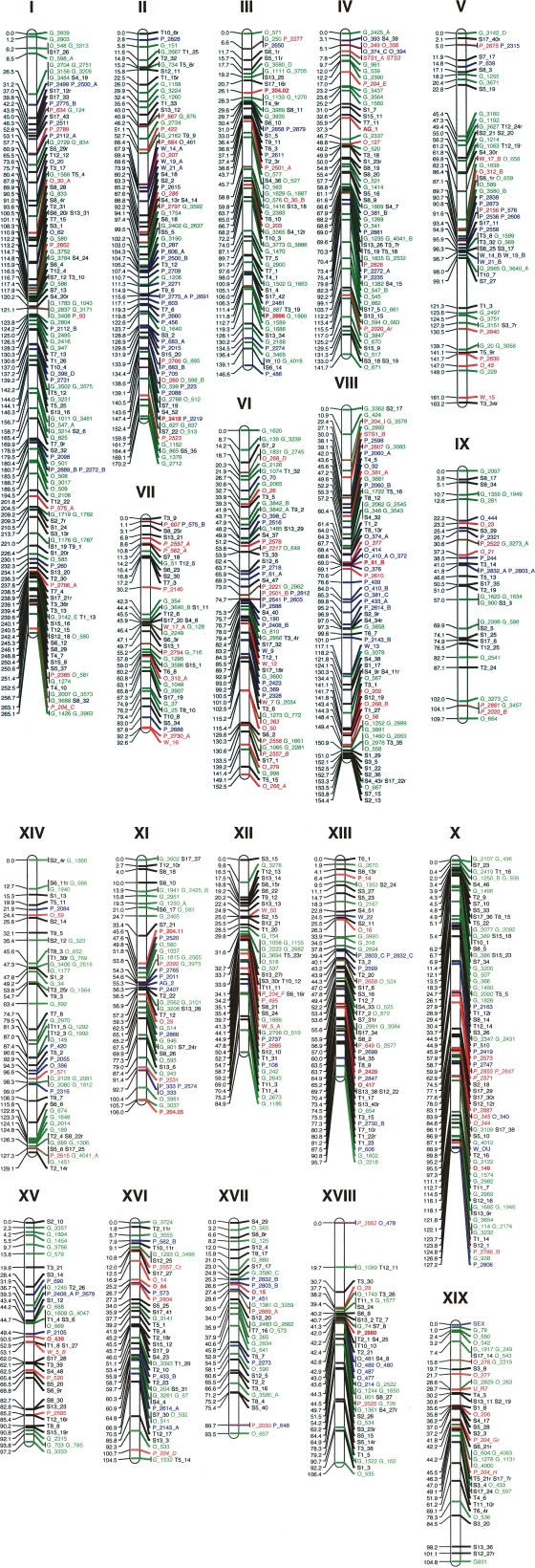
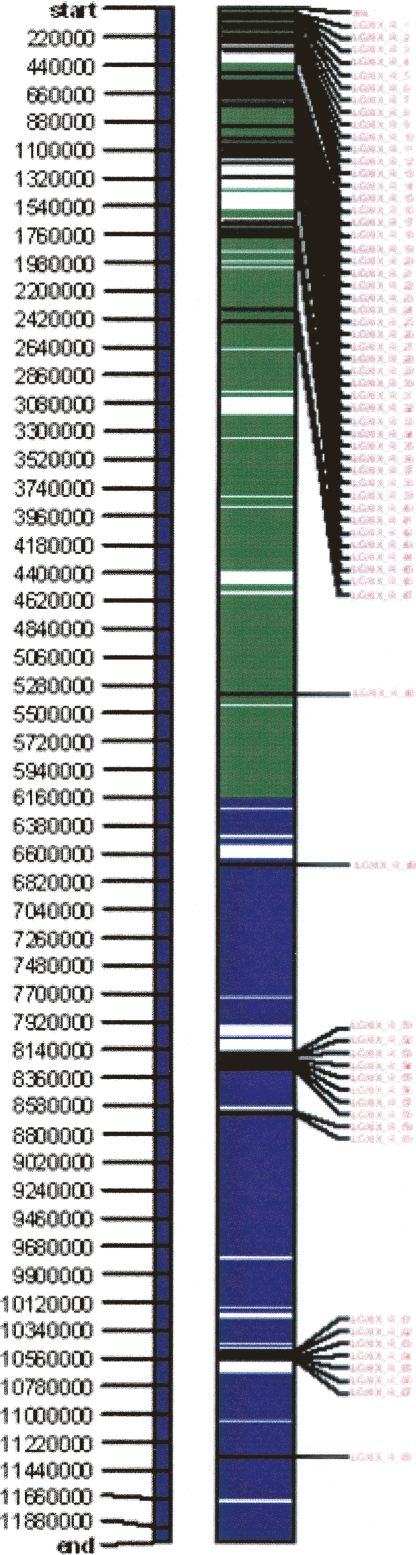
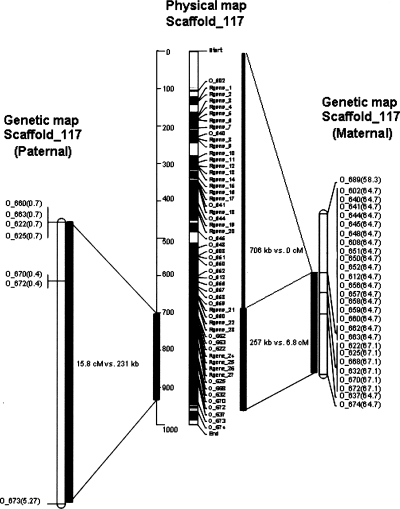
The genus Populus consists of dioecious woody species with largely unknown genetic mechanisms for gender determination. We have discovered genetic and genomic features in the peritelomeric region of chromosome XIX that suggest this region of the Populus genome is in the process of developing characteristics of a sex chromosome. We have identified a gender-associated locus that consistently maps to this region. Furthermore, comparison of genetic maps across multiple Populus families reveals consistently distorted segregation within this region. We have intensively characterized this region using an F(1) interspecific cross involving the female genotype that was used for genome sequencing. This region shows suppressed recombination and high divergence between the alternate haplotypes, as revealed by dense map-based genome assembly using microsatellite markers. The suppressed recombination, distorted segregation, and haplotype divergence were observed only for the maternal parent in this cross. Furthermore, the progeny of this cross showed a strongly male-biased sex ratio, in agreement with Haldane's rule that postulates that the heterogametic sex is more likely to be absent, rare, or sterile in interspecific crosses. Together, these results support the role of chromosome XIX in sex determination and suggest that sex determination in Populus occurs through a ZW system in which the female is the heterogametic gender.
Figures
References
-
- Ainsworth C. Boys and girls come out to play: The molecular biology of dioecious plants. Ann. Bot. 2000;86:211–221.
-
- Alstrom-Rapaport C., Lascoux M., Wang Y.C., Roberts G., Tuskan G.A., Lascoux M., Wang Y.C., Roberts G., Tuskan G.A., Wang Y.C., Roberts G., Tuskan G.A., Roberts G., Tuskan G.A., Tuskan G.A. Identification of a RAPD marker linked to sex determination in the basket willow (Salix viminalis L.) J. Hered. 1998;89:44–49.
-
- Altschul S.F., Madden T.L., Schaffer A.A., Zhang J., Zhang Z., Miller W., Lipman D.J., Madden T.L., Schaffer A.A., Zhang J., Zhang Z., Miller W., Lipman D.J., Schaffer A.A., Zhang J., Zhang Z., Miller W., Lipman D.J., Zhang J., Zhang Z., Miller W., Lipman D.J., Zhang Z., Miller W., Lipman D.J., Miller W., Lipman D.J., Lipman D.J. Gapped BLAST and PSI-BLAST: A new generation of protein database search programs. Nucleic Acids Res. 1997;25:3389–3402. - PMC - PubMed
-
- Aparicio S., Chapman J., Stupka E., Putnam N., Chia J.M., Dehal P., Christoffels A., Rash S., Hoon S., Smith A., Chapman J., Stupka E., Putnam N., Chia J.M., Dehal P., Christoffels A., Rash S., Hoon S., Smith A., Stupka E., Putnam N., Chia J.M., Dehal P., Christoffels A., Rash S., Hoon S., Smith A., Putnam N., Chia J.M., Dehal P., Christoffels A., Rash S., Hoon S., Smith A., Chia J.M., Dehal P., Christoffels A., Rash S., Hoon S., Smith A., Dehal P., Christoffels A., Rash S., Hoon S., Smith A., Christoffels A., Rash S., Hoon S., Smith A., Rash S., Hoon S., Smith A., Hoon S., Smith A., Smith A., et al. Whole-genome shotgun assembly and analysis of the genome of Fugu rubripes. Science. 2002;297:1301–1310. - PubMed
-
- Behura S.K., Valicente F.H., Rider S.D., Shun-Chen M., Jackson S., Stuart J.J., Valicente F.H., Rider S.D., Shun-Chen M., Jackson S., Stuart J.J., Rider S.D., Shun-Chen M., Jackson S., Stuart J.J., Shun-Chen M., Jackson S., Stuart J.J., Jackson S., Stuart J.J., Stuart J.J. A physically anchored genetic map and linkage to avirulence reveals recombination suppression over the proximal region of Hessian fly chromosome A2. Genetics. 2004;167:343–355. - PMC - PubMed
Publication types
MeSH terms
LinkOut - more resources
Full Text Sources