. 2008 Apr;19(4):1663-9.
doi: 10.1091/mbc.e07-12-1208. Epub 2008 Feb 6.

Diffusion coefficient of fluorescent phosphatidylinositol 4,5-bisphosphate in the plasma membrane of cells

Affiliations

Diffusion coefficient of fluorescent phosphatidylinositol 4,5-bisphosphate in the plasma membrane of cells

Urszula Golebiewska et al. Mol Biol Cell. 2008 Apr.

Abstract

Phosphatidylinositol 4,5-bisphosphate (PIP(2)) controls a surprisingly large number of processes in cells. Thus, many investigators have suggested that there might be different pools of PIP(2) on the inner leaflet of the plasma membrane. If a significant fraction of PIP(2) is bound electrostatically to unstructured clusters of basic residues on membrane proteins, the PIP(2) diffusion constant, D, should be reduced. We microinjected micelles of Bodipy TMR-PIP(2) into cells, and we measured D on the inner leaflet of fibroblasts and epithelial cells by using fluorescence correlation spectroscopy. The average +/- SD value from all cell types was D = 0.8 +/- 0.2 microm(2)/s (n = 218; 25 degrees C). This is threefold lower than the D in blebs formed on Rat1 cells, D = 2.5 +/- 0.8 microm(2)/s (n = 26). It is also significantly lower than the D in the outer leaflet or in giant unilamellar vesicles and the diffusion coefficient for other lipids on the inner leaflet of these cell membranes. The simplest interpretation is that approximately two thirds of the PIP(2) on inner leaflet of these plasma membranes is bound reversibly.


Figures
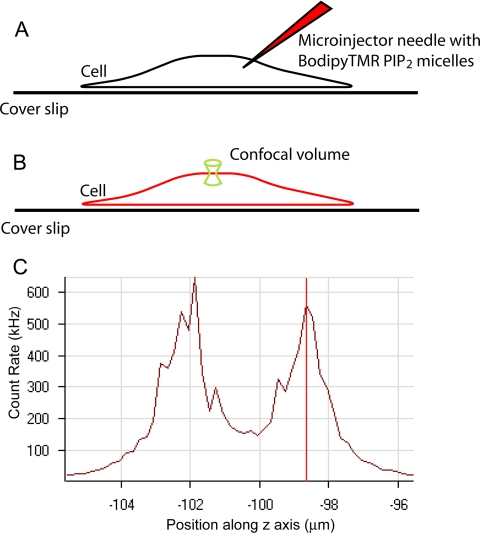
Figure 1.
Figure 1.
Incorporation of Bodipy TMR-PI(4,5)P2 into the inner leaflet of a plasma membrane. (A) Cartoon depicting a Rat1 fibroblast with an adjacent microinjector needle filled with micelles that contain Bodipy TMR-PIP2. (B) One minute after injecting the micelles, much of the fluorescent PIP2 incorporates as monomers into the inner leaflet of the plasma membrane. We use the confocal microscope to scan from the bottom to the top of the cell both to ensure incorporation of the fluorescent PIP2 and to determine the location of the upper membrane (C). We then focus on the upper membrane, as illustrated, and use the FCS function to record the fluctuations in fluorescence and compute the autocorrelation functions illustrated in Figure 2. (C) Fluorescence intensity scan in the z-direction of a Rat 1 cell after injection with arachidoyl-lysoPC/Bodipy TMR-PIP2 micelles. The peaks correspond to the positions of the plasma membrane; the data in Figure 2 are from the same cell. The simplest interpretation is that a significant fraction of the fluorescent PIP2 has incorporated into the plasma membrane.
Figure 2.
Figure 2.
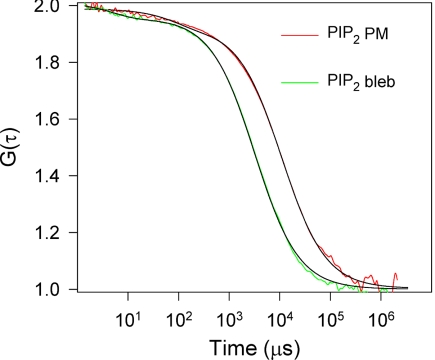
Autocorrelation function, G(τ), of Bodipy TMR-PIP2 diffusing in the inner leaflet of a Rat1 cell (red curve) and a large bleb (green curve) on a different Rat1 cell from the same dish. The black curves represent the fit of Eq. S3 in Supplemental Material to the data. The correlation time (approximate midpoint of curve) for PIP2 in the native plasma membrane is 10.2 ms, which corresponds to a D = 0.9 μm2/s. The correlation time for PIP2 in the large bleb is 3.2 ms, which corresponds to a D = 3 μm2/s. There are eight Bodipy TMR-PIP2 diffusing in the confocal volume and ∼103 native PIP2 in the ∼200-nm-radius area.
Figure 3.
Figure 3.
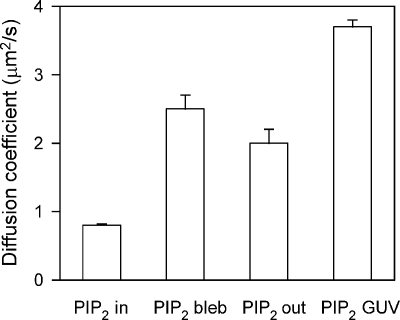
Average diffusion coefficients of Bodipy TMR-PIP2 in the inner leaflet of epithelial and fibroblast plasma membranes (PIP2 in), in large blebs formed on Rat1 cells (PIP2 bleb), in the outer leaflet of cells (PIP2 out), and in a giant unilamellar phospholipid vesicle formed from a mixture of palmitoyl-oleoyl phosphatidylcholine and palmitoyl-oleoyl phosphatidylserine (PIP2 GUV). Note that PIP2 diffuses threefold less rapidly in the inner leaflet than the bleb; the result is consistent (Eq. 1) with the hypothesis that two thirds of the PIP2 on the inner leaflet is bound reversibly to cytoskeletal elements that are absent in the bleb. All measurements were made at 25°C; vertical bars indicate SE. We calculated diffusion coefficients from autocorrelation curves similar to those illustrated in Figure 2. The difference between the values of D in the bleb and inner leaflet is statistically significant. See text for details.

Comment in

  • Mol Biol Cell. 19:1281.

References

    1. Aikawa Y., Martin T. F. ARF6 regulates a plasma membrane pool of phosphatidylinositol(4,5)bisphosphate required for regulated exocytosis. J. Cell Biol. 2003;162:647–659. - PMC - PubMed
    1. Almeida P. F., Vaz W.L.C. Lateral diffusion in membranes. In: Lipowsky R., Sackmann E., editors. Handbook of biological physics. Amsterdam, The Netherlands: Elsevier Science; 1995. pp. 305–357.
    1. Almeida P. F., Vaz W. L., Thompson T. E. Lipid diffusion, free area, and molecular dynamics simulations. Biophys. J. 2005;88:4434–4438. - PMC - PubMed
    1. Anderson R. A., Marchesi V. T. Regulation of the association of membrane skeletal protein 4.1 with glycophorin by a polyphosphoinositide. Nature. 1985;318:295–298. - PubMed
    1. Baumgart T., Hammond A. T., Sengupta P., Hess S. T., Holowka D. A., Baird B. A., Webb W. W. Large-scale fluid/fluid phase separation of proteins and lipids in giant plasma membrane vesicles. Proc. Natl. Acad. Sci. USA. 2007;104:3165–3170. - PMC - PubMed

Publication types