


Effects of local anthropogenic changes on potential malaria vector Anopheles hyrcanus and West Nile virus vector Culex modestus, Camargue, France
- PMID: 18258028
- PMCID: PMC2876767
- DOI: 10.3201/eid1312.070730
Effects of local anthropogenic changes on potential malaria vector Anopheles hyrcanus and West Nile virus vector Culex modestus, Camargue, France
Abstract
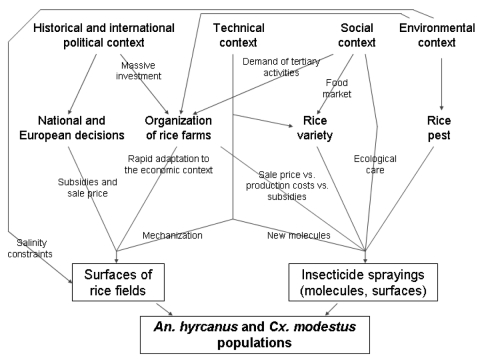
Using historical data, we highlight the consequences of anthropogenic ecosystem modifications on the abundance of mosquitoes implicated as the current most important potential malaria vector, Anopheles hyrcanus, and the most important West Nile virus (WNV) vector, Culex modestus, in the Camargue region, France. From World War II to 1971, populations of these species increased as rice cultivation expanded in the region in a political context that supported agriculture. They then fell, likely because of decreased cultivation and increased pesticide use to control a rice pest. The species increased again after 2000 with the advent of more targeted pest-management strategies, mainly the results of European regulations decisions. An intertwined influence of political context, environmental constraints, technical improvements, and social factors led to changes in mosquito abundance that had potential consequences on malaria and WNV transmission. These findings suggest that anthropogenic changes should not be underestimated in vectorborne disease recrudescence.
Figures
References
-
- Rioux JA. Les culicidés du midi Méditerranéen. Paris: Editions Paul Lechevalier; 1958.
Publication types
MeSH terms
Substances
LinkOut - more resources
Full Text Sources
Medical