. 2008 Feb;14(2):231-7.
doi: 10.3201/eid1402.070677.

Unexpected occurrence of plasmid-mediated quinolone resistance determinants in environmental Aeromonas spp

Affiliations

Unexpected occurrence of plasmid-mediated quinolone resistance determinants in environmental Aeromonas spp

Vincent Cattoir et al. Emerg Infect Dis. 2008 Feb.

Abstract

We searched for plasmid-mediated quinolone resistance determinants of the Qnr type in several water samples collected at diverse locations from the Seine River (Paris, France). The qnrS2 genes were identified from Aeromonas punctata subsp. punctata and A. media. The qnrS2 gene was located on IncU-type plasmids in both isolates, which resulted in increased MIC values of quinolones and fluoroquinolones, once they were transferred into Escherichia coli. The qnrS2 gene identified in A. punctata was part of novel genetic structure corresponding to a mobile insertion cassette element. This identification of plasmid-mediated qnr genes outside Enterobacteriaceae underlines a possible diffusion of those resistance determinants within gram-negative rods.


Figures
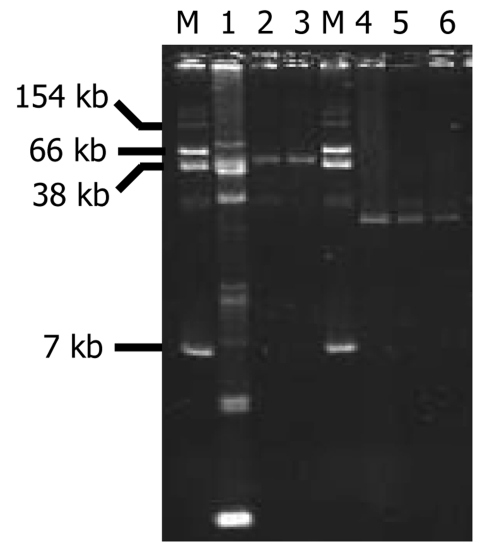
Figure 1
Figure 1
Plasmid DNAs from Aeromonas punctata 37 and A. media 42 and their Escherichia coli TOP10 transformants (TF) carrying plasmids p37 or p42. Lanes: 1, A. punctata 37; 2, E. coli TOP10/p37 TF-1; 3, E. coli TOP10/p37 TF-2; 4, A. media 42; 5, E. coli TOP10/p42 TF-1; 6, E. coli TOP10/p42 TF-2; M, E. coli NCTC 50192 (used as reference for plasmid sizes).
Figure 2
Figure 2
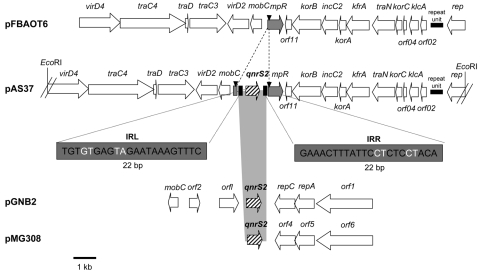
Genetic environments of the qnrS2 gene in plasmid p37 from Aeromonas punctata 37 and comparison with related plasmid structures. Plasmid pFBAOT6 is from A. punctata from the United Kingdom (23); plasmids pGNB2 and pMG308 are from a wastewater treatment plant from Germany (unknown bacterial reservoir) (24) and from a non-Typhi Salmonella clinical isolate from the United States (25), respectively. Recombinant plasmid pAS37 has been obtained from our study. Open reading frames (ORFs) are indicated by horizontal arrows. The right and left inverted repeats (IRR and IRL) are indicated, and duplication sites (CCTCC) are represented by black triangles. The EcoRI- restriction sites that have been used for cloning experiments are indicated. The identified mobile insertion cassette element is bracketed by IRL and IRR of 22-bp size (bases in black are identical, and bases in white are different).

References

    1. Hooper DC. Emerging mechanisms of fluoroquinolone resistance. Emerg Infect Dis. 2001;7:337–41. - PMC - PubMed
    1. Ruiz J. Mechanisms of resistance to quinolones: target alterations, decreased accumulation and DNA gyrase protection. J Antimicrob Chemother. 2003;51:1109–17. 10.1093/jac/dkg222 - DOI - PubMed
    1. Martinez-Martinez L, Pascual A, Jacoby GA. Quinolone resistance from a transferable plasmid. Lancet. 1998;351:797–9. 10.1016/S0140-6736(97)07322-4 - DOI - PubMed
    1. Tran JH, Jacoby GA, Hooper DC. Interaction of the plasmid-encoded quinolone resistance protein Qnr with Escherichia coli DNA gyrase. Antimicrob Agents Chemother. 2005;49:118–25. 10.1128/AAC.49.1.118-125.2005 - DOI - PMC - PubMed
    1. Tran JH, Jacoby GA, Hooper DC. Interaction of the plasmid-encoded quinolone resistance protein QnrA with Escherichia coli topoisomerase IV. Antimicrob Agents Chemother. 2005;49:3050–2. 10.1128/AAC.49.7.3050-3052.2005 - DOI - PMC - PubMed

Publication types

MeSH terms

LinkOut - more resources