. 2008 Feb;14(2):252-9.
doi: 10.3201/eid1402.070981.

Genetic characterization of feline leukemia virus from Florida panthers

Affiliations

Genetic characterization of feline leukemia virus from Florida panthers

Meredith A Brown et al. Emerg Infect Dis. 2008 Feb.

Abstract

From 2002 through 2005, an outbreak of feline leukemia virus (FeLV) occurred in Florida panthers (Puma concolor coryi). Clinical signs included lymphadenopathy, anemia, septicemia, and weight loss; 5 panthers died. Not associated with FeLV outcome were the genetic heritage of the panthers (pure Florida vs. Texas/Florida crosses) and co-infection with feline immunodeficiency virus. Genetic analysis of panther FeLV, designated FeLV-Pco, determined that the outbreak likely came from 1 cross-species transmission from a domestic cat. The FeLV-Pco virus was closely related to the domestic cat exogenous FeLV-A subgroup in lacking recombinant segments derived from endogenous FeLV. FeLV-Pco sequences were most similar to the well-characterized FeLV-945 strain, which is highly virulent and strongly pathogenic in domestic cats because of unique long terminal repeat and envelope sequences. These unique features may also account for the severity of the outbreak after cross-species transmission to the panther.


Figures
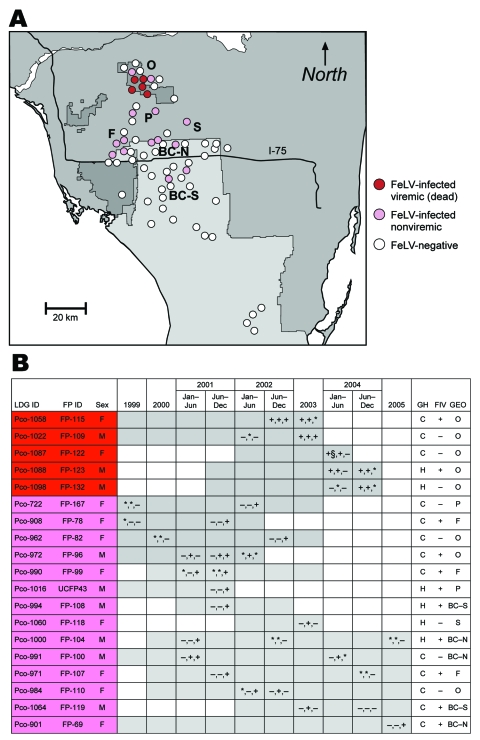
Figure 1
Figure 1
A) Prevalence and distribution of 19 Florida panthers, sampled 1999–2005, showing evidence of feline leukemia virus (FeLV) exposure. All antigen-positive panthers (red) are clustered in the Okaloacoochee Slough State Forest (O). PCR-positive and/or antibody-positive (pink) pumas were found there also, as well as in the surrounding areas including Florida Panther National Wildlife Refuge (F), private lands (P), Big Cypress Seminole Indian Reservation (S), and Big Cypress North and South (BC-N, BC-S respectively). All but 2 infected panthers were found north of Interstate 75. B) Information on affected panthers. Gray shading indicates timeline for monitoring of individual panthers until death. Symbols within gray boxes indicate presence (+), absence (–), or no data (*) for FeLV antigen in serum, FeLV sequence recovered by PCR, or presence of antibodies against FeLV in serum, respectively. FP-122 was antigen negative when tested 1 month previously (§). LGD ID, Laboratory of Genomic Diversity identification number; FP ID, Florida panther identification number; GH, genetic heritage; FIV, feline immunodeficiency virus; GEO, geographic locale; C, canonical (pure) Florida panther; H, Texas hybrid.
Figure 2
Figure 2
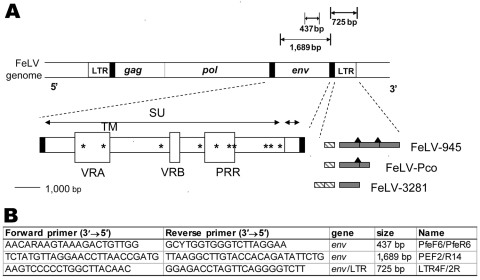
A) Diagram of the feline leukemia virus (FeLV) genome showing the PCR products obtained from FeLV-Pco env and long terminal repeat (LTR) genes. Envelope gene surface (SU) and transmembrane (TM) subunits, variable regions A and B (VRA and VRB) and the proline-rich region (PRR), 3’ LTR enhancer element(s) (hatched rectangle), signature 21-bp repeat(s) (gray shading), and putative c-Myb binding sites (black triangles) (12) are depicted for FeLV-945, FeLV-Pco, and FeLV-3281A . Unique signature amino acid residues found only in FeLV-945 and FeLV-Pco are marked by asterisks (see Figure 5). B) Primer pair PfeF6/PfeR6 was designed to detect all FeLV subgroups.
Figure 3
Figure 3
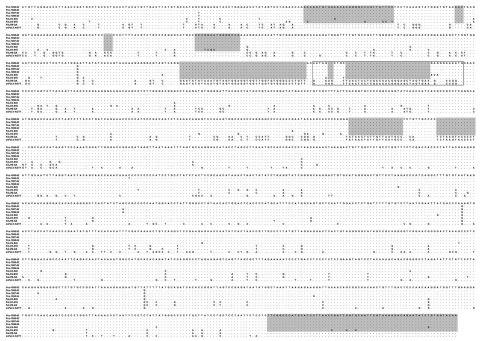
Excerpt of env nucleotide sequences. The shaded regions identify indels where FeLV-Pco sequence resembles that of feline leukemia virus A (FeLV-A), ruling out recombination with dissimilar endogenous FeLV sequences as represented in enFeLV-AGTT (bottom). Puma sequences, with year of sampling (for example FeLV-Pco-1058-03 was sampled in 2003); domestic cat subgroup A (FeLVA-945 and FeLVA-61E), recombinant (FeLVB-GA), and endogenous (enFeLV-AGTT) sequences are also shown. Matches to the reference sequence (Pco-1058-02) are indicated by a dot. Gaps are indicated by a dash. (Expanded Figure)
Figure 4
Figure 4
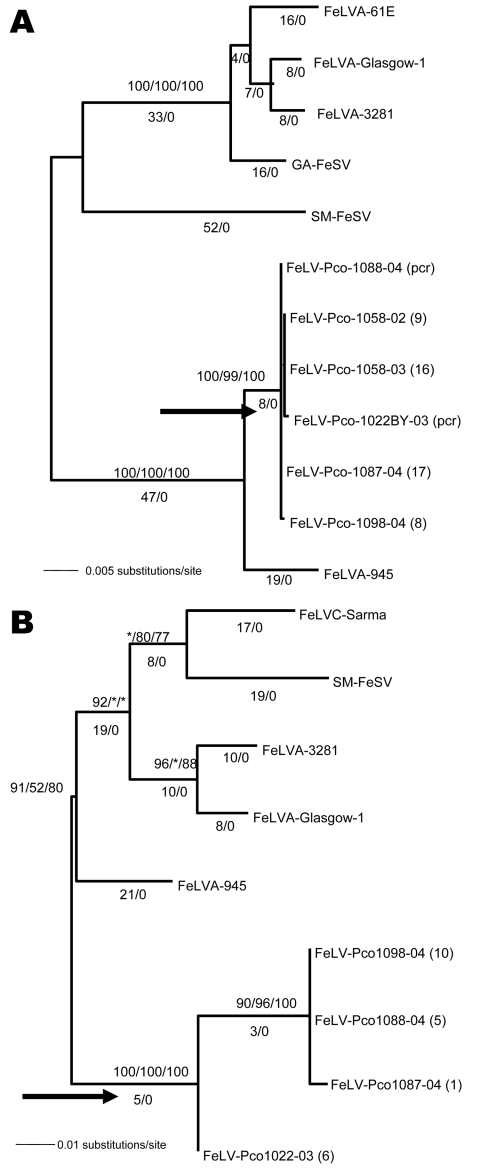
Phylogenetic trees of panther feline leukemia virus (FeLV-Pco) and domestic cat FeLV nucleotide sequences. A) Midpoint rooted maximum-likelihood phylogram based on 1,698 bp of env sequences. B) Midpoint rooted maximum-likelihood phylogram based on 463 bp of 3’ long terminal repeat (LTR) sequences. Consensus FeLV-Pco sequences of clones generated from 5 env and 4 LTR panthers and reference domestic cat sequences are shown. The number of FeLV-Pco–cloned PCR products used in each consensus sequence is indicated in parentheses. The arrow indicates the monophyletic clade of all FeLV-Pco sequences. A similar topology, including the monophyletic clade, was obtained by using the different FeLV-Pco clone sequences rather than a consensus. The year of panther sampling is indicated as a suffix, e.g., Pco-1088-04 was sampled in 2004. Where maximum-likelihood tree was congruent with maximum parsimony tree, branch lengths are indicated below branches. Number of homoplasies is indicated after the branch length. Bootstrap values are shown (maximum parsimony/minimum evolution/maximum likelihood). The score (–ln likelihood) of the best maximum-likelihood tree was env 3615.01706, LTRs 1836.05922 (best tree found by maximum parsimony: env length = 221, consistency index [CI] = 0.941, retention index [RI] = 0.963; LTR length = 132, CI = 0.871, RI = 0.787).
Figure 5
Figure 5
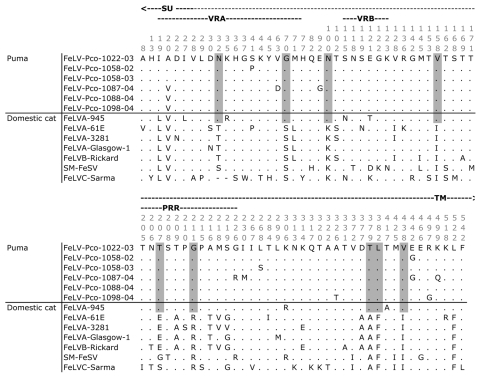
Variable sites in the amino acid alignment of panther feline leukemia virus (FeLV-Pco) and domestic cat FeLV env sequences (1,689 bp). Surface glycoprotein (SU), transmembrane (TM), variable region A and B (VRA and VRB), and proline-rich region (PRR) locations are indicated. Horizontal line separates sequences of puma (above) and domestic cat (below). The 10 amino acid residues in this region unique to FeLV-945 and FeLV-Pco sequences are shaded in gray. Matches to the reference sequence are indicated by dots; gaps are indicted by dashes.

References

    1. Culver M, Johnson WE, Pecon-Slattery J, O’Brien SJ. Genomic ancestry of the American puma (Puma concolor). J Hered. 2000;91:186–97. 10.1093/jhered/91.3.186 - DOI - PubMed
    1. Roelke ME, Martenson JS, O’Brien SJ. The consequences of demographic reduction and genetic depletion in the endangered Florida panther. Curr Biol. 1993;3:340–50. 10.1016/0960-9822(93)90197-V - DOI - PubMed
    1. Roelke ME, Forrester DJ, Jacobson ER, Kollias GV, Scott FW, Barr MC, et al. Seroprevalence of infectious disease agents in free-ranging Florida panthers (Felis concolor coryi). J Wildl Dis. 1993;29:36–49. - PubMed
    1. Maehr DS, Lacy R. Avoiding the lurking pitfalls in Florida panther recovery. Wildl Soc Bull. 2002;30:971–8.
    1. Cunningham MW, Brown MA, Shindle DB, Terrell SP, Hayes KA, Ferree BC, et al. Epizootiology and management of feline leukemia virus in the Florida puma. J Wildl Dis. In press. - PMC - PubMed

Publication types

MeSH terms

Substances

LinkOut - more resources