Additional value of 3D rotational angiography in angiographically negative aneurysmal subarachnoid hemorrhage: how negative is negative?
- PMID: 18258701
- PMCID: PMC8128569
- DOI: 10.3174/ajnr.A0972
Additional value of 3D rotational angiography in angiographically negative aneurysmal subarachnoid hemorrhage: how negative is negative?
Abstract
Background and purpose: In some patients with nonperimesencephalic nontraumatic subarachnoid hemorrhage (aneurysmal SAH), no aneurysm can be found on digital subtraction angiography (DSA), and repeat DSA is advocated. 3D rotational angiography (3DRA) is considered superior to DSA in the detection of small intracranial aneurysms. In this study, we assessed the additional diagnostic value of 3DRA in detecting DSA-occult aneurysms in 23 patients with aneurysmal SAH.
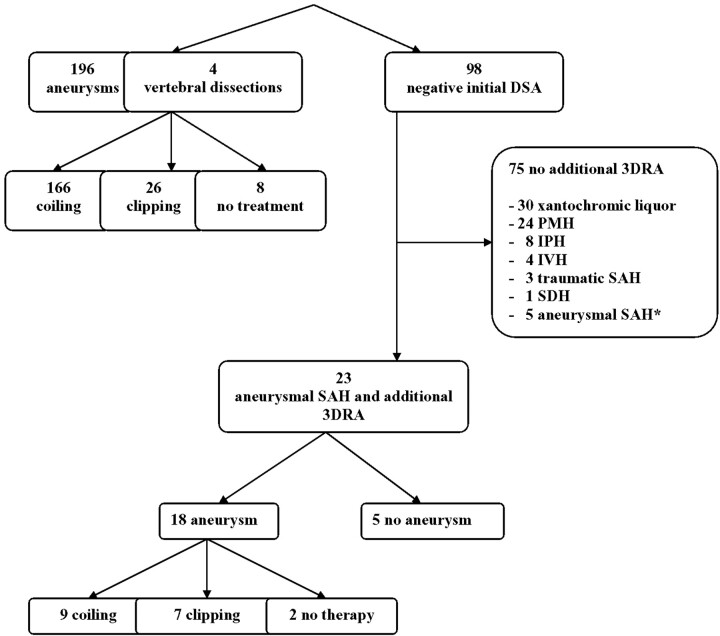
Materials and methods: Between January 2006 and September 2007, 298 patients with suggested ruptured intracranial aneurysm were referred for DSA, and in 98 patients, DSA was negative. Of these 98 patients, 28 had aneurysmal SAH, and in 23 of these additional 3DRA was performed in the same or in a repeat angiographic procedure.
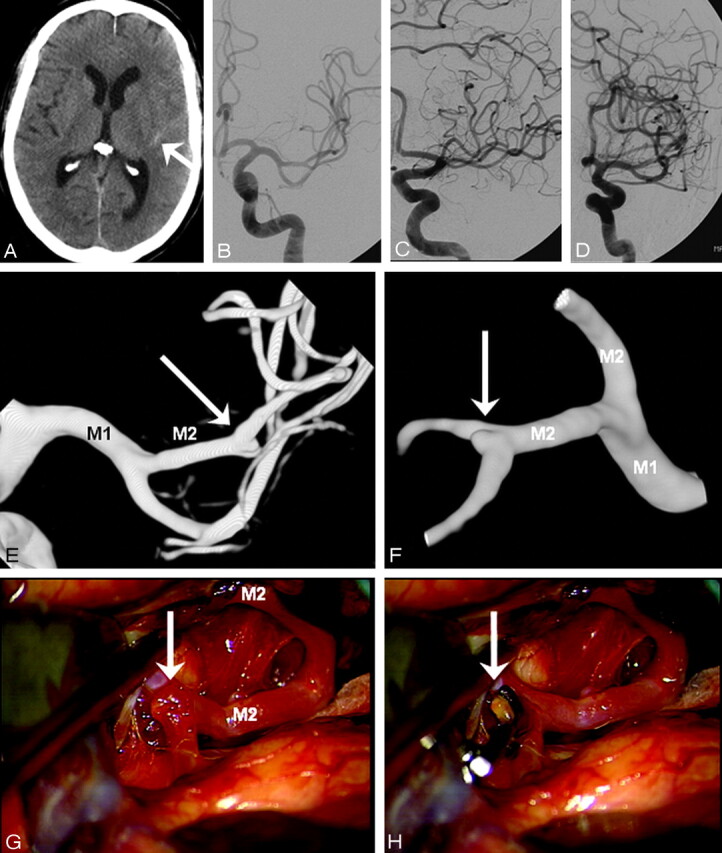
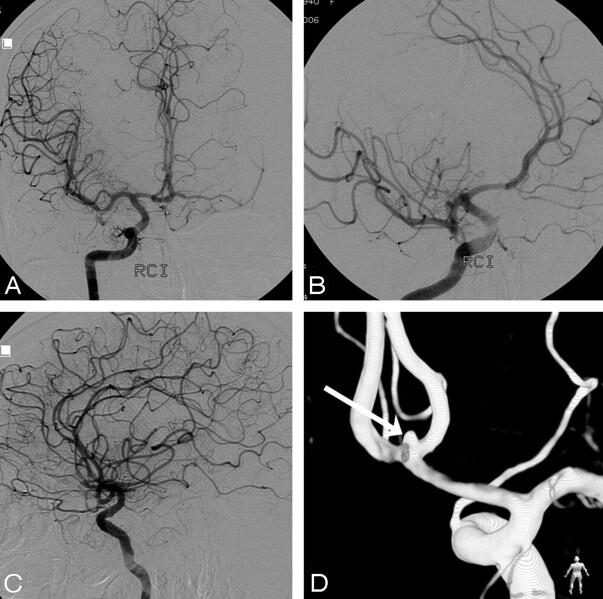
Results: In 18 of 23 patients (78%), a ruptured small aneurysm was diagnosed on additional 3DRA. The location of 18 aneurysms was the anterior communicating artery (n = 11), the middle cerebral artery (n = 3), the posterior communicating artery (n = 2), the ophthalmic artery (n = 1), and the posterior inferior cerebellar artery (n = 1). Aneurysm size was 3 mm in 4, 2 mm in 9, and 1 mm in 5. Of 18 aneurysms, 9 were treated with coil placement; 7 with surgical clipping; and 2 were not treated.
Conclusion: In this study, 18 of 23 (78%) patients with negative findings on DSA had a small ruptured aneurysm when studied with 3DRA. These were most commonly located on the anterior communicating artery.
Figures
References
-
- Rinkel GJ, van Gijn J, Wijdicks EF. Subarachnoid hemorrhage without detectable aneurysm: a review of the causes. Stroke 1993;24:1403–09 - PubMed
-
- Rinkel GJ, Wijdicks EF, Hasan D, et al. Outcome in patients with subarachnoid haemorrhage and negative angiography according to pattern of haemorrhage on computed tomography. Lancet 1991;338:964–68 - PubMed
-
- van Gijn J, Kerr RS, Rinkel GJ. Subarachnoid haemorrhage. Lancet 2007;369:306–18 - PubMed
-
- Ruigrok YM, Rinkel GJ, Van Gijn J. CT patterns and long-term outcome in patients with an aneurysmal type of subarachnoid hemorrhage and repeatedly negative angiograms. Cerebrovasc Dis 2002;14:221–27 - PubMed
-
- Inamasu J, Nakamura Y, Saito R, et al. “Occult” ruptured cerebral aneurysms revealed by repeat angiography: result from a large retrospective study. Clin Neurol Neurosurg 2003;106:33–37 - PubMed
Publication types
MeSH terms
LinkOut - more resources
Full Text Sources