. 2008 Apr 18;368(4):846-51.
doi: 10.1016/j.bbrc.2008.01.144. Epub 2008 Feb 7.

Trypanosome H2Bv replaces H2B in nucleosomes enriched for H3 K4 and K76 trimethylation

Affiliations

Trypanosome H2Bv replaces H2B in nucleosomes enriched for H3 K4 and K76 trimethylation

Veena Mandava et al. Biochem Biophys Res Commun. .

Abstract

Some inroads have been made into characterizing histone variants and post translational modifications of histones in Trypanosoma brucei. Histone variant H2BV lysine 129 is homologous to Saccharomyces cerevisiae H2B lysine 123, whose ubiquitination is required for methylation of H3 lysines 4 and 79. We show that T. brucei H2BV K129 is not ubiquitinated, but trimethylation of H3 K4 and K76, homologs of H3 K4 and K79 in yeast, was enriched in nucleosomes containing H2BV. Mutation of H2BV K129 to alanine or arginine did not disrupt H3 K4 or K76 methylation. These data suggest that H3 K4 and K76 methylation in trypanosomes is regulated by a novel mechanism, possibly involving the replacement of H2B with H2BV in the nucleosome.


Figures
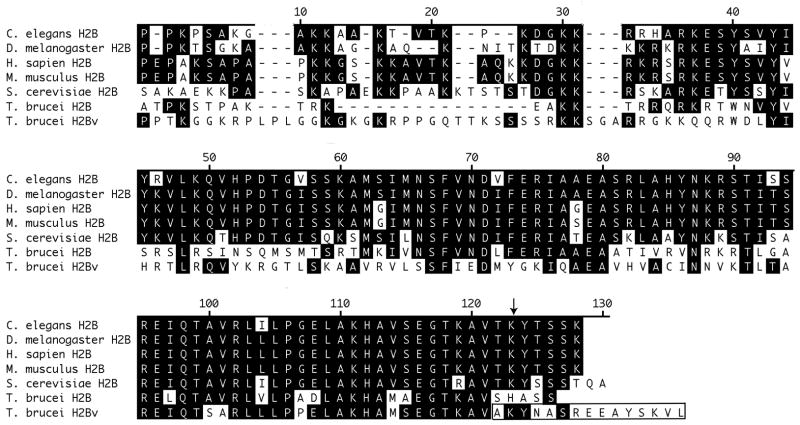
Fig. 1
Fig. 1
Sequence alignment of T. brucei histones H2B and H2BV with H2B from other organisms. Identical residues are shaded. The sequence ruler is numbered according to the S. cerevisiae sequence. An arrow points to T. brucei H2BV lysine 129, which is homologous to the ubiquitinated lysine 123 from S. cerevisiae. H2BV residues 128–142 are boxed.
Fig. 2
Fig. 2
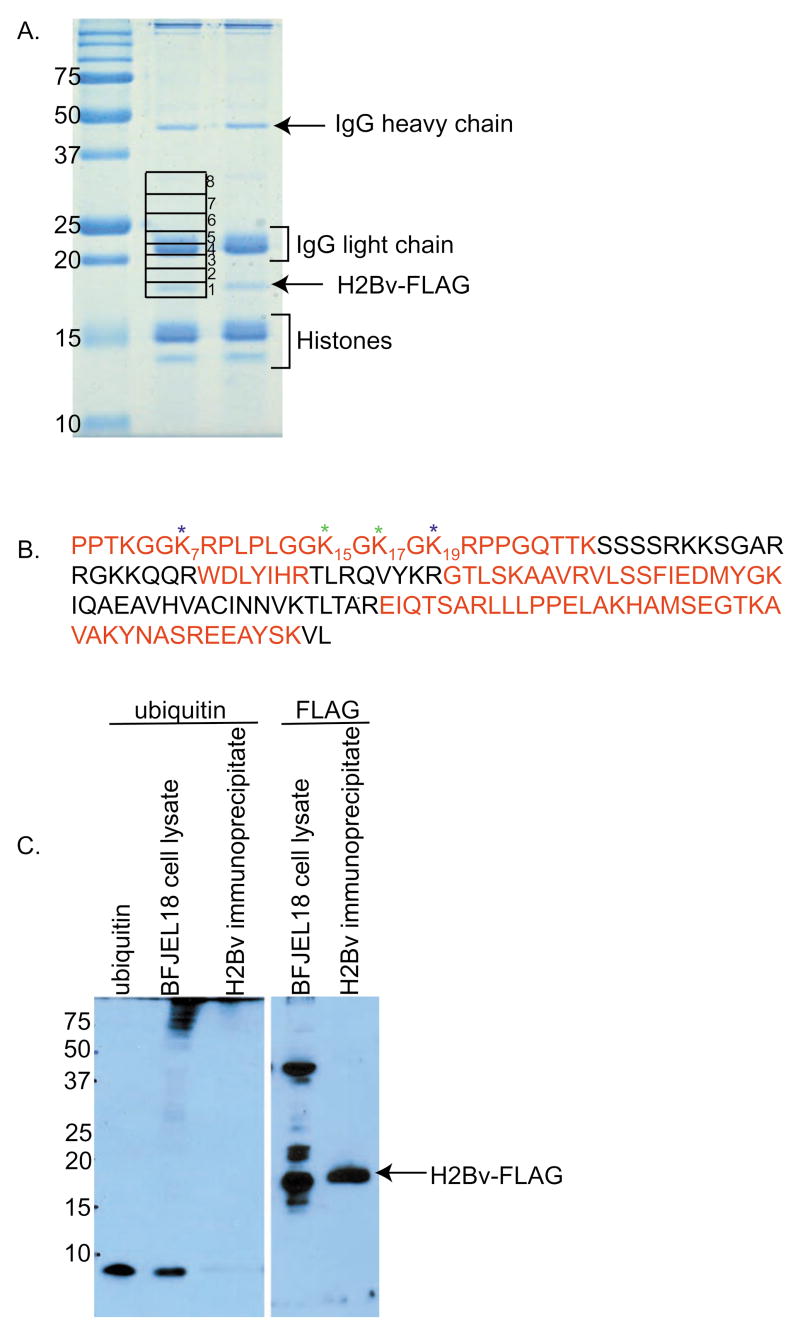
Histone H2BV is not ubiquitinated. (A) H2BV-FLAG was purified from BFJEL18 cells. The Coomassie-stained bands representing H2BV-FLAG, light and heavy chains of the α-FLAG M2 antibody, and histones are indicated. Eight gel slices were excised from the gel, trypsinized, and analyzed by MS. (B) Histone H2BV sequence, with regions for which tandem MS data were acquired highlighted in red. Acetylated and methylated lysines are indicated with a blue or green asterisk, respectively. (C) H2BV-FLAG was purified from 2 × 10⁸ BFJEL18 cells and analyzed with ubiquitin antibody (left panel). 100 ng ubiquitin (8.4 kDa, Sigma) and cell lysate from 2 × 10⁶ BFJEL18 cells are included to verify the activity of the antibody. BFJEL18 cell lysate and purified H2Bv-FLAG from 2 × 10⁷ cells were reacted with the FLAG antibody (Sigma), to confirm that the purification was successful (right panel).
Fig. 3
Fig. 3
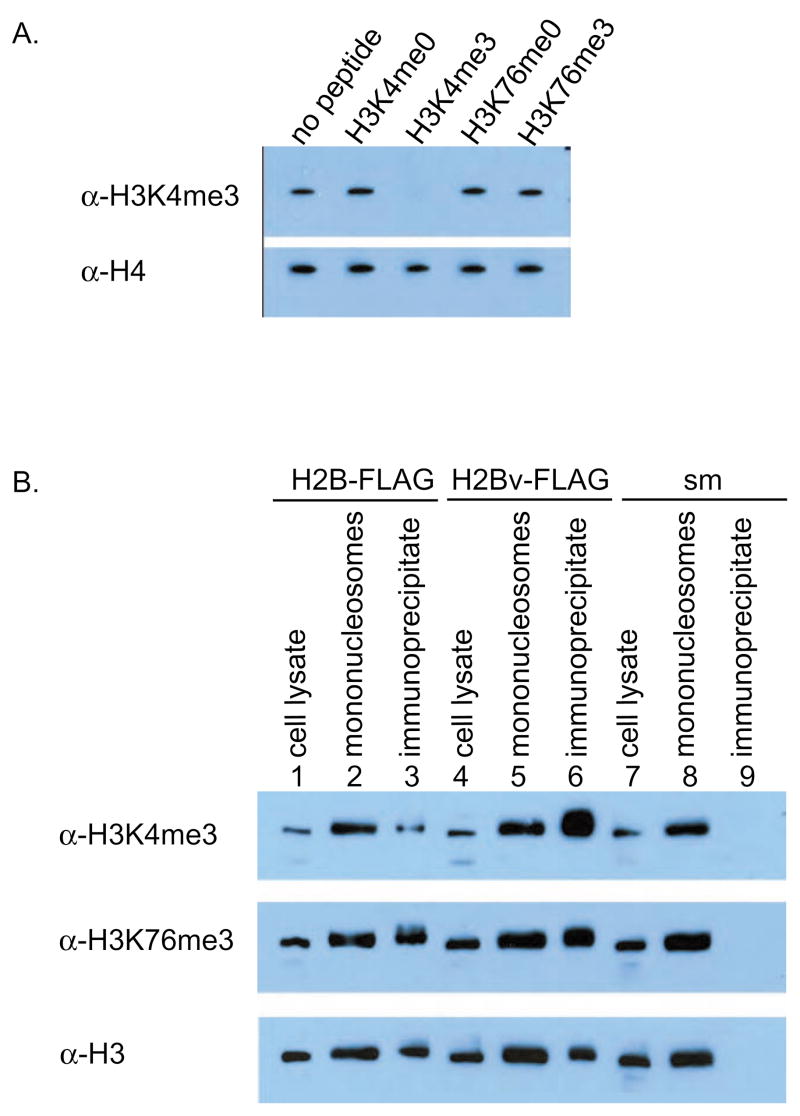
Histone H2BV co-immunoprecipitates with histone H3 that is trimethylated at lysines 4 and 76. (A) A specific antibody was raised against H3K4me3. Pre-incubation of the antibody without peptide or 10 ng/ml H3K4me0, H3K4me3, H3K76me0, or H3K76me3 peptides shows that the antibody only binds the H3K4me3 peptide. An antibody to H4 (Sigma) was used as a loading control. (B) Mononucleosomes containing either H2B-FLAG or H2BV-FLAG were immunoprecipitated with FLAG antibody affinity gel and analyzed by Western blot with H3K4me3 and H3K76me3 antibodies. An antibody to H3 (Abcam ab1791) was used as a loading control.
Fig. 4
Fig. 4
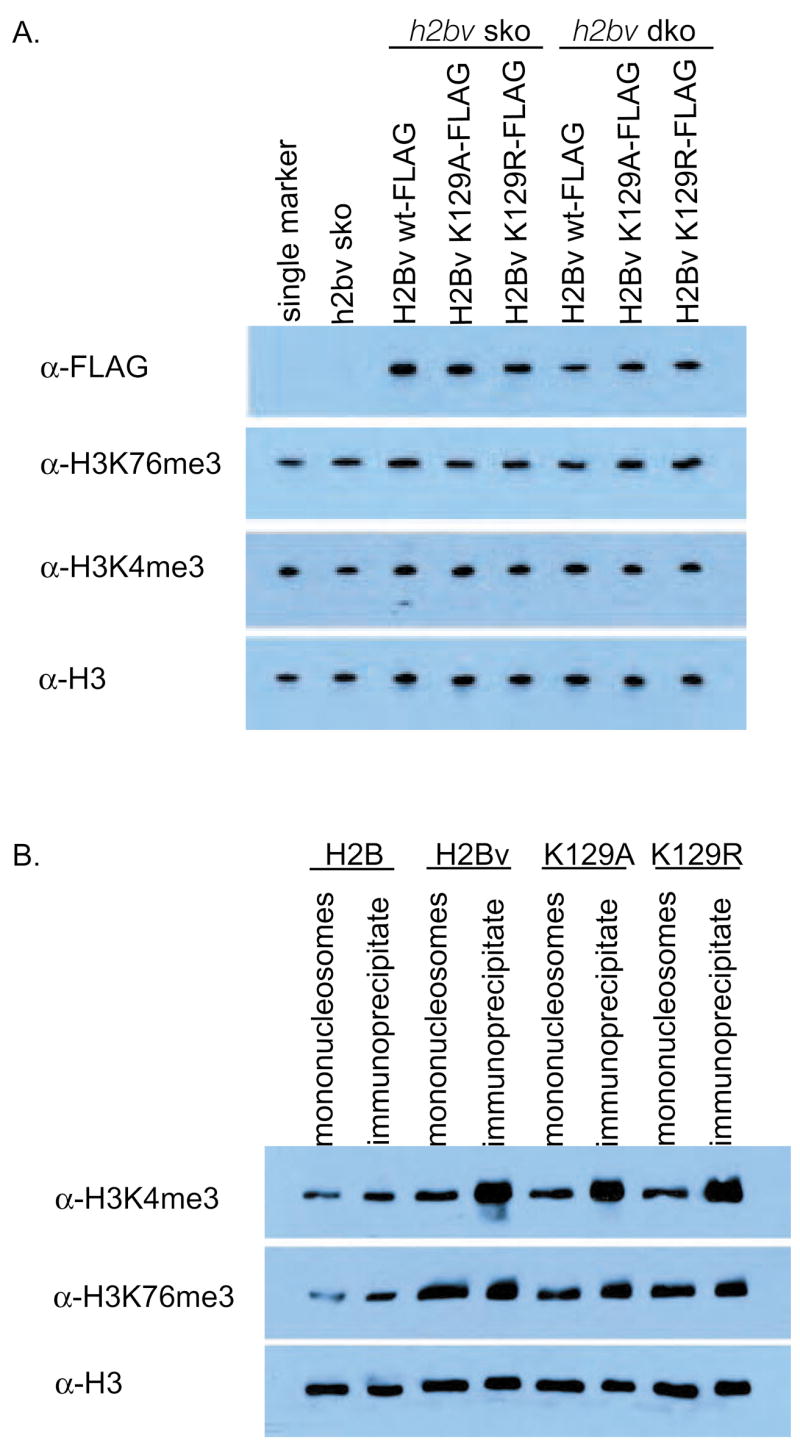
Mutation of H2BV lysine 129 does not interfere with H3 lysine 4 or 76 methylation. (A) Lysate from cells expressing ectopic copies of FLAG-tagged H2BV, H2BV K129A, or H2BV K129R in H2BV+/− heterozygous or homozygous deletion backgrounds. Lysates were analyzed by western blot with antibodies to FLAG, H3K4me3, H3K76me3, and H3. (B) Co-immunoprecipitation with mononucleosomes containing the H2BV K129 mutation.

References

    1. Kouzarides T. Chromatin modifications and their function. Cell. 2007;128:693–705. - PubMed
    1. Fischle W, Wang Y, Allis CD. Histone and chromatin cross-talk. Curr Opin Cell Biol. 2003;15:172–83. - PubMed
    1. Briggs SD, Xiao T, Sun ZW, Caldwell JA, Shabanowitz J, Hunt DF, Allis CD, Strahl BD. Gene silencing: trans-histone regulatory pathway in chromatin. Nature. 2002;418:498. - PubMed
    1. Sun ZW, Allis CD. Ubiquitination of histone H2B regulates H3 methylation and gene silencing in yeast. Nature. 2002;418:104–8. - PubMed
    1. Shilatifard A. Chromatin modifications by methylation and ubiquitination: implications in the regulation of gene expression. Annu Rev Biochem. 2006;75:243–69. - PubMed

Publication types

LinkOut - more resources