


Population levels of psychological stress, herpesvirus reactivation and HIV
- PMID: 18264753
- PMCID: PMC4156100
- DOI: 10.1007/s10461-008-9358-4
Population levels of psychological stress, herpesvirus reactivation and HIV
Abstract
Nearly 40,000 Americans are newly infected with Human Immunodeficiency Virus (HIV) each year. Recently, studies have demonstrated associations between group-level characteristics and the prevalence and incidence of HIV/Acquired Immune Deficiency Syndrome (AIDS) and other sexually transmitted diseases. Two mechanisms previously posited to explain these associations are neighborhood effects on risk behaviors and social or institutional policies. In this paper, we hypothesize that adversity at the population level, such as neighborhood poverty, also influences HIV risk through stress-mediated aberrations in immunological susceptibility by reviewing existing data examining each of these pathways. In particular, we review the evidence showing that: (1) Neighborhood ecologic stressors influence neighborhood- and individual-levels of mental health, psychosocial stress, and HIV/AIDS risk, (2) Individual-level psychosocial stressors influence progression from HIV to AIDS through stress-related hormonal changes, and (3) Individual-level psychosocial stressors influence HIV acquisition via stress-related reactivation of latent herpesviruses, specifically EBV and HSV-2. Our review indicates that further studies are needed to examine the joint pathways linking neighborhood-level sources of psychosocial stress, stress-related reactivation of HSV-2 and EBV, and increased acquisition rates of HIV. We suggest using a multi-level framework for targeting HIV prevention efforts that address not only behavioral risk factors, but structural, political, and institutional factors associated with neighborhood disadvantage, levels of psychosocial stress, and prevention or treatment of HSV-2 and EBV.
Figures
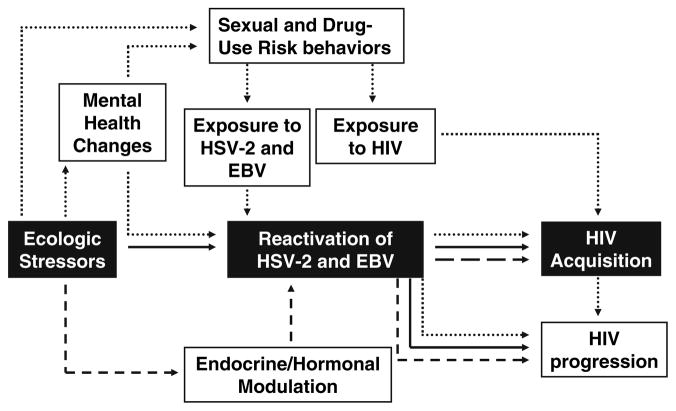
 ): Ecologic stressors may lead to mental health changes which cause increased sexual and drug-use risk behaviors and consequent increased exposure to HSV-2 and EBV, future reactivation of HSV-2 and EBV and subsequent increased risk of HIV acquisition and progression. Path 2 (
 ): Ecologic stressors may cause increased reactivation of HSV-2 and EBV directly, which subsequently increases risk for HIV acquisition and progression. Path 3 (
 ): Ecologic stressors may cause endocrine/hormonal changes which lead to reactivation of HSV-2 and EBV and subsequent increased risk for HIV acquisition and progression
References
-
- Aneshensel CS, Sucoff CA. The neighborhood context of adolescent mental health. Journal of Health and Social Behavior. 1996;37(4):293–310. - PubMed
-
- Anonymous. Racism, poverty, sexism all play a role in epidemic’s spread among black women. New resource guide educates on problem. AIDS Alert. 2006;21(2):13–17. - PubMed
-
- Antoni MH, Schneiderman N, Fletcher MA, Goldstein DA, Ironson G, Laperriere A. Psychoneuroimmunology and HIV-1. Journal of Consulting and Clinical Psychology. 1990;58(1):38–49. - PubMed
-
- Biondi M. Psychoneuroimmunology. 3. Vol. 2. New York: Academic Press; 2001. Chapter. 39: Effects of Stress on Immune Functions: An Overview.
Publication types
MeSH terms
Grants and funding
LinkOut - more resources
Full Text Sources
Medical
