


Helminth infection and eosinophilia and the risk of Plasmodium falciparum malaria in 1- to 6-year-old children in a malaria endemic area
- PMID: 18265875
- PMCID: PMC2238708
- DOI: 10.1371/journal.pntd.0000164
Helminth infection and eosinophilia and the risk of Plasmodium falciparum malaria in 1- to 6-year-old children in a malaria endemic area
Abstract
Background: Helminth infection is common in malaria endemic areas, and an interaction between the two would be of considerable public health importance. Animal models suggest that helminth infections may increase susceptibility to malaria, but epidemiological data has been limited and contradictory.
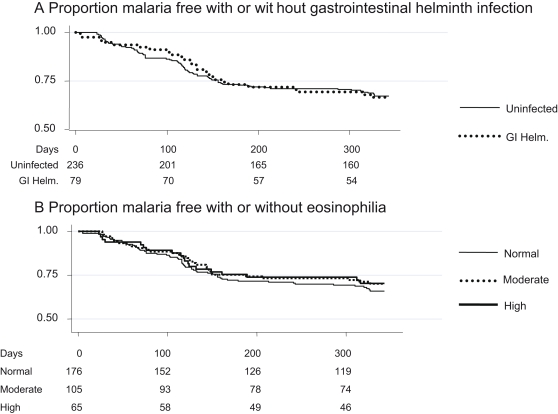
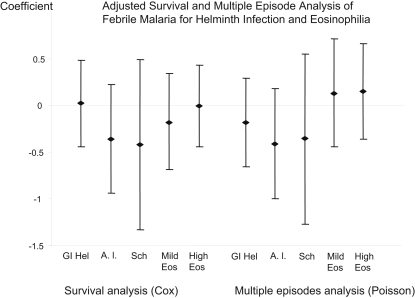
Methodology/principal findings: In a vaccine trial, we studied 387 one- to six-year-old children for the effect of helminth infections on febrile Plasmodium falciparum malaria episodes. Gastrointestinal helminth infection and eosinophilia were prevalent (25% and 50% respectively), but did not influence susceptibility to malaria. Hazard ratios were 1 for gastrointestinal helminth infection (95% CI 0.6-1.6) and 0.85 and 0.85 for mild and marked eosinophilia, respectively (95% CI 0.56-1.76 and 0.69-1.96). Incident rate ratios for multiple episodes were 0.83 for gastro-intestinal helminth infection (95% CI 0.5-1.33) and 0.86 and 0.98 for mild and marked eosinophilia (95% CI 0.5-1.4 and 0.6-1.5).
Conclusions/significance: There was no evidence that infection with gastrointestinal helminths or urinary schistosomiasis increased susceptibility to Plasmodium falciparum malaria in this study. Larger studies including populations with a greater prevalence of helminth infection should be undertaken.
Conflict of interest statement
The authors have declared that no competing interests exist.
Figures
References
-
- Yoshida A, Maruyama H, Kumagai T, Amano T, Kobayashi F, et al. Schistosoma mansoni infection cancels the susceptibility to Plasmodium chabaudi through induction of type 1 immune responses in A/J mice. International Immunology. 2000;12:1117–1125. - PubMed
-
- Spiegel A, Tall A, Raphenon G, Trape JF, Druilhe P. Increased frequency of malaria attacks in subjects co-infected by intestinal worms and Plasmodium falciparum malaria. Transactions of the Royal Society of Tropical Medicine and Hygiene. 2003;97:198–199. - PubMed
Publication types
MeSH terms
Substances
Grants and funding
LinkOut - more resources
Full Text Sources
Medical
