Quality of life and depression of people living with type 2 diabetes mellitus and those at low and high risk for type 2 diabetes: findings from the Study to Help Improve Early evaluation and management of risk factors Leading to Diabetes (SHIELD)
- PMID: 18266708
- PMCID: PMC2423273
- DOI: 10.1111/j.1742-1241.2008.01703.x
Quality of life and depression of people living with type 2 diabetes mellitus and those at low and high risk for type 2 diabetes: findings from the Study to Help Improve Early evaluation and management of risk factors Leading to Diabetes (SHIELD)
Abstract
Objectives: This study compared health-related quality of life (HRQoL) and depression among individuals with type 2 diabetes mellitus (T2D) and those at low or high risk for T2D.
Methods: Respondents in a population-based US 2004 survey reported whether they had T2D (n = 3530) or risk factors for T2D [abdominal obesity, body mass index (BMI) >/= 28 kg/m(2), dyslipidaemia, hypertension and history of cardiovascular disease]. Respondents without T2D were stratified into low risk (0-2 risk factors, n = 5335) and high risk (3-5 risk factors, n = 5051). SF-12 version 2 (SF-12) and Patient Health Questionnaire (PHQ)-9 were used to measure HRQoL and depression. Mean scores were compared across the three groups using analysis of variance. Linear regression identified factors associated with SF-12 Physical and Mental Component Summary scores (PCS and MCS), adjusting for age, gender, race, income, geographic region, household size, BMI and group.
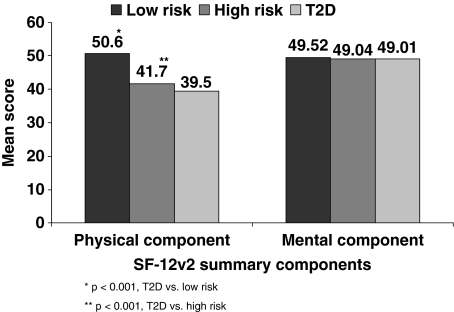
Results: Respondents were mostly women (60%) with mean age of 54 years. Mean PCS scores for T2D and high risk (39.5 and 41.7, respectively) were significantly lower than for low risk (50.6, p < 0.001). After adjustment, high-risk and T2D groups were associated with lower PCS and MCS scores compared with low risk group (p < 0.05). Mean PHQ-9 scores and per cent with moderate-to-severe depression were significantly higher for T2D and high risk than for low risk (p < 0.01).
Conclusions: Health-related quality of life and depression scores in T2D were similar to those at high risk, and indicated significant decrements in physical health and greater depression compared with low-risk respondents.
Figures
Comment in
-
Research on diabetes: prioritization, quality of life, medication adherence, and self-efficacy.Home Healthc Nurse. 2011 May;29(5):320-5. doi: 10.1097/NHH.0b013e3182173b1b. Home Healthc Nurse. 2011. PMID: 21543922
References
-
- Centers for Disease Control and Prevention. National Diabetes Fact Sheet: General Information and National Estimates on Diabetes in the United States, 2005. Atlanta, GA: U.S. Department of Health and Human Services, Centers for Disease Control and Prevention; 2005.
-
- Thom T, Haase N, Rosamond W, et al. Heart disease and stroke statistics – 2006 update. A report from the American Heart Association Statistics Committee and Stroke Statistics Subcommittee. Circulation. 2006;113:e85–151. - PubMed
-
- American Diabetes Association. Complications of Diabetes in the United States. [April 2007]. http://www.diabetes.org/diabetes-statistics/complications.jsp.
-
- Luscombe FA. Health-related quality of life measurement in type 2 diabetes. Value Health. 2000;3(Suppl. 1):15–28. - PubMed
-
- Garratt AM, Schmidt L, Fitzpatrick R. Patient-assisted health outcome measures for diabetes: a structured review. Diabet Med. 2002;19:1–11. - PubMed
Publication types
MeSH terms
LinkOut - more resources
Full Text Sources
Medical