Review
. 2008 Jun;12(3):829-75.
doi: 10.1111/j.1582-4934.2008.00281.x. Epub 2008 Feb 8.

Membranes: a meeting point for lipids, proteins and therapies

Affiliations
Review

Membranes: a meeting point for lipids, proteins and therapies

Pablo V Escribá et al. J Cell Mol Med. 2008 Jun.

Abstract

Membranes constitute a meeting point for lipids and proteins. Not only do they define the entity of cells and cytosolic organelles but they also display a wide variety of important functions previously ascribed to the activity of proteins alone. Indeed, lipids have commonly been considered a mere support for the transient or permanent association of membrane proteins, while acting as a selective cell/organelle barrier. However, mounting evidence demonstrates that lipids themselves regulate the location and activity of many membrane proteins, as well as defining membrane microdomains that serve as spatio-temporal platforms for interacting signalling proteins. Membrane lipids are crucial in the fission and fusion of lipid bilayers and they also act as sensors to control environmental or physiological conditions. Lipids and lipid structures participate directly as messengers or regulators of signal transduction. Moreover, their alteration has been associated with the development of numerous diseases. Proteins can interact with membranes through lipid co-/post-translational modifications, and electrostatic and hydrophobic interactions, van der Waals forces and hydrogen bonding are all involved in the associations among membrane proteins and lipids. The present study reviews these interactions from the molecular and biomedical point of view, and the effects of their modulation on the physiological activity of cells, the aetiology of human diseases and the design of clinical drugs. In fact, the influence of lipids on protein function is reflected in the possibility to use these molecular species as targets for therapies against cancer, obesity, neurodegenerative disorders, cardiovascular pathologies and other diseases, using a new approach called membrane-lipid therapy.


Figures
1
1
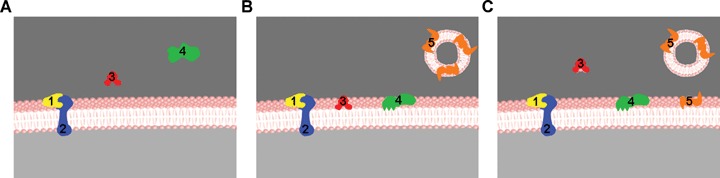
A simplified drawing representing the various interactions of proteins with lipid bilayers as a function of time:1, a peripheral or extrinsic protein; 2, an integral or intrinsic protein; 3, a non-permanent protein that interacts reversibly with the membrane, a lipid-transfer protein in this particular example; 4, a non-permanent protein that becomes irreversibly bound to the bilayer once it interacts with it; 5, a non-permanent protein reversibly bound to a secretion vesicle and then transferred to a target membrane. A, B and C correspond to consecutive stages in the interaction process.
2
2
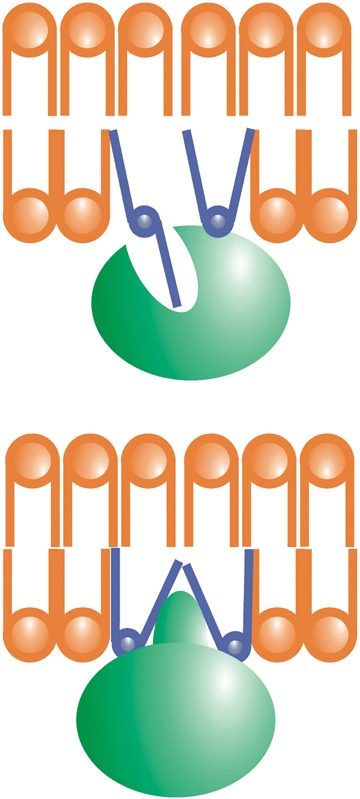
Non-lamellar-prone lipids with a small polar head-group (e.g. phosphatidylethanolamine [PE], blue) induce the formation of non-lamellar-prone regions. These bilayers, with a frustrated (lɛ) lamellar phase, can be stabilized by proteins (green) or other lamellar-prone lipids (orange). The loose packing of these bilayers allows some acyl chains to exit the membrane plane and become located in hydrophobic protein sockets (upper scheme). Hydrophobic protein domains, which may correspond to amino acid sequences or lipid modifications, may also be inserted into the membrane. Therefore, non-lamellar-prone lipids facilitate the docking of amphitropic proteins to the membrane. One of these lipids, PE, is abundant in the inner monolayer of the plasma membrane where most peripheral proteins are found.
3
3
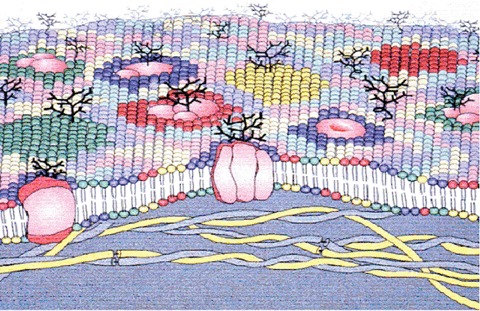
Schematic illustration of a biomembrane, depicting membrane lipid asymmetry as well as microdomains enriched in particular lipids and those induced by membrane proteins.
4
4
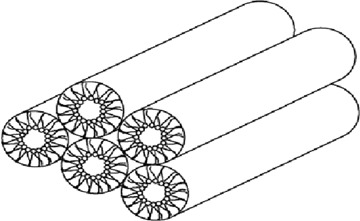
Inverted HII hexagonal phase composed of water-filled tubes with the lipid acyl chains pointing outwards. Different cellular membranes with a planar geometry invariably contain a variety of lipids and would therefore form such a phase. The presence of these lipids imparts frustration to the membrane, with a high packing density in the hydrocarbon region of the bilayer. Adapted from [51].
5
5
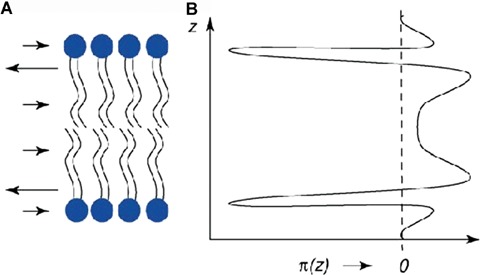
Lateral pressure profile for a lipid bilayer (left), with surface tension being balanced by steric repulsion between the head-groups and acyl chains. See text for details. Adapted from [51].
6
6
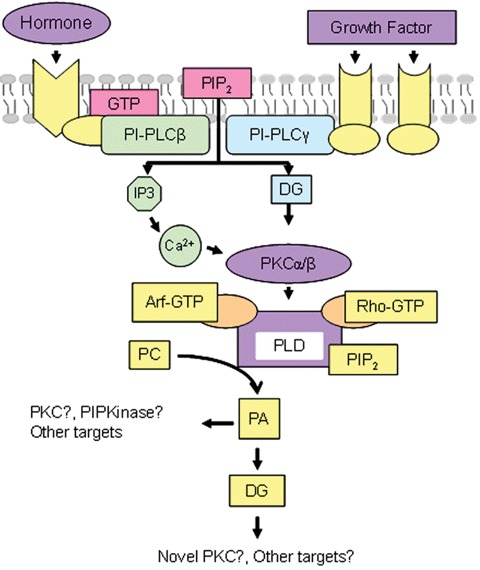
Phospholipase cascade of PLD activation and amplification of diacylglycerol production. Abbreviations: PI-PLC, phosphatidylinositol-specific phospholipase C; DG, diacylglyerol; PC, phosphatidylcholine; PA, phosphatidic acid; PKC, protein kinase C; PIP2, PI-4,5-bisphosphate and PIP kinase, PI phosphate kinase. Adapted from [100].
7
7
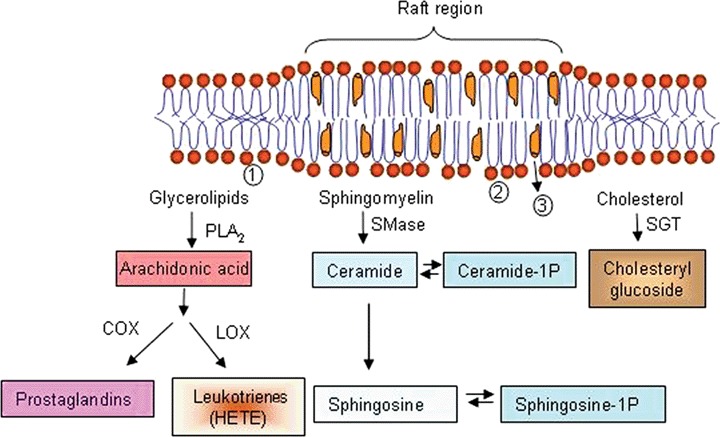
Some typical lipid mediators capable of altering the Hsp response. The parental molecules of a variety of lipid mediators (boxes) are:(1) glycerolipids of the bulk membrane; constituents of rafts such as (2) SM and (3) cholesterol. PLA2: phospholipase A2; SMase: sphingomyelinase; SGT: sterol glucosyltransferase; COX: cyclooxygenase and LOX: lipoxygenase.

References

    1. Escribá PV, Wedegaertner PB, Goñi FM, Vögler O. Lipid-protein interactions in GPCR-associated signaling. Biochim Biophys Acta. 2007;1768:836–52. - PubMed
    1. Funari SS, Prades J, Escribá PV, Barceló F. Farnesol and geranylgeraniol modulate the structural properties of phosphatidylethanolamine model membranes. Mol Membr Biol. 2005;22:303–11. - PubMed
    1. Barceló F, Prades J, Encinar JA, Funari SS, Vögler O, Gonzalez-Ros JM, Escribá PV. Interaction of the C-terminal region of the G{gamma} protein with model membranes. Biophys J. 2007;93:2530–41. - PMC - PubMed
    1. Escribá PV, Sastre M, García-Sevilla JA. Disruption of cellular signaling pathways by daunomycin through destabilization of nonlamellar membrane structures. Proc Natl Acad Sci USA. 1995;92:7595–9. - PMC - PubMed
    1. Escribá PV, Ozaita A, Ribas C, Miralles A, Fodor E, Farkas T, García-Sevilla JA. Role of lipid polymorphism in G protein-membrane interactions: nonlamellar-prone phospholipids and peripheral protein binding to membranes. Proc Natl Acad Sci USA. 1997;94:11375–80. - PMC - PubMed

Publication types