. 2008 Feb 18;205(2):287-94.
doi: 10.1084/jem.20072208. Epub 2008 Feb 11.

Vaccine protection against Staphylococcus aureus pneumonia

Affiliations

Vaccine protection against Staphylococcus aureus pneumonia

Juliane Bubeck Wardenburg et al. J Exp Med. .

Abstract

Staphylococcus aureus pneumonia causes significant mortality in hospitalized or healthy individuals, and recent increases in morbidity are attributed to the rapid spread of methicillin-resistant S. aureus (MRSA) strains, which are often not susceptible to antibiotic therapy. Alpha-hemolysin (Hla), a secreted pore-forming toxin, is an essential virulence factor of MRSA in a mouse model of S. aureus pneumonia. We show that the level of Hla expression by independent S. aureus strains directly correlates with their virulence. Active immunization with a mutant form of Hla (Hla(H35L)), which cannot form pores, generates antigen-specific immunoglobulin G responses and affords protection against staphylococcal pneumonia. Moreover, transfer of Hla-specific antibodies protects naive animals against S. aureus challenge and prevents the injury of human lung epithelial cells during infection. Thus, Hla vaccination or immunotherapy may prevent S. aureus pneumonia in humans.


Figures
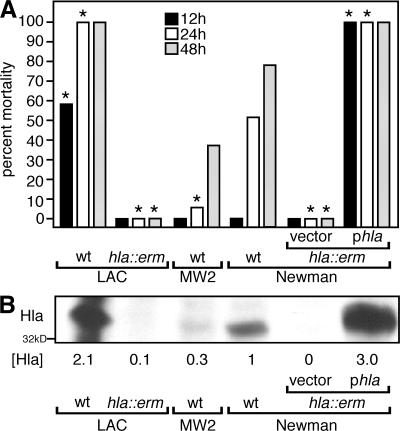
Figure 1.
Figure 1.
S. aureus secretion of Hla correlates with mortality from lung infection. (A) Animals infected via the i.n. route (10 animals per group) with 3–4 × 10⁸ wild-type S. aureus LAC, MW2, and Newman strains or the Hla-deficient strain (hla∷erm) complemented with either vector or phla revealed strain-dependent differences in mortality. LAC and Newman hla∷erm phla caused marked mortality at 12 h (P = 0.017 and 0.00001, respectively) and 24 h (P = 0.03 for both strains) compared with Newman wild-type. In contrast, infection with the MW2 strain resulted in a lower mortality compared with Newman (P = 0.046); infection with LAC hla∷erm and Newman hla∷erm demonstrated these strains to be avirulent. Statistical significance is indicated by an asterisk. (B) Strain-based differences in the level of Hla secretion. Immunoblot analysis of 18-h culture supernatants revealed increased Hla production by LAC and Newman hla∷erm phla compared with wild-type Newman, whereas MW2 produces lesser amounts of Hla. Amounts of Hla ([Hla]) secreted by each strain were quantified by evaluation of chemiluminescence signals derived from antibody binding to antigen and were recorded relative to the amount of Hla secreted by Newman.
Figure 2.
Figure 2.
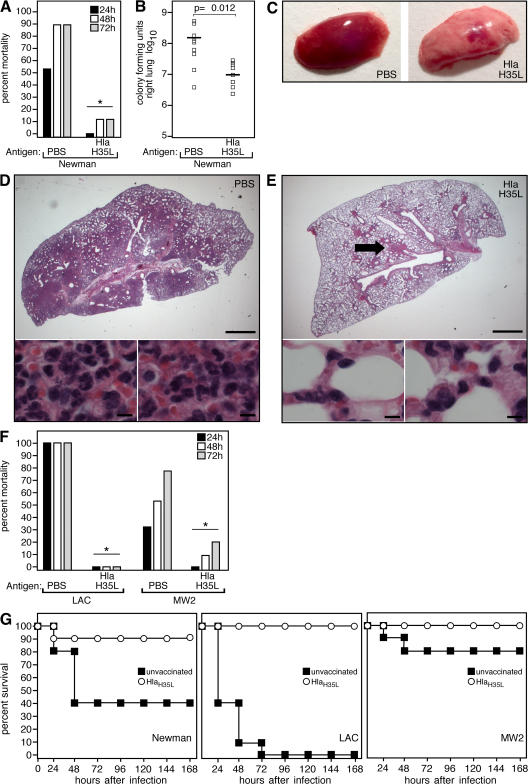
Immunization with HlaH35L protects mice against S. aureus pneumonia. (A) C57BL/6J mice were immunized by i.m. injection with PBS or 20 μg HlaH35L, a mutant Hla with a single amino acid substitution that abolishes toxin activity, and challenged with S. aureus Newman. Mortality was recorded 24, 48, or 72 h after infection (P = 0.001; 10 animals per group). (B) Immunization of mice with HlaH35L reduces the growth of S. aureus Newman in infected lung tissue (P = 0.012; 10 animals per group). Horizontal bars indicate the mean of bacterial load measurements. (C) Gross pathology of S. aureus Newman–infected lung tissue from mice that were immunized with PBS or HlaH35L. (D and E) Histopathology of S. aureus Newman–infected lung tissue from mice that were immunized with PBS or HlaH35L. The arrow in E points to the focal area of consolidation in lung tissue of HlaH35L-immunized animals. Bars: (top) 0.1 cm; (bottom) 10 μm. (F) HlaH35L-immunized C57BL/6J mice were challenged via the i.n. route with S. aureus CA-MRSA strains LAC or MW2 (10 animals per group). Mortality was recorded 24, 48, or 72 h after infection. The mortality of HlaH35L-immunized animals was significantly reduced over that of mock (PBS)-immunized animals challenged with either S. aureus LAC (P = 0.00001) or MW2 (P = 0.018). Statistical significance in A and F is indicated by an asterisk. (G) Survival curves of either unvaccinated or HlaH35L-immunized animals over a 168-h time course after infection with S. aureus Newman (left), LAC (middle), or MW2 (right).
Figure 3.
Figure 3.
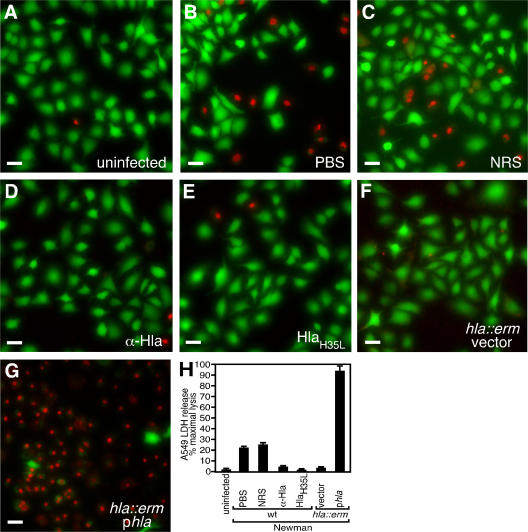
S. aureus injury of human alveolar epithelial cells is reduced by antagonism of Hla. Live (green)/dead (red) imaging of human A549 cells was captured by fluorescence microscopy 4 h after infection. A549 cells were left uninfected (A) or co-cultured with S. aureus Newman in media treated with PBS (1:1,000; B), NRS (1:1,000; C), anti-Hla rabbit sera (α-Hla; 1:1,000; D), or purified HlaH35L (10 μg/ml; E). Infections were also performed with the Newman isogenic hla insertion mutant, hla∷erm, transformed with vector (F) or phla (G). Bars, 20 μm. (H) Assessment of LDH release by A549 cells that were lysed during S. aureus infection. A significant reduction in LDH release was observed compared with PBS-treated cultures upon addition of anti-Hla sera or HlaH35L, whereas an increase in LDH release was observed upon co-culture with S. aureus hla∷erm phla. Error bars indicate mean ± SD.
Figure 4.
Figure 4.
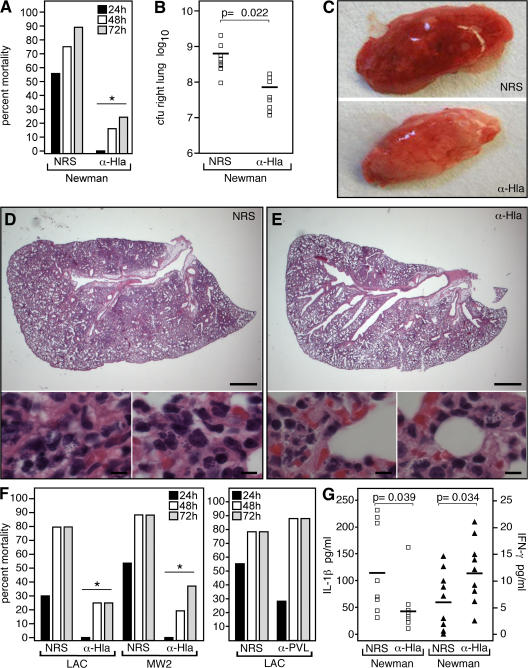
Passive immunization of mice with anti-Hla protects against S. aureus lung infection. (A) Mice were passively immunized by i.p. injection with NRS or rabbit serum that harbored anti-Hla and were challenged via the i.n. route with S. aureus Newman (P = 0.018; 10 animals per group). Mortality was recorded 24, 48, and 72 h after infection. Passive i.p. immunization of mice with anti-Hla reduces the ability of S. aureus Newman to grow in mouse lung tissue (P = 0.022; 10 animals per group; B) and decreases the gross pathological (C) and histopathologic (D and E) lesions evident after infection. Horizontal bars in B indicate the mean. Bars: (D and E, top) 0.1 cm; (D and E, bottom) 10 μm. (F) i.p. administration of anti-Hla antisera protects animals upon challenge by i.n. inoculation with LAC (P = 0.028) or MW2 (P = 0.04; 10 animals per group; left), whereas immunization with anti-PVL immune sera does not confer protection (P = 0.45; 10 animals per group; right). Statistical significance in A and F is indicated by an asterisk. (G) Cytokine responses during lung infection are influenced by passive immunization with antibodies against Hla. Serum cytokine levels were determined 24 h after infection, revealing a decrease in IL-1β secretion in anti-Hla–immunized animals (P = 0.039) and a corresponding increase in serum IFN-γ (P = 0.034) relative to sham-immunized animals (nine animals per group). Horizonal bars indicate the mean.

Comment in

References

    1. Lowy, F.D. 1998. Staphylococcus aureus infections. N. Engl. J. Med. 339:520–532. - PubMed
    1. Gillet, Y., B. Issartel, P. Vanhems, G. Lina, F. Vandenesch, J. Etienne, and D. Floret. 2001. Severe staphylococcal pneumonia in children. [In French.] Arch. Pediatr. 8(Suppl. 4):742–746. - PubMed
    1. Gillet, Y., B. Issartel, P. Vanhems, J.C. Fournet, G. Lina, M. Bes, F. Vandenesch, Y. Piemont, N. Brousse, D. Floret, and J. Etienne. 2002. Association between Staphylococcus aureus strains carrying gene for Panton-Valentine leukocidin and highly lethal necrotising pneumonia in young immunocompetent patients. Lancet. 359:753–759. - PubMed
    1. Kollef, M.H., L.E. Morrow, M.S. Niederman, K.V. Leeper, A. Anzueto, L. Benz-Scott, and F.J. Rodino. 2006. Clinical characteristics and treatment patterns among patients with ventilator-associated pneumonia. Chest. 129:1210–1218. - PubMed
    1. Bubeck Wardenburg, J., R.J. Patel, and O. Schneewind. 2007. Surface proteins and exotoxins are required for the pathogenesis of Staphylococcus aureus pneumonia. Infect. Immun. 75:1040–1044. - PMC - PubMed

Publication types