


BRCA1 promoter methylation in peripheral blood DNA of mutation negative familial breast cancer patients with a BRCA1 tumour phenotype
- PMID: 18269736
- PMCID: PMC2374968
- DOI: 10.1186/bcr1858
BRCA1 promoter methylation in peripheral blood DNA of mutation negative familial breast cancer patients with a BRCA1 tumour phenotype
Abstract
Introduction: Individuals with germline mutations in the BRCA1 gene have an elevated risk of developing breast cancer, and often display characteristic clinicopathological features. We hypothesised that inactivation of BRCA1 by promoter methylation could occur as a germline or an early somatic event that predisposes to breast cancer with the phenotype normally associated with BRCA1 germline mutation.
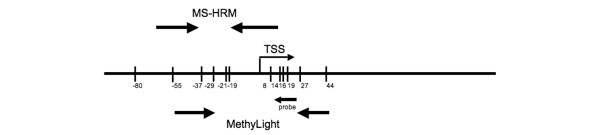
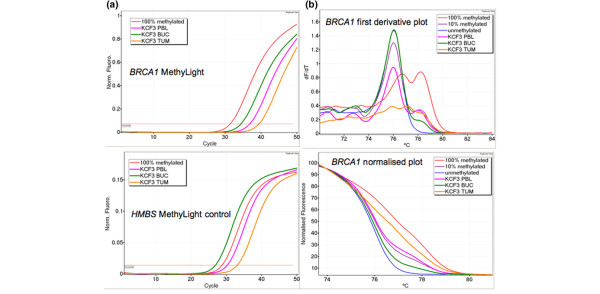
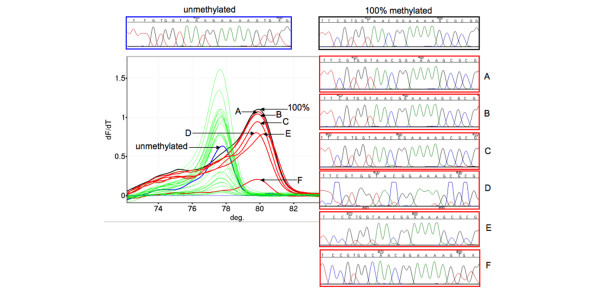
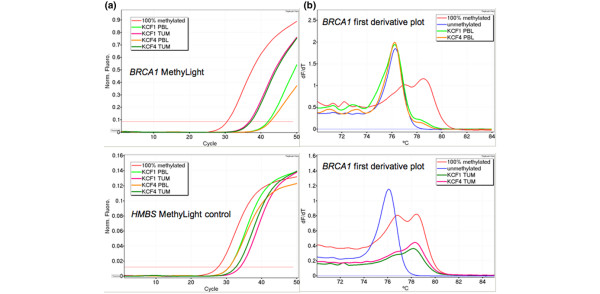
Methods: We examined seven cases from breast-ovarian cancer families with tumours that showed BRCA1-like pathology but did not have detectable BRCA1 or BRCA2 germline mutations present. Methylation levels were tested by several quantitative techniques including MethyLight, methylation-sensitive high resolution melting (MS-HRM) and a newly developed digital MS-HRM assay.
Results: In one patient, methylation of 10% of the BRCA1 alleles was detected in the peripheral blood DNA, consistent with 20% of cells having one methylated allele. Buccal mucosa DNA from this individual displayed approximately 5% BRCA1 methylation. In two other patients, methylation of BRCA1 was detected in the peripheral blood at significantly lower but still readily detectable levels (approximately 1%). Tumour DNAs from these three patients were heavily methylated at BRCA1. The other patients had no detectable BRCA1 methylation in their peripheral blood. One of seven age-matched controls showed extremely low levels of methylation in their peripheral blood (approximately 0.1%).
Conclusion: These results demonstrate that in some cases of breast cancer, low-level promoter methylation of BRCA1 occurs in normal tissues of the body and is associated with the development of BRCA1-like breast cancer.
Figures
References
-
- Miki Y, Swensen J, Shattuck-Eidens D, Futreal PA, Harshman K, Tavtigian S, Liu Q, Cochran C, Bennett LM, Ding W, Bell R, Rosenthal J, Hussey C, Than T, McClure M, Frye C, Hattier T, Phelps R, Haugen-Strano A, Katcher H, Yakumo K, Gholami Z, Shaffer D, Stone S, Bayer S, Wray C, Bogden R, Dayananth P, Ward J, Tonin P, et al. A strong candidate for the breast and ovarian cancer susceptibility gene BRCA1. Science. 1994;266:66–71. doi: 10.1126/science.7545954. - DOI - PubMed
-
- Eisinger F, Stoppa-Lyonnet D, Longy M, Kerangueven F, Noguchi T, Bailly C, Vincent-Salomon A, Jacquemier J, Birnbaum D, Sobol H. Germ line mutation at BRCA1 affects the histoprognostic grade in hereditary breast cancer. Cancer Res. 1996;56:471–474. - PubMed
-
- Armes JE, Egan AJ, Southey MC, Dite GS, McCredie MR, Giles GG, Hopper JL, Venter DJ. The histologic phenotypes of breast carcinoma occurring before age 40 years in women with and without BRCA1 or BRCA2 germline mutations: a population-based study. Cancer. 1998;83:2335–2345. doi: 10.1002/(SICI)1097-0142(19981201)83:11<2335::AID-CNCR13>3.0.CO;2-N. - DOI - PubMed
Publication types
MeSH terms
Substances
LinkOut - more resources
Full Text Sources
Other Literature Sources
Medical
Miscellaneous
