Review
. 2008 Jan;7(1):35-49.
doi: 10.1093/bfgp/eln004. Epub 2008 Feb 12.

The plasma proteome, adductome and idiosyncratic toxicity in toxicoproteomics research

Affiliations
Review

The plasma proteome, adductome and idiosyncratic toxicity in toxicoproteomics research

B Alex Merrick. Brief Funct Genomic Proteomic. 2008 Jan.

Abstract

Toxicoproteomics uses the discovery potential of proteomics in toxicology research by applying global protein measurement technologies to biofluids and tissues after host exposure to injurious agents. Toxicoproteomic studies thus far have focused on protein profiling of major organs and biofluids such as liver and blood in preclinical species exposed to model toxicants. The slow pace of discovery for new biomarkers, toxicity signatures and mechanistic insights is partially due to the limited proteome coverage derived from analysis of native organs, tissues and body fluids by traditional proteomic platforms. Improved toxicoproteomic analysis would result by combining higher data density LC-MS/MS platforms with stable isotope labelled peptides and parallel use of complementary platforms. Study designs that remove abundant proteins from biofluids, enrich subcellular structures and include cell specific isolation from heterogeneous tissues would greatly increase differential expression capabilities. By leveraging resources from immunology, cell biology and nutrition research communities, toxicoproteomics could make particular contributions in three inter-related areas to advance mechanistic insights and biomarker development: the plasma proteome and circulating microparticles, the adductome and idiosyncratic toxicity.


Figures
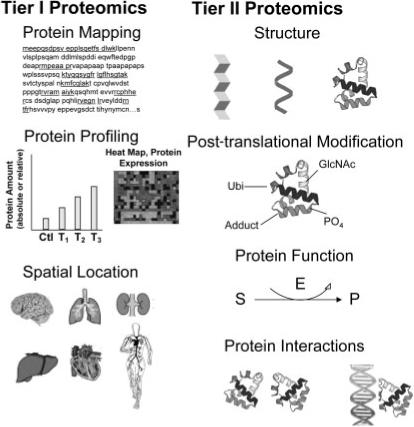
Figure 1
Figure 1
Disciplines of toxicoproteomics to study effects of drug, chemical, disease or environmental stressor exposure. Proteomic analysis attempts to describe various protein attributes in a global manner. Tier I Proteomic Analysis involves protein mapping or profiling. Protein mapping for identification reflects the property of primary amino acid sequence; quantitations of all proteins from a defined space are inherent in Protein Profiling; and isolation or enrichment of proteins from a particular spatial location within cells or tissues help characterize the organism's phenotype. Tier II Proteomic Analysis involves global determination of individual protein attributes (behaviour and structure) regarding their three-dimensional structures, PTMs, functional capabilities and interactions and complexation with other biomolecules. Further explanations follow. In Protein Mapping, the underlined portions of an individual protein represent tryptic peptides for amino acid sequencing for identification by MALDI or MS/MS. In Protein Profiling, changing levels of individual proteins (bar graph) I or groups of proteins (cluster analysis) are measured over treatment (T1, T2, T3) or time. A proteome of interest occupies a specific spatial location for analysis and may comprise a subcellular organelle, tissue or organ. Protein structure may represent the β-pleated sheet or α-helix to form tertiary or quaternary protein folding. Specific post-translational moieties such as ubiquitin (Ubi), phosphorylation (PO4), glycosylation (ClcNAc), chemical adduct or many others are covalently bound to specific amino acid residues on the protein that impart important functional and biophysical properties. Protein Function may be: enzymatic such as enzymatic (E) conversion of substrate (S) to product (P); structural providing form and shape; translocational across cells or tissues; signalling and transduction; or many other utilities to be carried out within cells and tissues. Protein interactions may occur between other proteins, between DNA and proteins, or between other biomolecules.
Figure 2
Figure 2
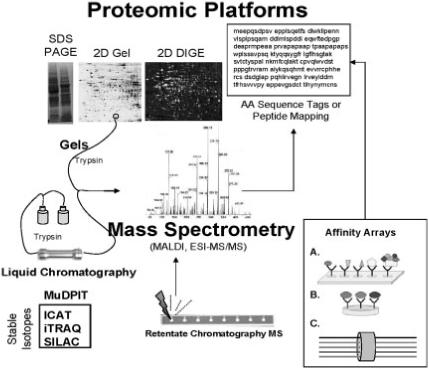
Proteomic platforms for toxicoproteomics studies. Proteomic platforms represent strategies for global separation and identification of proteins. Separations are generally accomplished by gel electrophoresis in toxicoproteomic studies although more recent studies incorporate liquid chromatography-based (LC) platforms such as linear column gradients or multidimensional chromatography (MuDPIT). Use of stable isotopes greatly facilitates protein quantitation (ICAT = isotope coded affinity tags; iTRAQ = isobaric tags for relative and absolute quantitation; SILAC = stable isotope labelling by amino acids in cell culture). Mass spectrometry predominates as a means of protein identification. Identification occurs by peptide mapping or amino acid (AA) sequencing. Retentate chromatography mass spectrometry has been used for rapid profiling of biofluid samples using chemically reactive surfaces for separation and MALDI for generating protein mass spectra (i.e. SELDI technology). Alternatives for MS-based proteomics involve affinity arrays such as (A) antibody arrays, (B) antibody multiplexing and (C) fluorescently tagged antibody bound bead suspensions (i.e. Luminex technology).

References

    1. Wetmore BA, Merrick BA. Toxicoproteomics: proteomics applied to toxicology and pathology. Toxicol Pathol. 2004;32:619–42. - PubMed
    1. Merrick BA, Bruno ME. Genomic and proteomic profiling for biomarkers and signature profiles of toxicity. Curr Opin Mol Ther. 2004;6:600–7. - PubMed
    1. Silbergeld EK, Davis DL. Role of biomarkers in identifying and understanding environmentally induced disease. Clin Chem. 1994;40:1363–7. - PubMed
    1. Hood L, Heath JR, Phelps ME, et al. Systems biology and new technologies enable predictive and preventative medicine. Science. 2004;306:640–3. - PubMed
    1. Lin J, Qian J. Systems biology approach to integrative comparative genomics. Expert Rev Proteomics. 2007;4:107–19. - PubMed

Publication types

LinkOut - more resources