


Sulfadoxine-pyrimethamine-based combinations for malaria: a randomised blinded trial to compare efficacy, safety and selection of resistance in Malawi
- PMID: 18270569
- PMCID: PMC2229666
- DOI: 10.1371/journal.pone.0001578
Sulfadoxine-pyrimethamine-based combinations for malaria: a randomised blinded trial to compare efficacy, safety and selection of resistance in Malawi
Abstract
Background: In Malawi, there has been a return of Plasmodium falciparum sensitivity to chloroquine (CQ) since sulfadoxine-pyrimethamine (SP) replaced CQ as first line treatment for uncomplicated malaria. When used for prophylaxis, Amodiaquine (AQ) was associated with agranulocytosis but is considered safe for treatment and is increasingly being used in Africa. Here we compare the efficacy, safety and selection of resistance using SP or CQ+SP or artesunate (ART)+SP or AQ+SP for the treatment of uncomplicated falciparum malaria.
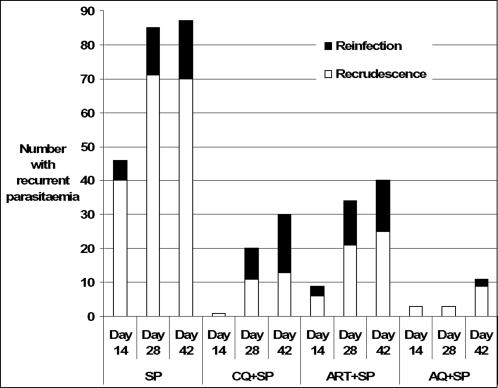
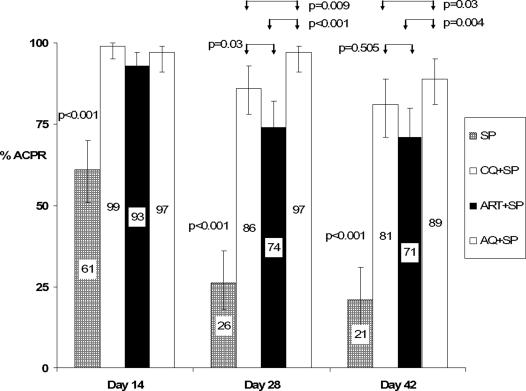
Methodology and findings: 455 children aged 1-5 years were recruited into a double-blinded randomised trial comparing SP to the three combination therapies. Using intention to treat analysis with missing outcomes treated as successes, and without adjustment to distinguish recrudescence from new infections, the day 28 adequate clinical and parasitological response (ACPR) rate for SP was 25%, inferior to each of the three combination therapies (p<0.001). AQ+SP had an ACPR rate of 97%, higher than CQ+SP (81%) and ART+SP (70%), p<0.001. Nineteen children developed a neutropenia of </=0.5x10(3) cells/microl by day 14, more commonly after AQ+SP (p = 0.03). The mutation pfcrt 76T, associated with CQ resistance, was detected in none of the pre-treatment or post-treatment parasites. The prevalence of the pfmdr1 86Y mutation was higher after treatment with AQ+SP than after SP, p = 0.002.
Conclusions: The combination AQ+SP was highly efficacious, despite the low efficacy of SP alone; however, we found evidence that AQ may exert selective pressure for resistance associated mutations many weeks after treatment. This study confirms the return of CQ sensitivity in Malawi and importantly, shows no evidence of the re-emergence of pfcrt 76T after treatment with CQ or AQ. Given the safety record of AQ when used as a prophylaxis, our observations of marked falls in neutrophil counts in the AQ+SP group requires further scrutiny.
Trial registration: Controlled-Trials.com ISRCTN22075368.
Conflict of interest statement
Figures

References
-
- Laufer MK, Thesing PC, Eddington ND, Masonga R, Dzinjalamala FK, et al. Return of chloroquine antimalarial efficacy in Malawi. N Engl J Med. 2006;355:1959–1966. - PubMed
-
- World Health Organisation. 2006. Guidelines for the treatment of malaria.
-
- Olumese P. 2007. Antimalarial treatment policies for P.falciparum and P.vivax by country in WHO Africa region. http://www.who.int/malaria/amdp/amdp_afro.htm.
-
- Obonyo CO, Juma EA, Ogutu BR, Vulule JM, Lau J. Amodiaquine combined with sulfadoxine/pyrimethamine versus artemisinin-based combinations for the treatment of uncomplicated falciparum malaria in Africa: a meta-analysis. Trans R Soc Trop Med Hyg. 2007;101:117–126. - PubMed
Publication types
MeSH terms
Substances
Associated data
Grants and funding
LinkOut - more resources
Full Text Sources
Medical
