


Impact of meningococcal serogroup C conjugate vaccines on carriage and herd immunity
- PMID: 18271745
- PMCID: PMC6767871
- DOI: 10.1086/527401
Impact of meningococcal serogroup C conjugate vaccines on carriage and herd immunity
Abstract
Background: In 1999, meningococcal serogroup C conjugate (MCC) vaccines were introduced in the United Kingdom for those under 19 years of age. The impact of this intervention on asymptomatic carriage of meningococci was investigated to establish whether serogroup replacement or protection by herd immunity occurred.
Methods: Multicenter surveys of carriage were conducted during vaccine introduction and on 2 successive years, resulting in a total of 48,309 samples, from which 8599 meningococci were isolated and characterized by genotyping and phenotyping.
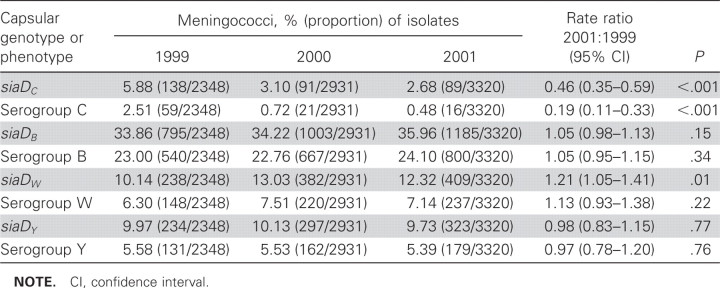
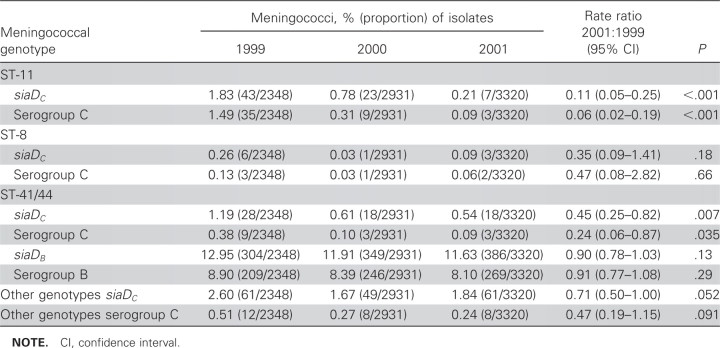
Results: A reduction in serogroup C carriage (rate ratio, 0.19) was observed that lasted at least 2 years with no evidence of serogroup replacement. Vaccine efficacy against carriage was 75%, and vaccination had a disproportionate impact on the carriage of sequence type (ST)-11 complex serogroup C meningococci that (rate ratio, 0.06); these meningococci also exhibited high rates of capsule expression.
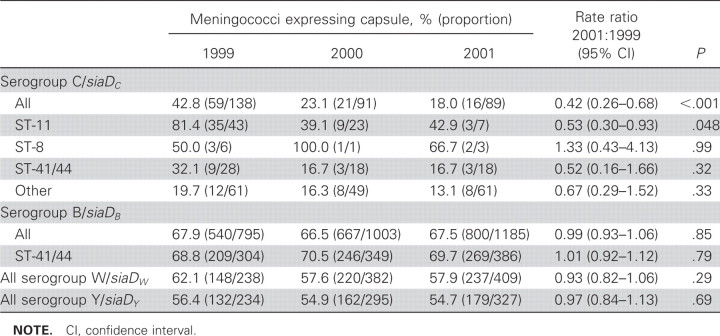
Conclusions: The impact of vaccination with MCC vaccine on the prevalence of carriage of group C meningococci was consistent with herd immunity. The high impact on the carriage of ST-11 complex serogroup C could be attributed to high levels of capsule expression. High vaccine efficacy against disease in young children, who were not protected long-term by the schedule initially used, is attributed to the high vaccine efficacy against carriage in older age groups.
Conflict of interest statement
Potential conflicts of interest: none reported.
Figures
Comment in
-
Vaccines for the unvaccinated: protecting the herd.J Infect Dis. 2008 Mar 1;197(5):643-5. doi: 10.1086/527402. J Infect Dis. 2008. PMID: 18271744 No abstract available.
References
-
- Claus H, Maiden MC, Wilson DJ, et al. Genetic analysis of meningococci carried by children and young adults. J Infect Dis. 2005;191:1263–71. - PubMed
-
- Gray SJ, Trotter CL, Ramsay ME, et al. Epidemiology of meningococcal disease in England and Wales 1993/94 to 2003/04: contribution and experiences of the Meningococcal Reference Unit. J Med Microbiol. 2006;55:887–96. - PubMed
-
- Miller E, Salisbury D, Ramsay M. Planning, registration, and implementation of an immunisation campaign against meningococcal serogroup Cdisease in the UK: a success story. Vaccine. (Suppl 1) 2001;20:S58–S67. - PubMed
Publication types
MeSH terms
Substances
Grants and funding
LinkOut - more resources
Full Text Sources
Other Literature Sources
Medical
