


Epstein-Barr virus associated gastric carcinoma: epidemiological and clinicopathological features
- PMID: 18271915
- PMCID: PMC11158035
- DOI: 10.1111/j.1349-7006.2007.00674.x
Epstein-Barr virus associated gastric carcinoma: epidemiological and clinicopathological features
Abstract
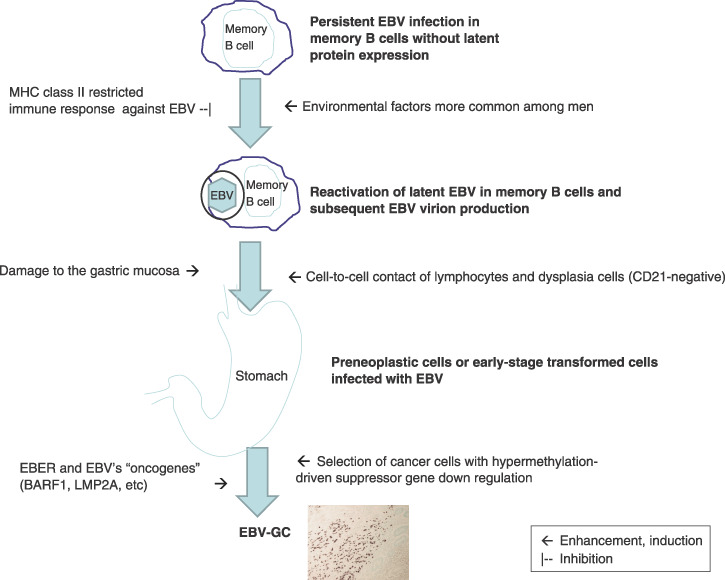
In this paper, the roles of Epstein-Barr virus (EBV) in gastric carcinogenesis are discussed, reviewing mainly epidemiological and clinicopathological studies. About 10% of gastric carcinomas harbor clonal EBV. LMP1, an important EBV oncoprotein, is only rarely expressed in EBV-associated gastric carcinoma (EBV-GC) while EBV-encoded small RNA is expressed in almost every EBV-GC cell, suggesting its importance for developing and maintaining this carcinoma. In addition, the hypermethylation-driven suppressor gene downregulation, frequently observed in EBV-GC, appears to give a selective advantage for carcinoma cells. EBV reactivation is suspected to precede EBV-GC development since antibodies against EBV-related antigens, including EBV capsid antigen (VCA), are elevated in prediagnostic sera. Interestingly, the average anti-VCA immunoglobulin G antibody titer in EBV-GC patients was significantly higher among men than among women, whereas EBV-negative GC cases did not show such a sex difference. A higher frequency of human leucocyte antigen-DR11 in EBV-GCs suggests that major histocompatibility complex-restricted EBV nuclear antigen 1 epitope recognition may enhance EBV reactivation. EBV infection of gastric cells by lymphocytes with reactivated EBV is suspected to be the first step of EBV-GC development. Male predominance of EBV-GC suggests the involvement of lifestyles and occupational factors common among men. The predominance of EBV with XhoI+ and BamHI type i polymorphisms in EBV-GC in Latin America suggests a possibility of some EBV oncogene expressions being affected by EBV polymorphism. The lack of such predominance in Asian countries, however, indicates an interaction between EBV polymorphism and the host response. In conclusion, further studies are necessary to examine the interaction between EBV infection, its polymorphisms, environmental factors, and genetic backgrounds.
Figures

References
-
- Mueller N, Birmann B, Parsonnet J, Schiffman M, Stuver S. Infectious agents. In: Schottenfeld D, Fraumeni JF, eds. Cancer Epidemiology and Prevention, 3rd edn. New York: Oxford University Press, 2006; 507–49.
-
- Thorley‐Lawson EBV. Persistence and latent infection in vivo . In: Robertson ES, ed. Epstein‐Barr Virus. Norfolk: Caister Academic Press, 2005: 309–58.
-
- Yates JL, Warren N, Sugden B. Stable replication of plasmids derived from Epstein‐Barr virus in various mammalian cells. Nature 1985; 313: 812–15. - PubMed
-
- Levitskaya J, Coram M, Levitsky V et al . Inhibition of antigen processing by the internal repeat region of the Epstein‐Barr virus nuclear antigen‐1. Nature 1995; 375: 685–8. - PubMed
-
- Munz C. Immune response and evasion in the host–EBV interaction. In: Robertson ES, ed. Epstein‐Barr Virus. Norfolk: Caister Academic Press, 2005; 197–231.
Publication types
MeSH terms
Substances
LinkOut - more resources
Full Text Sources
Medical
Miscellaneous
