


Utility of Cardiac Magnetic Resonance to assess association between admission hyperglycemia and myocardial damage in patients with reperfused ST-segment elevation myocardial infarction
- PMID: 18272004
- PMCID: PMC2244607
- DOI: 10.1186/1532-429X-10-2
Utility of Cardiac Magnetic Resonance to assess association between admission hyperglycemia and myocardial damage in patients with reperfused ST-segment elevation myocardial infarction
Abstract
Aims: to investigate the association between admission hyperglycemia and myocardial damage in patients with ST-segment elevation myocardial infarction (STEMI) using Cardiac Magnetic Resonance (CMR).
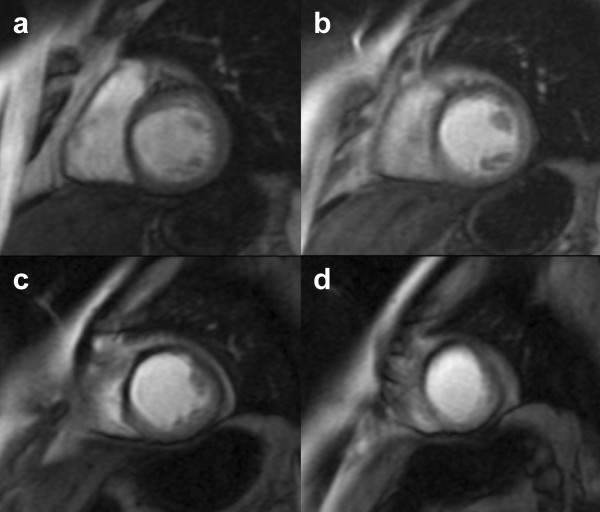
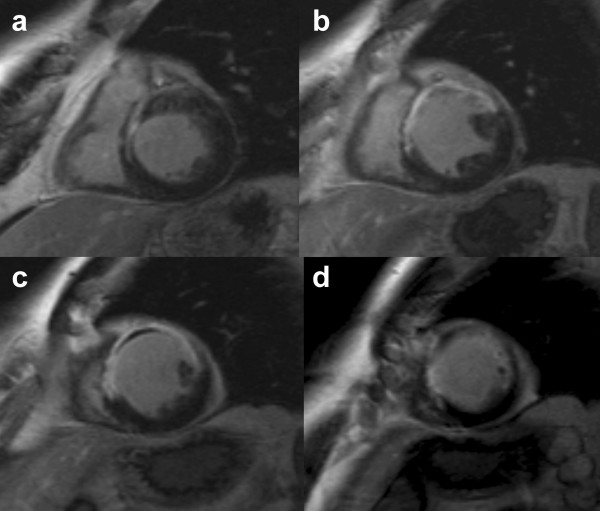
Methods: We analyzed 113 patients with STEMI treated with successful primary percutaneous coronary intervention. Admission hyperglycemia was defined as a glucose level >/= 7.8 mmol/l. Contrast-enhanced CMR was performed between 3 and 7 days after reperfusion to evaluate left ventricular function and perfusion data after injection of gadolinium-DTPA. First-pass images (FP), providing assessment of microvascular obstruction and Late Gadolinium Enhanced images (DE), reflecting the extent of infarction, were investigated and the extent of transmural tissue damage was determined by visual scores.
Results: Patients with a supramedian FP and DE scores more frequently had left anterior descending culprit artery (p = 0.02 and <0.001), multivessel disease (p = 0.02 for both) and hyperglycemia (p < 0.001). Moreover, they were characterized by higher levels of HbA1c (p = 0.01 and 0.04), peak plasma Creatine Kinase (p < 0.001), left ventricular end-systolic volume (p = 0.005 and <0.001), and lower left ventricular ejection fraction (p = 0.001 and <0.001). In a multivariate model, admission hyperglycemia remains independently associated with increased FP and DE scores.
Conclusion: Our results show the existence of a strong relationship between glucose metabolism impairment and myocardial damage in patients with STEMI. Further studies are needed to show if aggressive glucose control improves myocardial perfusion, which could be assessed using CMR.
Figures
References
-
- Zeller M, Cottin Y, Brindisi MC, Dentan G, Laurent Y, Janin-Manificat L, L'Huillier I, Beer JC, Touzery C, Makki H, Verges B, Wolf JE. The RICO survey working group. Impaired fasting glucose and cardiogenic shock in patient with acute myocardial infarction. Eur Heart J. 2004;25:308–312. doi: 10.1016/j.ehj.2003.12.014. - DOI - PubMed
-
- Iwakura K, Ito H, Ikushima M, Kawano S, Okamura A, Asano K, Kuroda T, Tanaka K, Masuyama T, Hori M, Fujii K. Association between hyperglycemia and the no reflow phenomenon in patients with acute myocardial infarction. J Am Coll Cardiol. 2003;41:1–7. doi: 10.1016/S0735-1097(02)02626-8. - DOI - PubMed
Publication types
MeSH terms
Substances
LinkOut - more resources
Full Text Sources
Medical
