. 2008 May;82(9):4595-611.
doi: 10.1128/JVI.02588-07. Epub 2008 Feb 13.

Genome analysis of a Glossina pallidipes salivary gland hypertrophy virus reveals a novel, large, double-stranded circular DNA virus

Affiliations

Genome analysis of a Glossina pallidipes salivary gland hypertrophy virus reveals a novel, large, double-stranded circular DNA virus

Adly M M Abd-Alla et al. J Virol. 2008 May.

Abstract

Several species of tsetse flies can be infected by the Glossina pallidipes salivary gland hypertrophy virus (GpSGHV). Infection causes salivary gland hypertrophy and also significantly reduces the fecundity of the infected flies. To better understand the molecular basis underlying the pathogenesis of this unusual virus, we sequenced and analyzed its genome. The GpSGHV genome is a double-stranded circular DNA molecule of 190,032 bp containing 160 nonoverlapping open reading frames (ORFs), which are distributed equally on both strands with a gene density of one per 1.2 kb. It has a high A+T content of 72%. About 3% of the GpSGHV genome is composed of 15 sequence repeats, distributed throughout the genome. Although sharing the same morphological features (enveloped rod-shaped nucleocapsid) as baculoviruses, nudiviruses, and nimaviruses, analysis of its genome revealed that GpSGHV differs significantly from these viruses at the level of its genes. Sequence comparisons indicated that only 23% of GpSGHV genes displayed moderate homologies to genes from other invertebrate viruses, principally baculoviruses and entomopoxviruses. Most strikingly, the GpSGHV genome encodes homologues to the four baculoviral per os infectivity factors (p74 [pif-0], pif-1, pif-2, and pif-3). The DNA polymerase encoded by GpSGHV is of type B and appears to be phylogenetically distant from all DNA polymerases encoded by large double-stranded DNA viruses. The majority of the remaining ORFs could not be assigned by sequence comparison. Furthermore, no homologues to DNA-dependent RNA polymerase subunits were detected. Taken together, these data indicate that GpSGHV is the prototype member of a novel group of insect viruses.


Figures

FIG. 1.
FIG. 1.
Virions of GpSGHV observed by electron microscopy after negative staining.
FIG. 2.
FIG. 2.
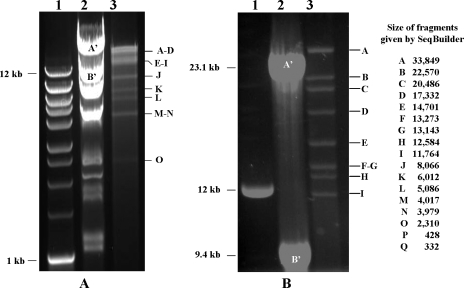
Electrophoretic profile of BglII-restricted GpSGHV DNA, showing 15 of the 17 restriction fragments generated by this enzyme. (A and B) Agarose gels after 3 h and 24 h of migration, respectively. The two small fragments P and Q (<1 kb) cannot be seen on the gels. Submolar bands were not apparent but may be present at a lower concentration. Lanes 1, 1-kb DNA ladder; lanes 2, Hind III-restricted λ DNA ladder (A′ and B] correspond to 23,130 and 9,416 bp, respectively); lanes 3, GpSGHV DNA.
FIG. 3.
FIG. 3.
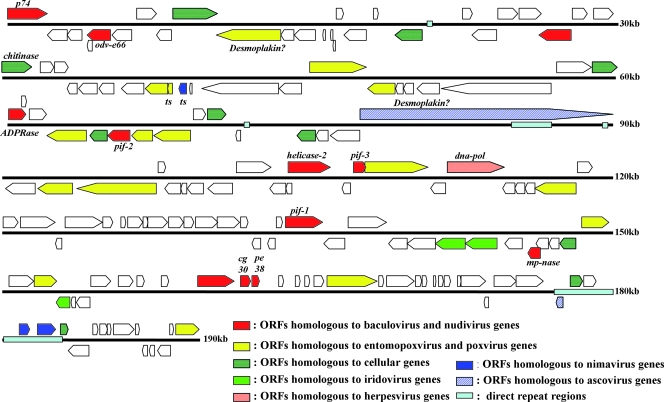
Linearized representation of the GpSGHV genome. The genome was linearized at the ATG start codon of p74 (SGHV001). Arrows indicate the positions and directions of transcription for potential ORFs, which are colored according to suggested homology to those of other viruses. Light blue boxes indicate positions of repeat regions.
FIG. 4.
FIG. 4.
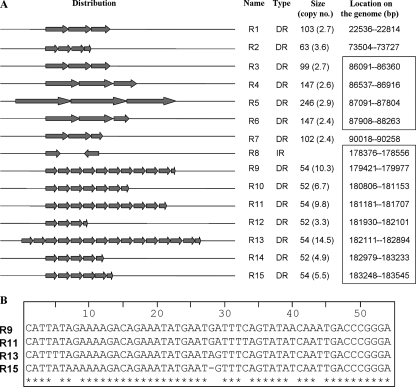
(A) Loci of the GpSGHV genome with repeated elements. The repeat core elements and their direction are represented by arrows. The name, type, size, copy number, and genome location of the repeat are indicated on the right. DR, direct repeat; IR, inverted repeat. Length, >50 bp; number, >2). (B) Alignment of nucleotide sequences of R9, R11, R13, and R15 direct repeats.
FIG. 5.
FIG. 5.
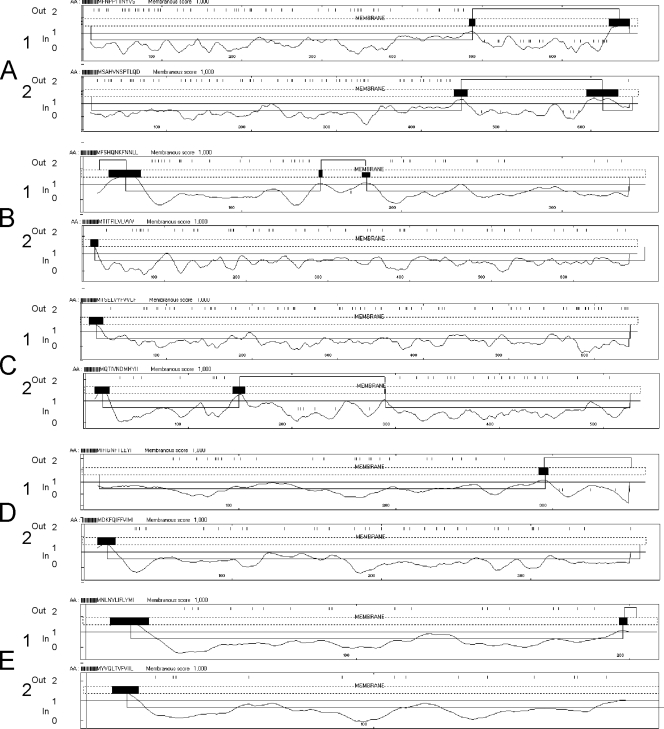
Hydrophobicity profiles of GpSGHV PIF- and ODV-E66-like proteins compared to their insect virus homologues. (A) SGHV001 (1) and p74 of Spodoptera litura NPV (2); (B) SGHV005 (odv-e66) (1) and odv-e66 of Epiphyas postvittana NPV (2); (C) SGHV102 (1) and pif-1 of Neodiprion abietis NPV (2); (D) SGHV053 (1) and pif-2 of Gryllus bimaculatus nudivirus (2); (E) SGHV076 (1) and pif-3 of Helicoverpa zea SNPV (2).
FIG. 6.
FIG. 6.
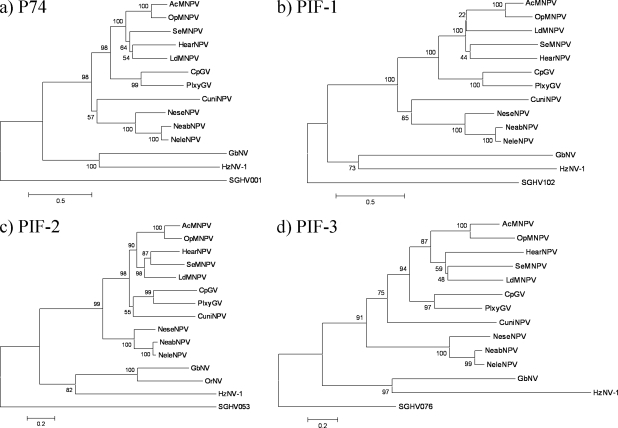
Neighbor-joining phylogenetic trees of SGHV001 (p74) (a), SGHV102 (pif-1) (b), SGHV053 (pif-2) (c), and SGHV076 (pif-3) (d) and their homologues in baculoviruses and nimaviruses. The following viruses (GenBank accession numbers are in parentheses) were included: lepidopteran-specific NPVs AcMNPV (NC_001623), O. pseudotsugata (Op) MNPV (NC_001875), L. dispar (Ld) MNPV (NC_001973), S. exigua (Se) MNPV (NC_002169), and H. armigera (Hear) NPV (NC_002654); granuloviruses C. pomonella (Cp) GV (NC_002816) and P. xylostella (Plxy) GV (NC_002593); hymenopteran-specific NPVs N. sertifer (Nese) NPV (NC_005905), N. lecontei (Nele) NPV (NC_005906), and N. abietes (Neab) NPV (NC_008252); dipteran-specific NPV C. nigripalpus (Cuni) NPV (NC_003084); and nudiviruses H. zea (Hz) NV-1 (NC_004156), G. bimaculatus (Gb) NV (NC_009240), and O. rhinoceros (Or) NV (DQ665871 and DQ665870). Distances were calculated using Poisson correction. The homogeneous substitution pattern among lineages with gamma distributed rate among sites (gamma parameter 2.25) was employed for reconstruction of the trees. The robustness of the tree was tested using bootstrap analysis (500 replicates). Numbers on the nodes indicate bootstrap values.
FIG. 7.
FIG. 7.
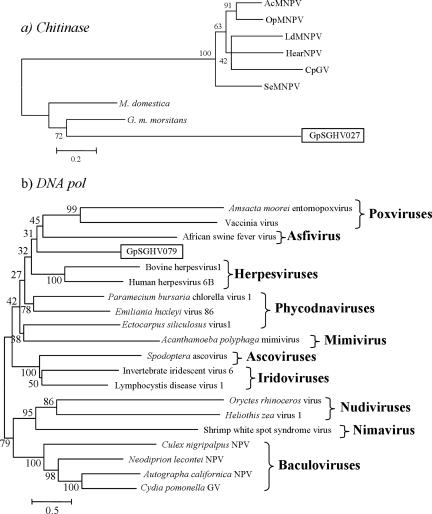
Neighbor-joining phylogenetic trees of SGHV027 (chitinase) (a) and SGHV079 (DNA polymerase) (b) proteins. The phylogenetic tree of SGHV027 chitinase was constructed by using the following lepidopteran baculovirus chitinases (GenBank accession number are in parentheses): AcMNPV (NC_001623), O. pseudotsugata (Op) MNPV (NC_001875), L. dispar (Ld) MNPV (NC_001973), H. armigera (Hear) NPV (NC_002654), C. pomonella (Cp) GV (NC_002816), S. exigua (Se) MNPV (NC_002169), and two putative chitinase proteins from Musca domestica (ABI29879) and Glossina morsitans morsitans (AF337908). Distances were calculated as for Fig. 6. The phylogenetic tree of SGHV079 DNA polymerase and its homologues is based on 2,374 sites of DNA polymerases of 20 viruses from various families. Distances were calculated using Poisson correction. The robustness of the tree was tested using bootstrap analysis (1,000 replicates). Numbers on the nodes indicate bootstrap values. The names of the selected virus families are indicated on the tree. The GenBank accession numbers of the viral DNA polymerases (from top to bottom with the exception of SGHV079) are NP_064832, NP_063712, NP_042783, NP_045328, NP_050219, NP_048532, YP_293784, NP_077578, YP_142676, AAC54632, NP_149500, NP_078724, ABF93350, NP_690550, NP_478036, NP_203396, YP_025217, NP_054095, and NP_148895.

References

    1. Abd-Alla, A., H. Bossin, F. Cousserans, A. Parker, M. Bergoin, and A. Robinson. 2007. Development of a non-destructive PCR method for detection of the salivary gland hypertrophy virus (SGHV) in tsetse flies. J. Virol. Methods 139143-149. - PubMed
    1. Afonso, C. L., E. R. Tulman, Z. Lu, E. Oma, G. F. Kutish, and D. L. Rock. 1999. The genome of Melanoplus sanguinipes entomopoxvirus. J. Virol. 73533-552. - PMC - PubMed
    1. Aksoy, S., and R. V. M. Rio. 2005. Interactions among multiple genomes: Tsetse, its symbionts and trypanosomes. Insect Biochem. Mol. Biol. 35691-698. - PubMed
    1. Albrecht, J. C., J. Nicholas, D. Biller, K. R. Cameron, B. Biesinger, C. Newman, S. Wittmann, M. A. Craxton, H. Coleman, B. Fleckenstein, and R. W. Honess. 1992. Primary structure of the herpesvirus saimiri genome. J. Virol. 665047-5058. - PMC - PubMed
    1. Altschul, S. F., T. L. Madden, A. A. Schäffer, J. Zhang, Z. Zhang, W. Miller, and D. J. Lipman. 1997. Gapped BLAST and PSI-BLAST: a new generation of protein database search programs. Nucleic Acids Res. 253389-3402. - PMC - PubMed

Associated data

LinkOut - more resources