Broadly neutralizing human monoclonal antibodies to the hepatitis C virus E2 glycoprotein
- PMID: 18272755
- PMCID: PMC2885755
- DOI: 10.1099/vir.0.83386-0
Broadly neutralizing human monoclonal antibodies to the hepatitis C virus E2 glycoprotein
Abstract
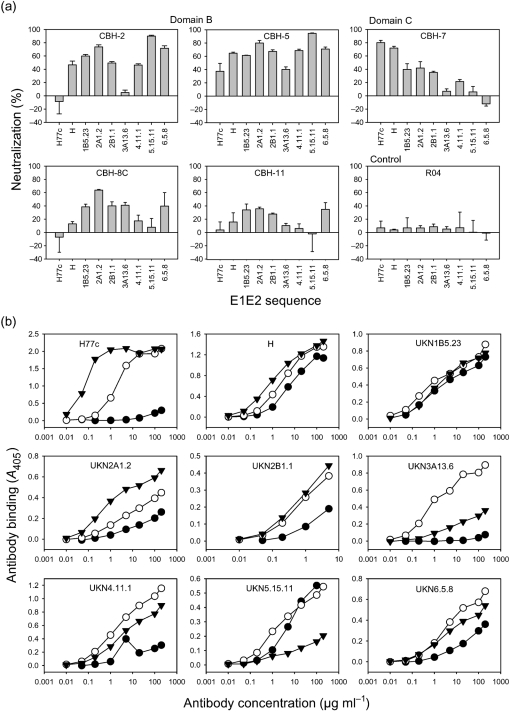
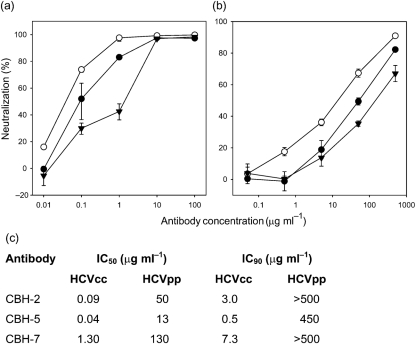
The humoral response to hepatitis C virus (HCV) may contribute to controlling infection. We previously isolated human monoclonal antibodies to conformational epitopes on the HCV E2 glycoprotein. Here, we report on their ability to inhibit infection by retroviral pseudoparticles incorporating a panel of full-length E1E2 clones representing the full spectrum of genotypes 1-6. We identified one antibody, CBH-5, that was capable of neutralizing every genotype tested. It also potently inhibited chimeric cell culture-infectious HCV, which had genotype 2b envelope proteins in a genotype 2a (JFH-1) background. Analysis using a panel of alanine-substitution mutants of HCV E2 revealed that the epitope of CBH-5 includes amino acid residues that are required for binding of E2 to CD81, a cellular receptor essential for virus entry. This suggests that CBH-5 inhibits HCV infection by competing directly with CD81 for a binding site on E2.
Figures

References
-
- Allander, T., Drakenberg, K., Beyene, A., Rosa, D., Abrignani, S., Houghton, M., Widell, A., Grillner, L. & Persson, M. A. (2000). Recombinant human monoclonal antibodies against different conformational epitopes of the E2 envelope glycoprotein of hepatitis C virus that inhibit its interaction with CD81. J Gen Virol 81, 2451–2459. - PubMed
-
- Anonymous (1999). Global surveillance and control of hepatitis C. Report of a WHO Consultation organized in collaboration with the Viral Hepatitis Prevention Board, Antwerp, Belgium. J Viral Hepat 6, 35–47. - PubMed
-
- Bartosch, B., Bukh, J., Meunier, J. C., Granier, C., Engle, R. E., Blackwelder, W. C., Emerson, S. U., Cosset, F. L. & Purcell, R. H. (2003a). In vitro assay for neutralizing antibody to hepatitis C virus: evidence for broadly conserved neutralization epitopes. Proc Natl Acad Sci U S A 100, 14199–14204. - PMC - PubMed
-
- Bartosch, B., Vitelli, A., Granier, C., Goujon, C., Dubuisson, J., Pascale, S., Scarselli, E., Cortese, R., Nicosia, A. & Cosset, F. L. (2003c). Cell entry of hepatitis C virus requires a set of co-receptors that include the CD81 tetraspanin and the SR-BI scavenger receptor. J Biol Chem 278, 41624–41630. - PubMed
Publication types
MeSH terms
Substances
Grants and funding
LinkOut - more resources
Full Text Sources
Other Literature Sources