. 2008 Feb 14:8:61.
doi: 10.1186/1471-2458-8-61.

Social contact networks for the spread of pandemic influenza in children and teenagers

Affiliations

Social contact networks for the spread of pandemic influenza in children and teenagers

Laura M Glass et al. BMC Public Health. .

Abstract

Background: Influenza is a viral infection that primarily spreads via fluid droplets from an infected person's coughs and sneezes to others nearby. Social contact networks and the way people interact within them are thus important to its spread. We developed a method to characterize the social contact network for the potential transmission of influenza and then applied the method to school aged children and teenagers.

Methods: Surveys were administered to students in an elementary, middle and high-school in the United States. The social contact network of a person was conceptualized as a set of groups to which they belong (e.g., households, classes, clubs) each composed of a sub-network of primary links representing the individuals within each group that they contact. The size of the group, number of primary links, time spent in the group, and level of contact along each primary link (near, talking, touching, or kissing) were characterized. Public activities done by groups venturing into the community where random contacts occur (e.g., friends viewing a movie) also were characterized.

Results: Students, groups and public activities were highly heterogeneous. Groups with high potential for the transmission of influenza were households, school classes, friends, and sports; households decreased and friends and sports increased in importance with grade level. Individual public activity events (such as dances) were also important but lost their importance when averaged over time. Random contacts, primarily in school passing periods, were numerous but had much lower transmission potential compared to those with primary links within groups. Students are highly assortative, interacting mainly within age class. A small number of individual students are identified as likely "super-spreaders".

Conclusion: High-school students may form the local transmission backbone of the next pandemic. Closing schools and keeping students at home during a pandemic would remove the transmission potential within these ages and could be effective at thwarting its spread within a community. Social contact networks characterized as groups and public activities with the time, level of contact and primary links within each, yields a comprehensive view, which if extended to all ages, would allow design of effective community containment for pandemic influenza.


Figures
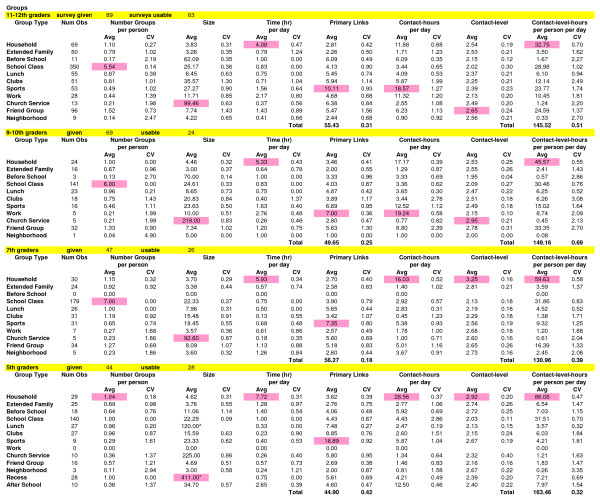
Figure 1
Figure 1
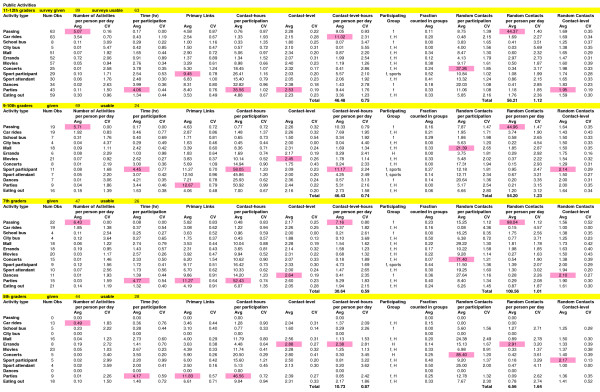
Summary Statistics for Groups. The highest average value (Avg) for each grade and group is shaded in pink. CV is the coefficient of variation. The number of observations (Obs) for groups is the total number of each kind of group across all people for each grade. Per-person values were calculated for the average student. Per-day values were formed for an average day that incorporated both week days and weekends. All terms are defined in Table 1. * denotes number of students in the school; ^ denotes one third of the school.
Figure 2
Figure 2
Summary Statistics for Public Activities. The highest average value (Avg) for each grade and public activity is shaded in pink. CV is the coefficient of variation. The number of observations (Obs) for public activities is the total number of people who had these activities. Per-person values were calculated for the average student. Per-day values were formed for an average day that incorporated both week days and weekends. The participating group is the group that the majority of students recorded doing a certain public activity with. H stands for household, f stands for friends, and sports for sports group. All terms are defined in Table 1.
Figure 3
Figure 3
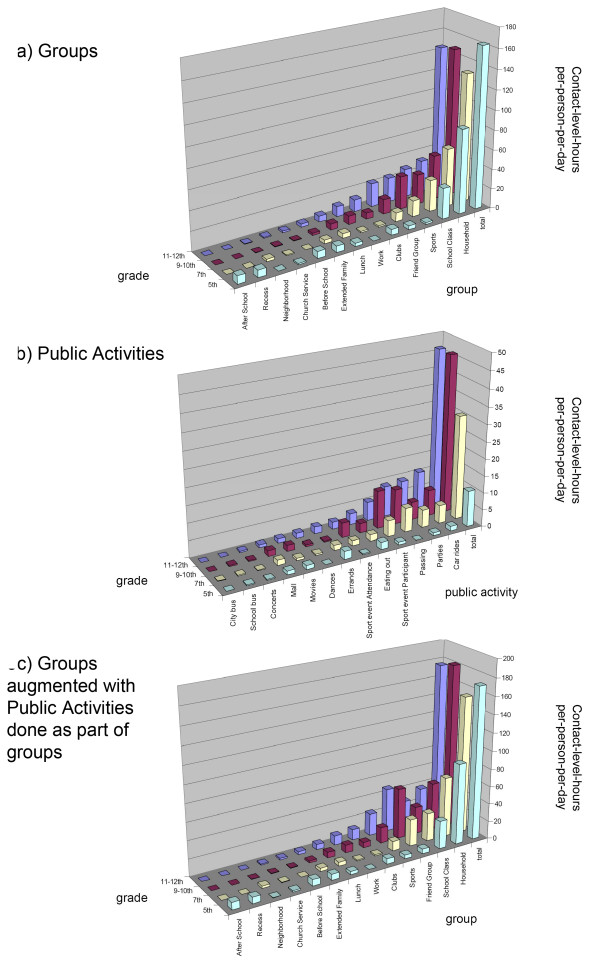
Contact-level-hours by Grade and Group/Public Activity. Contact-level-hours per-person-per-day is shown by grade and group/public activity with smaller values to the left and totals at the far right. Figure 3a) illustrates groups, 3b) illustrates public activities, and 3c) illustrates groups augmented with public activities, based on the participating group (for example, if students recorded going to dances with friends and these were not already included in time spent with friends, the contact-level-hours per-person-per-day in dances was added to the friend group). Per-person values were calculated for the average student. Per-day values were formed for an average day that incorporated both week days and weekends.
Figure 4
Figure 4
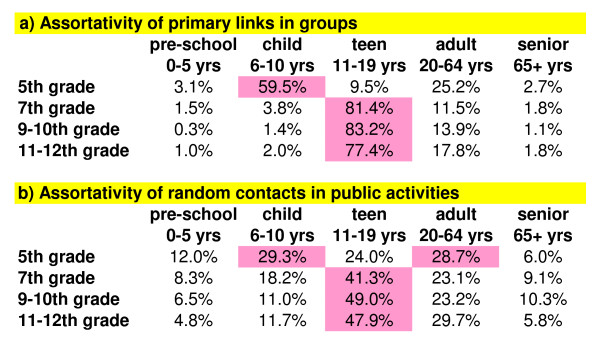
Age Assortativity. The percent of contacts between students in the surveyed grades and various age classes are shown for 4a) group primary links and 4b) random contacts. The highest percent of contacts are highlighted in pink. Assortativity is the tendency of a particular age class to assort with another.
Figure 5
Figure 5
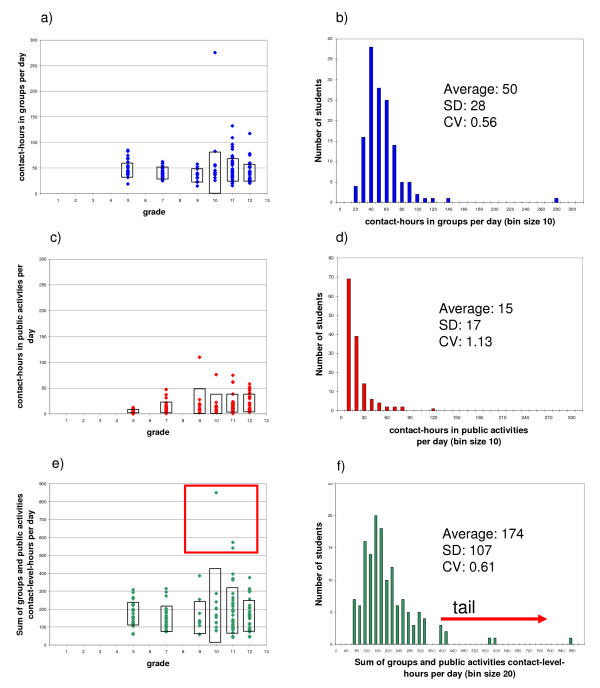
Individuals. We show for each grade the 5a) contact-hours in groups per-day, 5c) contact-hours in public activities per-day and 5e) the contact-level-hours per-day added across both groups and public activities without double counting. In each figure a point is plotted for an individual and a box denotes plus and minus one SD centered on the mean value. The red box in 5e) calls attention to the three data points as possible "super-spreaders" within the population surveyed. 5b), 5d), and 5f) show histograms that combine all students in all grades. Per-day values were formed for an average day that incorporated both week days and weekends.
Figure 6
Figure 6
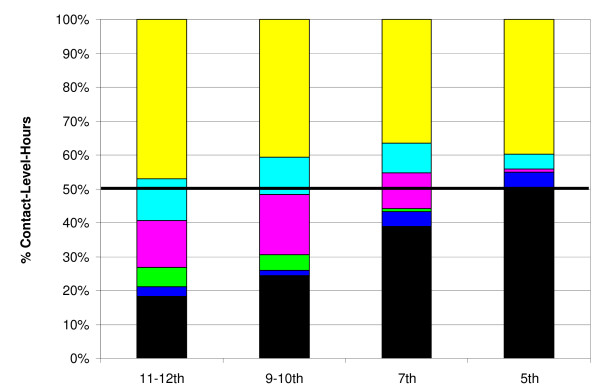
School Closure and Social Distancing Measures. Data are binned into the settings of school (yellow), non-school public activities (light blue), friends (magenta), work (green), neighborhood (blue) and household (black) expressed as a percentage of the total for each grade. For school (yellow) we have combined before school classes, classes, lunch, passing periods, and school bus rides and also all clubs, dances, sports, sport participant and attendance as all of these groups and public activities are school related. Neighborhood (blue) includes the neighborhood group as well as church and extended family. The black line represents a reduction to 50%.

References

    1. Ferguson NM, Cummings DAT, Cauchemez S, Fraser C, Riley S, Meeyai A, Iamsirithaworn S, Burke DS. Nature. Vol. 437. MACMILLAN BUILDING, 4 CRINAN ST, LONDON N1 9XW, ENGLAND , NATURE PUBLISHING GROUP; 2005. Strategies for containing an emerging influenza pandemic in Southeast Asia; p. 209. - DOI - PubMed
    1. Longini IM, Nizam A, Xu SF, Ungchusak K, Hanshaoworakul W, Cummings DAT, Halloran ME. Science (Washington D C) Vol. 309. 1200 NEW YORK AVE, NW, WASHINGTON, DC 20005 USA , AMER ASSOC ADVANCEMENT SCIENCE; 2005. Containing pandemic influenza at the source; p. 1083. - DOI - PubMed
    1. Ferguson NM, Cummings DAT, Fraser C, Cajka JC, Cooley PC, Burke DS. Nature. doi:10.1038/nature04795. MACMILLAN BUILDING, 4 CRINAN ST, LONDON N1 9XW, ENGLAND , NATURE PUBLISHING GROUP; 2006. Strategies for mitigating an influenza pandemic . - PMC - PubMed
    1. Germann TC, Kadau K, Longini IM, Macken CA. Proceedings of the National Academy of Sciences of the United States of America. Vol. 103. 2101 CONSTITUTION AVE NW, WASHINGTON, DC 20418 USA , NATL ACAD SCIENCES; 2006. Mitigation strategies for pandemic influenza in the United States; p. 5935. - DOI - PMC - PubMed
    1. IOM/NAS . Modeling Community Containment for Pandemic Influenza. Institute of Medicine of the National Academies, The National Academies Press, Washington, DC 20001; 2006.