


Review
doi: 10.1016/j.sbi.2007.12.014.
Epub 2008 Feb 13.
Protein targeting to ATP-dependent proteases
Affiliations
- PMID: 18276129
- PMCID: PMC2346608
- DOI: 10.1016/j.sbi.2007.12.014
Item in Clipboard
Review
Protein targeting to ATP-dependent proteases
Curr Opin Struct Biol.
2008 Feb.
Abstract
ATP-dependent proteases control diverse cellular processes by degrading specific regulatory proteins. Recent work has shown that protein substrates are specifically transferred to ATP-dependent proteases through different routes. These routes can function in parallel or independently. In all of these targeting mechanisms, it can be useful to separate two steps: substrate binding to the protease and initiation of degradation.
Figures
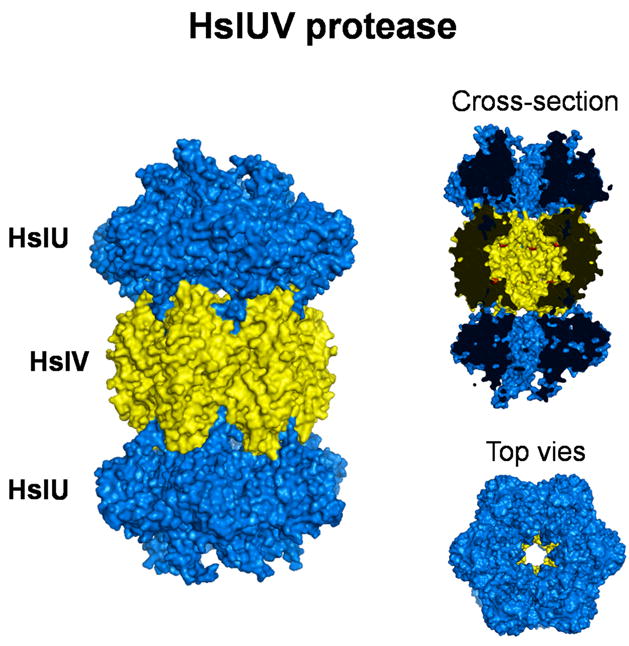
Structures of the bacterial ATP-dependent protease HslUV (PDB 1G3I). The protease subunits HlsV are shown in yellow, the ATPase subunits HslU are shown in blue. A side-on cross section reveals the active site of proteolysis (red dots) in the catalytic chamber and the degradation channel that connects the active site to the exterior of the protease. End-on view shows the sixfold axis of symmetry. Structures were produced by PyMOL.
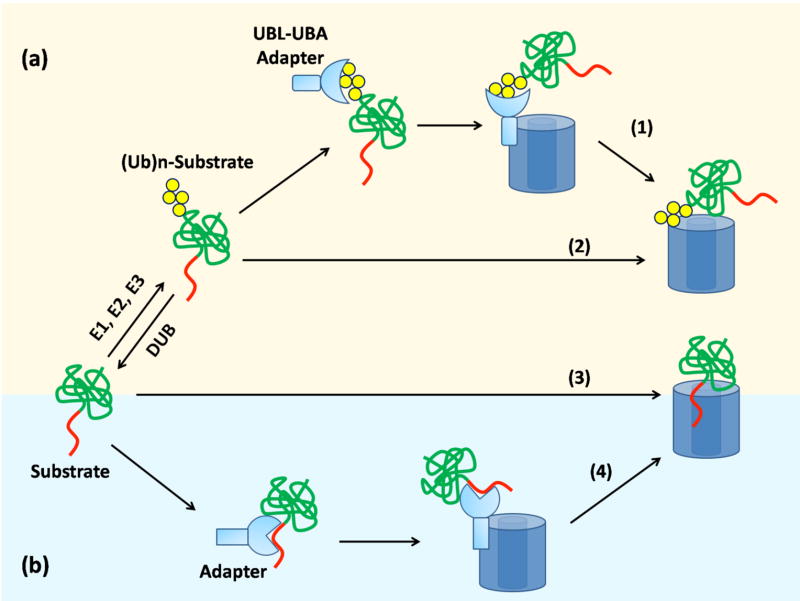
Pathways regulating the transfer of substrate to proteases in eukaryotes (a) and bacteria (b). Subunits of 26S proteasome bind to the polyubiquitin chain of modified substrate (2) or to exposed polypeptide sequence of the substrate (3). Alternatively, adaptor proteins that bind the polyubiquitin chain and the proteasome simultaneously can mediate targeting(1). Bacterial proteases recognize substrate via exposed sequence tags (3) or via adaptor proteins (4).
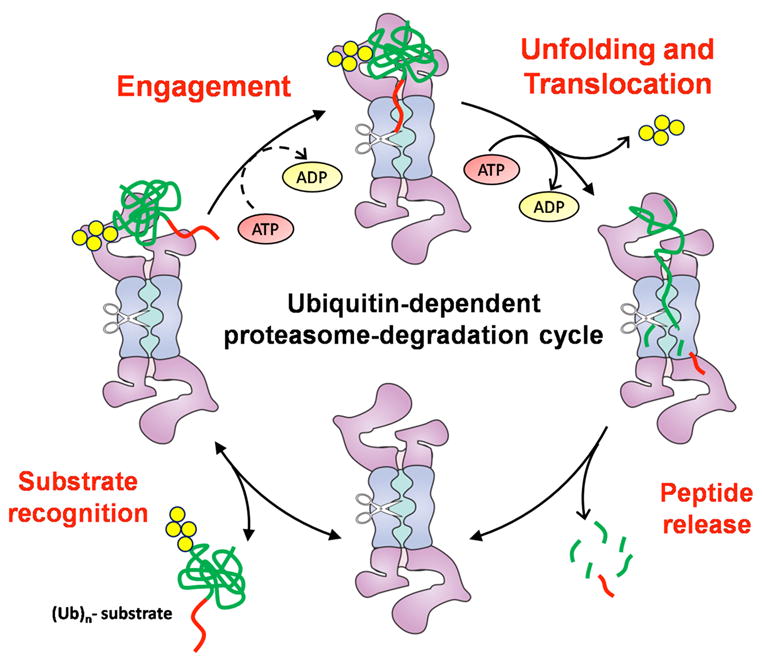
The degradation cycle of the proteasome. Polyubiquitinated (Ubn) proteins bind to the proteasome through the ubiquitin chain (bottom left). Unfolding and degradation (top right) occur only after the substrate has engaged the proteasome through an unstructured region (red strings) (top left). Once the substrate is engaged, it is degraded sequentially along the polypeptide chain from its unstructured initiation site (bottom right).
References
-
- Prakash S, Matouschek A. Protein unfolding in the cell. Trends Biochem Sci. 2004;29:593–600. - PubMed
-
- Baumeister W, Walz J, Zühl F, Seemüller E. The proteasome: paradigm of a self-compartmentalizing protease. Cell. 1998;92:367–380. - PubMed
-
- Leggett DS, Hanna J, Borodovsky A, Crosas B, Schmidt M, Baker RT, Walz T, Ploegh H, Finley D. Multiple associated proteins regulate proteasome structure and function. Mol Cell. 2002;10:495–507. - PubMed
-
- Larsen CN, Finley D. Protein translocation channels in the proteasome and other proteases. Cell. 1997;91:431–434. - PubMed
Publication types
MeSH terms
Substances
Grants and funding
LinkOut - more resources
Full Text Sources
