. 2008 Mar 7;319(5868):1391-4.
doi: 10.1126/science.1153018. Epub 2008 Feb 14.

A cholesterol biosynthesis inhibitor blocks Staphylococcus aureus virulence

Affiliations

A cholesterol biosynthesis inhibitor blocks Staphylococcus aureus virulence

Chia-I Liu et al. Science. .

Abstract

Staphylococcus aureus produces hospital- and community-acquired infections, with methicillin-resistant S. aureus posing a serious public health threat. The golden carotenoid pigment of S. aureus, staphyloxanthin, promotes resistance to reactive oxygen species and host neutrophil-based killing, and early enzymatic steps in staphyloxanthin production resemble those for cholesterol biosynthesis. We determined the crystal structures of S. aureus dehydrosqualene synthase (CrtM) at 1.58 angstrom resolution, finding structural similarity to human squalene synthase (SQS). We screened nine SQS inhibitors and determined the structures of three, bound to CrtM. One, previously tested for cholesterol-lowering activity in humans, blocked staphyloxanthin biosynthesis in vitro (median inhibitory concentration approximately 100 nM), resulting in colorless bacteria with increased susceptibility to killing by human blood and to innate immune clearance in a mouse infection model. This finding represents proof of principle for a virulence factor-based therapy against S. aureus.


Figures
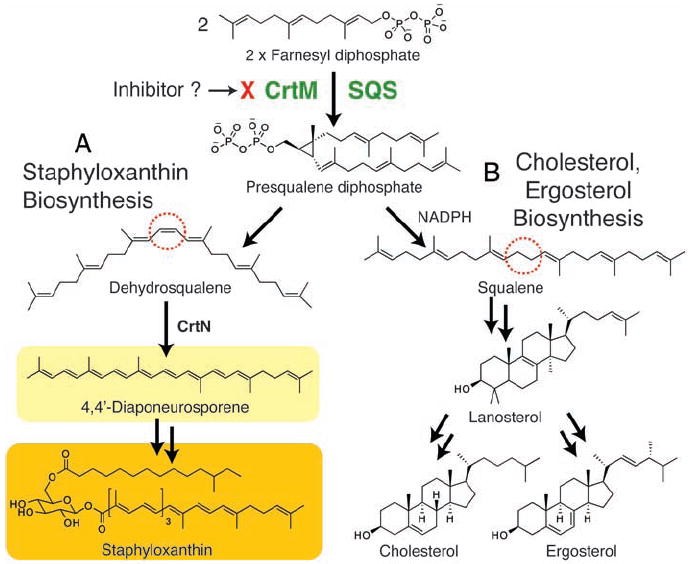
Fig. 1
Fig. 1
Biosynthetic pathways. (A) Staphyloxanthin biosynthesis (in S. aureus). (B) Cholesterol (in humans) and ergosterol (in, e.g., yeasts and some parasitic protozoa) biosynthesis. Each biosynthetic pathway involves initial formation of presqualene diphosphate, catalyzed by CrtM (S. aureus) or by squalene synthase (SQS). In S. aureus, the NADPH reduction step is absent, resulting in production of dehydrosqualene, not squalene.
Fig. 2
Fig. 2
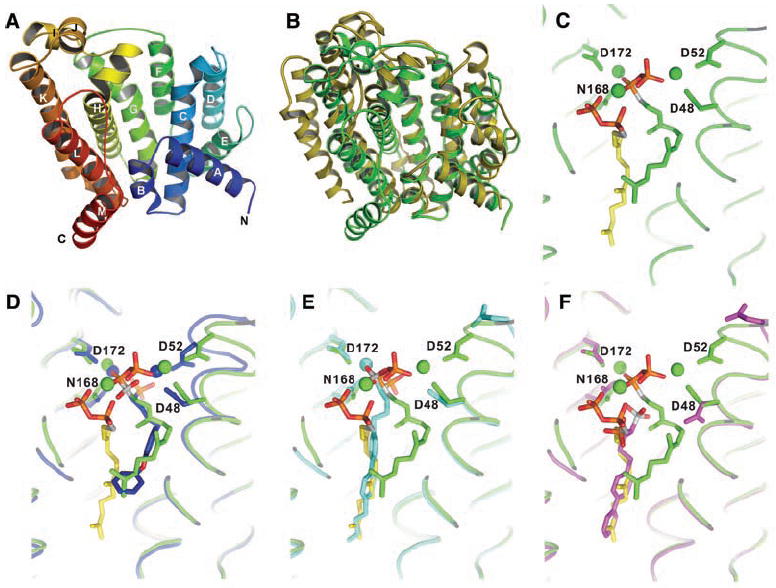
X-ray crystallographic structures. (A) X-ray structure of S. aureus CrtM. (B) Superposition of CrtM and human squalene synthase structures. There is a 5.5 Å Cα RMS deviation between the two structures. (C) Close-up view of FsPP bound to CrtM. (D) Close-up view of S. aureus CrtM with bound BPH-652. (E) S. aureus CrtM with bound BPH-698. (F) S. aureus CrtM with bound BPH-700. In (C) to (F), the FsPP ligands are in green or yellow; BPH-652, BPH-698, and BPH-700 (and associated Mg2+) are in blue, cyan, and magenta, respectively. Key contacts with Asp (D) and Asn (N) residues are indicated.
Fig. 3
Fig. 3
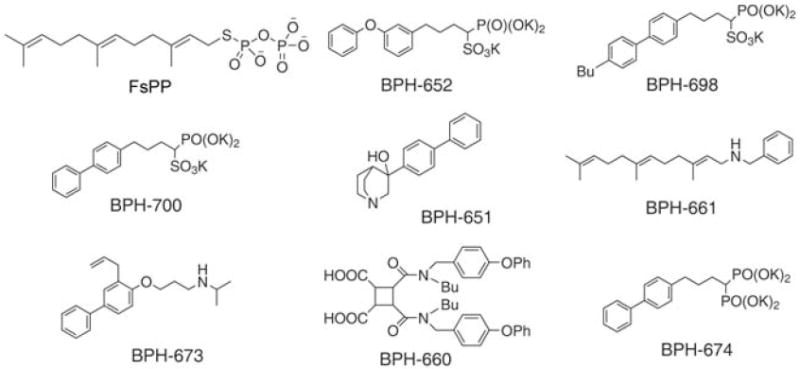
Chemical structures of farnesyl thiodiphosphate (FsPP) and eight squalene synthase inhibitors. There are many different types of SQS inhibitor, but only the phosphonosulfonates (and related bisphosphonates) inhibit CrtM. To date, only the phosphonosulfonates have been found to have activity in S. aureus.
Fig. 4
Fig. 4
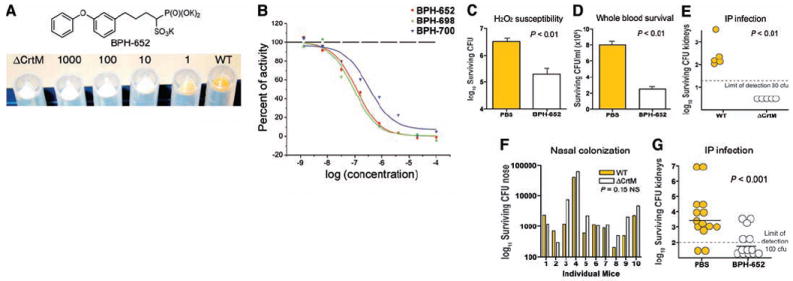
In vitro, in vivo, and CrtM inhibition results. (A) Inhibition of wild-type (WT) S. aureus pigmentation using 0 to 1000 μM BPH-652, with ΔCrtM control at left. The IC50 for pigment formation is ~110 nM. (B) Pigment inhibition by phosphonosulfonates and BPH-674 (no inhibition observed). Note that good CrtM inhibition does not guarantee activity in S. aureus. (C) Effect of BPH-652 on S. aureus susceptibility to H2O2 (1.5%, 1 hour). (D) Effect of BPH-652 on S. aureus susceptibility to killing in human whole blood. (E) CFU isolated from kidneys 3 days after intraperitoneal inoculation of mice with either WT or ΔCrtM S. aureus. (F) CFU isolated from noses 5 days after intranasal inoculation of mice with 1:1 mixture of WT and ΔCrtM S. aureus. (G) Effect of BPH-652 on S. aureus survival in the kidney after intraperitoneal infection. In vitro data shown are representative of at least three identical experiments. In vivo data in (G) are compiled from two sets of experiments, using different numbers of mice, performed under the same conditions (13).

References

    1. Bancroft EA. JAMA. 2007;298:1803. - PubMed
    1. Klevens RM, et al. JAMA. 2007;298:1763. - PubMed
    1. National Research Council. Treating Infectious Diseases in a Microbial World: Report of Two Workshops on Novel Antimicrobial Therapeutics. National Academies Press; Washington, DC: 2006. pp. 21–22. - PubMed
    1. Liu GY, et al. J Exp Med. 2005;202:209. - PMC - PubMed
    1. Clauditz A, Resch A, Wieland KP, Peschel A, Gotz F. Infect Immun. 2006;74:4950. - PMC - PubMed

Publication types

MeSH terms