Predicting synthetic rescues in metabolic networks
- PMID: 18277384
- PMCID: PMC2267730
- DOI: 10.1038/msb.2008.1
Predicting synthetic rescues in metabolic networks
Abstract
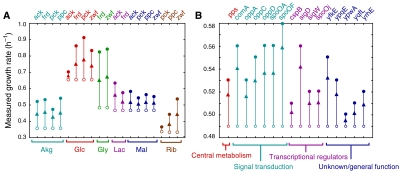
An important goal of medical research is to develop methods to recover the loss of cellular function due to mutations and other defects. Many approaches based on gene therapy aim to repair the defective gene or to insert genes with compensatory function. Here, we propose an alternative, network-based strategy that aims to restore biological function by forcing the cell to either bypass the functions affected by the defective gene, or to compensate for the lost function. Focusing on the metabolism of single-cell organisms, we computationally study mutants that lack an essential enzyme, and thus are unable to grow or have a significantly reduced growth rate. We show that several of these mutants can be turned into viable organisms through additional gene deletions that restore their growth rate. In a rather counterintuitive fashion, this is achieved via additional damage to the metabolic network. Using flux balance-based approaches, we identify a number of synthetically viable gene pairs, in which the removal of one enzyme-encoding gene results in a non-viable phenotype, while the deletion of a second enzyme-encoding gene rescues the organism. The systematic network-based identification of compensatory rescue effects may open new avenues for genetic interventions.
Figures
References
-
- Albert R (2005) Scale-free networks in cell biology. J Cell Sci 118: 4947–4957 - PubMed
-
- Barabási A-L (2007) Network medicine—from obesity to the ‘diseasome'. N Engl J Med 357: 404–407 - PubMed
-
- Barabási A-L, Oltvai ZN (2004) Network biology: understanding the cell's functional organization. Nat Rev Genet 5: 101–113 - PubMed
-
- BiGG (2007) Database of Biochemically, Genetically and Genomically (BiGG) Structured Genome-Scale Metabolic Network Reconstruction. Available online at: http://bigg.ucsd.edu/
Publication types
MeSH terms
Grants and funding
LinkOut - more resources
Full Text Sources
Other Literature Sources