


Clonal predominance of CD8(+) T cells in patients with unexplained neutropenia
- PMID: 18279717
- PMCID: PMC2643087
- DOI: 10.1016/j.exphem.2007.11.011
Clonal predominance of CD8(+) T cells in patients with unexplained neutropenia
Abstract
Objective: T-cell-mediated autoimmunity may be involved in some cases of idiopathic neutropenia. We hypothesized that a precise T-cell receptor repertoire analysis may uncover cytotoxic T-cell (CTL) expansions that are less pronounced than those seen in T large granular lymphocyte leukemia (T-LGL), but are pathophysiologically analogous and thus can serve as markers of a T-cell-mediated process.
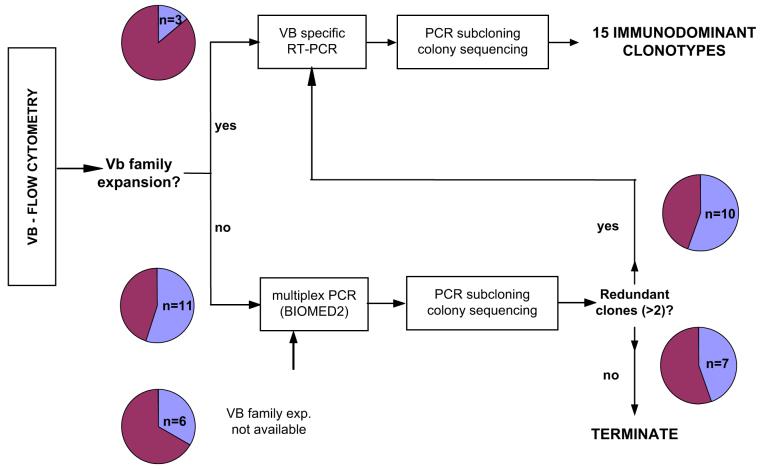
Materials and methods: Using rational algorithms for T-cell receptor analysis and in vivo tracking of CTL responses previously established in our laboratory, we studied patients with unexplained chronic neutropenia (n = 20), T-LGL (n = 15), and healthy controls (n = 12). We further investigated the involvement of soluble inhibitory factors by coculture assays. To determine the level of immune activation, we studied interferon-gamma expression in CD8(+)cells using Taqman polymerase chain reaction.
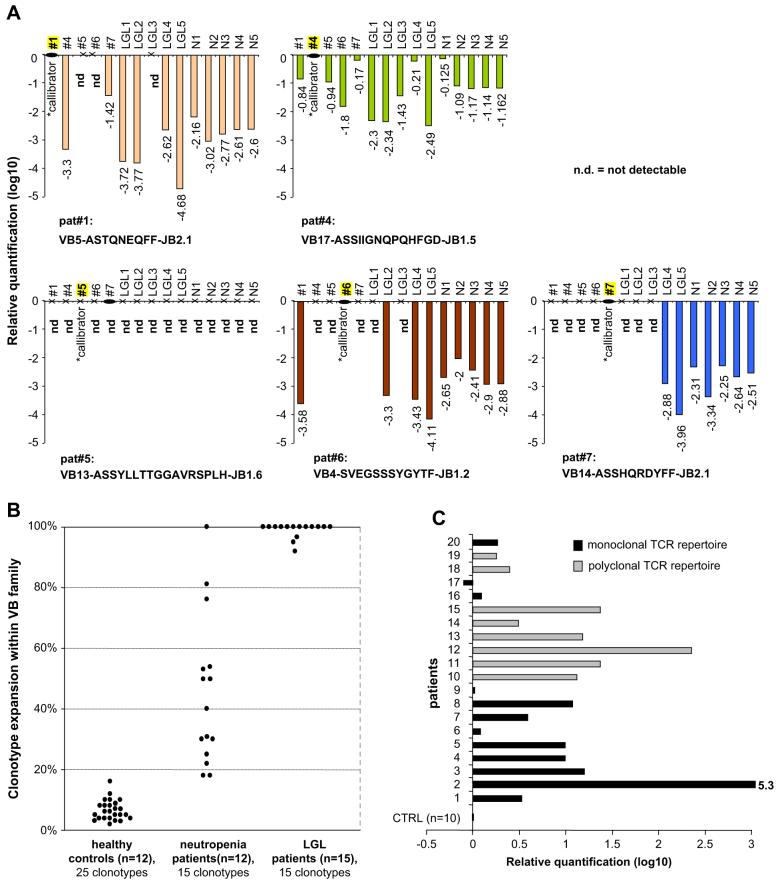
Results: Fifteen expanded (immunodominant) CTL clones were detected in 12 of 20 patients. In comparison to LGL leukemia, these clones were less immunodominant, but clearly discernible from subclinical lymphoproliferations in controls. As a surrogate of cytotoxic activity, we found markedly increased production of interferon-gamma in most of the neutropenia patients, irrespective of the presence of immunodominant CTL clones.
Conclusions: These results suggest that, while immunodominant CTL clones are detectable in a proportion of patients only, CTL-mediated pathophysiology may be a general mechanism operating in idiopathic neutropenia. Oligogoclonal CTL expansions in chronic neutropenia may indicate an ongoing autoimmune process, while highly polarized monoclonalities in a subset of neutropenic LGL patients may represent the "extreme" end of the clonal continuum.
Figures
References
-
- Starkebaum G. Chronic neutropenia associated with autoimmune disease. Semin Hematol. 2002;39:121–127. - PubMed
-
- Berliner N, Horwitz M, Loughran TP., Jr. Congenital and acquired neutropenia. Hematology. 2004 Jan;:63–79. - PubMed
-
- Papadaki HA, Palmblad J, Eliopoulos GD. Non-immune chronic idiopathic neutropenia of adult: an overview. Eur J Haematol. 2001;67:35–44. - PubMed
-
- Palmblad J, Papadaki HA, Eliopoulos G. Acute and chronic neutropenias. What is new? J Intern Med. 2001;250:476–491. - PubMed
-
- Palmblad JE, von dem Borne AE. Idiopathic, immune, infectious, and idiosyncratic neutropenias. Semin Hematol. 2002;39:113–120. - PubMed
Publication types
MeSH terms
Substances
Grants and funding
LinkOut - more resources
Full Text Sources
Other Literature Sources
Molecular Biology Databases
Research Materials
