


Misrepresentation of health risks by mass media
- PMID: 18281322
- PMCID: PMC7107549
- DOI: 10.1093/pubmed/fdn009
Misrepresentation of health risks by mass media
Abstract
Background: Mass media are a leading source of health information for general public. We wished to examine the relationship between the intensity of media coverage for selected health topics and their actual risk to public health.
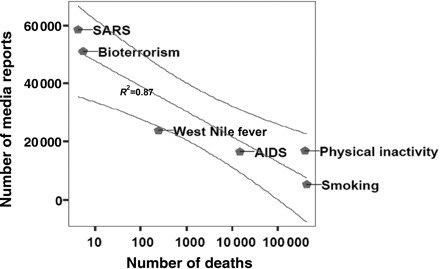
Methods: Mass media reports in the United States on emerging and chronic health hazards (severe acute respiratory syndrome (SARS), bioterrorism, West Nile Fever, AIDS, smoking and physical inactivity) were counted for the year 2003, using LexisNexis database. The number of media reports for each health risk was correlated with the corresponding death rate as reported by the Centers for Disease Control and Prevention.
Results: The number of media reports inversely correlated with the actual number of deaths for the health risks evaluated. SARS and bioterrorism killed less than a dozen people in 2003, but together generated over 100 000 media reports, far more than those covering smoking and physical inactivity, which killed nearly a million Americans.
Conclusions: Emerging health hazards are over-reported in mass media by comparison to common threats to public health. Since premature mortality in industrialized societies is most often due to well-known risks such as smoking and physical inactivity, their under-representation on public agendas may cause suboptimal prioritization of public health resources.
Figures
References
-
- Johnson T. Shattuck lecture: Medicine and the media. N Engl J Med. 1998;339(2):87–92. - PubMed
-
- Brezis M, Halpern-Reichert D. Mass media-induced availability bias in the clinical suspicion of west Nile fever. Ann Intern Med. 2004;140(3):234–5. - PubMed
-
- Kahneman D. Maps of bounded rationality: a perspective on intuitive judgment and choice. Nobel Prize Lecture, 2002 http://nobelprize.org/economics/laureates/2002/kahnemann-lecture.pdf. (25 August 2006, date last accessed) - PubMed
-
- Centers for Disease Control and Prevention. Deaths-Leading Causes. http://www.cdc.gov/nchs/fastats/lcod.htm. (16 August 2004, date last accessed).
-
- Mokdad AH, Marks JS, Stroup DF, Gerberding JL. Actual causes of death in the United States, 2000. JAMA. 2004;291(10):1238–45. - PubMed
MeSH terms
LinkOut - more resources
Full Text Sources
Miscellaneous
