. 2008 Apr;7(4):712-20.
doi: 10.1128/EC.00453-07. Epub 2008 Feb 15.

An internal polarity landmark is important for externally induced hyphal behaviors in Candida albicans

Affiliations

An internal polarity landmark is important for externally induced hyphal behaviors in Candida albicans

Alexandra Brand et al. Eukaryot Cell. 2008 Apr.

Abstract

Directional growth is a function of polarized cells such as neurites, pollen tubes, and fungal hyphae. Correct orientation of the extending cell tip depends on signaling pathways and effectors that mediate asymmetric responses to specific environmental cues. In the hyphal form of the eukaryotic fungal pathogen Candida albicans, these responses include thigmotropism and galvanotropism (hyphal turning in response to changes in substrate topography and imposed electrical fields, respectively) and penetration into semisolid substrates. During vegetative growth in C. albicans, as in the model yeast Saccharomyces cerevisiae, the Ras-like GTPase Rsr1 mediates internal cellular cues to position new buds in a prespecified pattern on the mother cell cortex. Here, we demonstrate that Rsr1 is also important for hyphal tip orientation in response to the external environmental cues that induce thigmotropic and galvanotropic growth. In addition, Rsr1 is involved in hyphal interactions with epithelial cells in vitro and its deletion diminishes the hyphal invasion of kidney tissue during systemic infection. Thus, Rsr1, an internal polarity landmark in yeast, is also involved in polarized growth responses to asymmetric environmental signals, a paradigm that is different from that described for the homologous protein in S. cerevisiae. Rsr1 may thereby contribute to the pathogenesis of C. albicans infections by influencing hyphal tip responses triggered by interaction with host tissues.


Figures
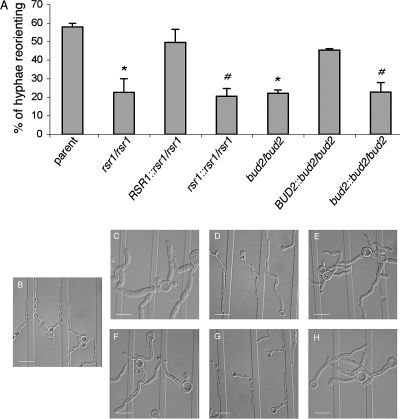
FIG. 1.
FIG. 1.
Thigmotropism responses of C. albicans strains. C. albicans strains JB6284 (wild type) (B), CA8880 (rsr1/rsr1) (C), MG9215 (RSR1::rsr1/rsr1) (D), MG9339 (rsr1::rsr1/rsr1) (E), DH7453 (bud2/bud2) (F), MG9017 (bud2/BUD2::bud2) (G), and MG9061 (bud2/bud2::bud2) (H) were incubated on ridged slides. (A) The number of hyphal contacts with ridges that resulted in a reorientation of growth direction is expressed as a percentage of total contacts (n, >100 for each strain and experiment). Error bars represent the standard deviations of the means obtained from three independent experiments. *, the P value was <0.001 based on a comparison with the parent strain; #, the P value was <0.005 based on a comparison with the RSR1-expressing reintegrant strain (for the rsr1 null strain) or the BUD2-expressing reintegrant strain (for the bud2 null strain), by analysis of variance and post hoc Dunnett's t test. (B to H) Photomicrographs of the interactions of C. albicans mutant hyphae, described above, with ridges in the substrate. Bars, 15 μm.
FIG. 2.
FIG. 2.
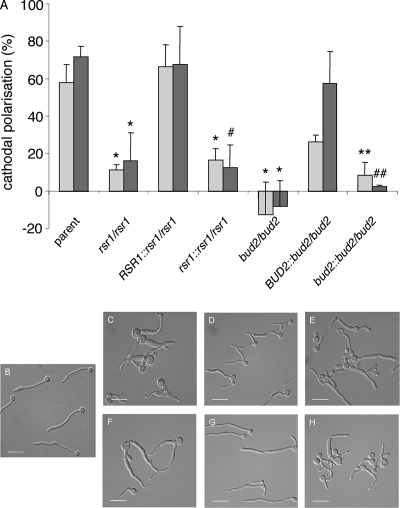
Galvanotropism responses of C. albicans strains. Control and mutant yeast cells (described in the legend for Fig. 1) were adhered to poly-l-lysine-coated glass slides. Hyphae were induced by incubation at 37°C for 6 h, and an electric field of 10 V/cm was applied for the duration of the experiment. (A) Germ tube emergence angles (light bars) and final hyphal angles (dark bars) relative to the cathode are shown where +100% cathodal polarization denotes perfect cathodal orientation, −100% denotes anodal orientation, and 0% is obtained for a randomly oriented population (n, >100 cells per strain). Error bars represent the standard deviations of the means obtained from three independent experiments. P values were <0.001 (*) and 0.016 (#) based on comparisons with the parent strain. P values were 0.002 (**) and 0.005 (##) based on comparisons with the BUD2-expressing reintegrant strain, by analysis of variance and post hoc Dunnett's t test. (B to H) Photomicrographs of the response of C. albicans mutant hyphae (described in the legend for Fig. 1) to an applied electric field. The cathodal stimulus is to the left of each image panel. Bars, 15 μm.
FIG. 3.
FIG. 3.
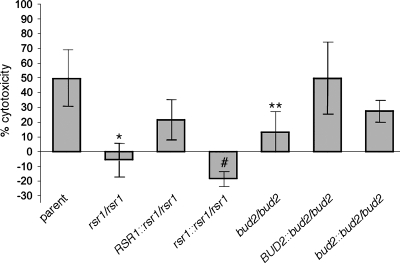
Oral epithelial cell damage caused by C. albicans strains as determined by the LDH release assay. C. albicans strains, described in the legend for Fig. 1, were grown to stationary phase in SDC medium. Equal numbers of cells were inoculated to TERT-2 epithelial cell monolayers and incubated for 8 h. The results are expressed as percent cytotoxicity as defined in Materials and Methods and are the means ± standard deviations (error bars) from at least four independent experiments, each performed in triplicate. *, the P value was 0.001 based on a comparison with the parent strain; #, the P value was 0.002 based on a comparison with the RSR1 reintegrant strain; **, the P value was 0.007 based on a comparison with the parent strain by analysis of variance and post hoc t test. Large standard deviations were due to day-to-day variation in the raw numbers obtained and not due to variations in the triplicate samples on any single day.
FIG. 4.
FIG. 4.
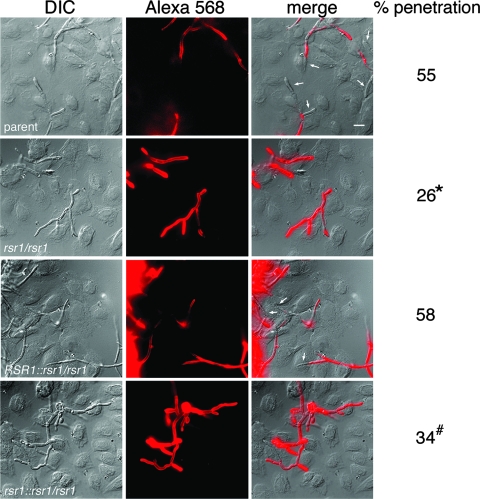
DIC and immunofluorescence (Alexa 568) analysis of C. albicans interaction with TERT-2 oral epithelial cells (strains are described in the legend for Fig. 1). DIC and Alexa 568 images were merged in MetaMorph to achieve the images in the panels on the right. Scale bar, 10 μm. Arrows, hyphal cells devoid of antibody staining indicating penetration into epithelial cells. At least 75 hyphal cells were analyzed per strain per experiment, with representative images shown. The number of penetrating hyphae is expressed as a percentage of the total number of hyphae analyzed (percent penetration; average from three experiments). *, The difference between the parent and rsr1 null strain was statistically significant, with a P value of 0.01. #, Although the difference between the rsr1 null reintegrant and the RSR1 reintegrant strain suggests a trend toward decreased penetration events for the null reintegrant, this difference did not reach statistical significance (P = 0.19).
FIG. 5.
FIG. 5.
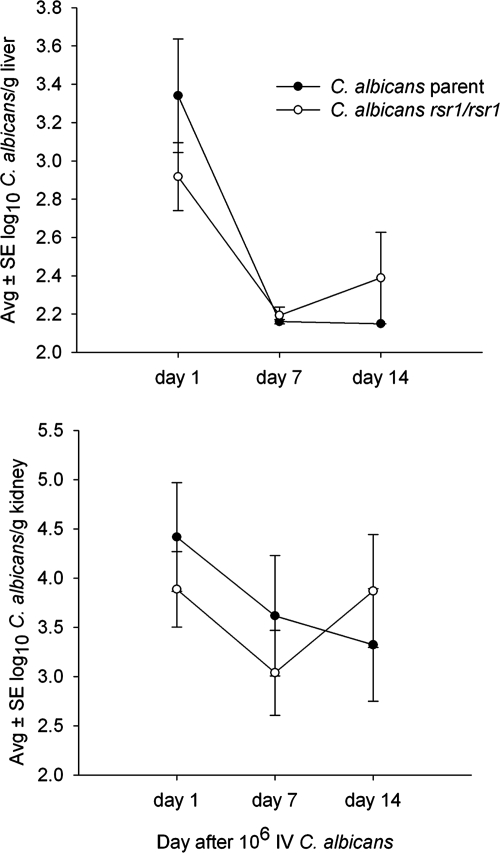
Liver (top panel) and kidney (bottom panel) fungal burdens after infection with RSR1-expressing and rsr1 null strains. Numbers of viable C. albicans recovered from the livers and kidneys of mice killed 1, 7, and 14 days after i.v. inoculation with 106 cells of C. albicans JB6284 (parent) and CA8880 (rsr1/rsr1). There were no significant differences between the concentrations of C. albicans JB6284 and CA8880 at any of the time points in both livers and kidneys. Error bars indicate standard errors. Avg., average; SE, standard error.
FIG. 6.
FIG. 6.
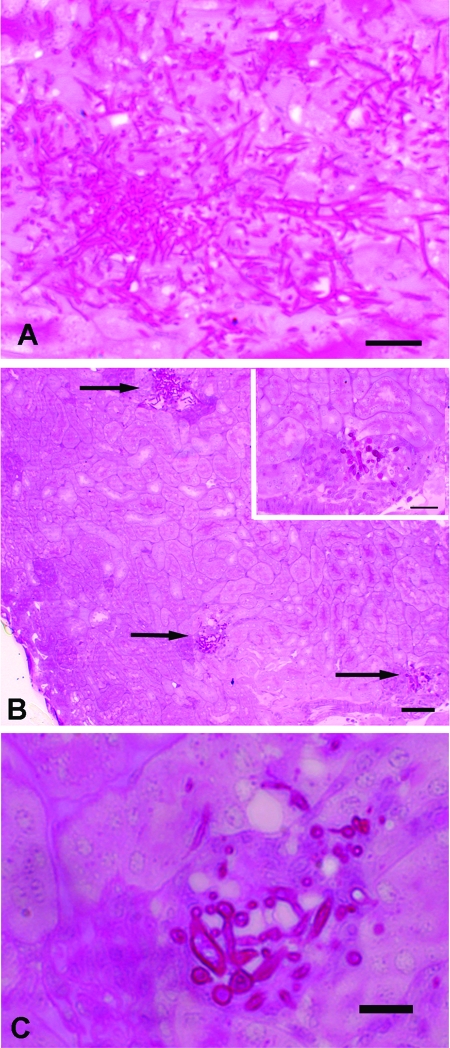
Periodic acid-Schiff stains of kidney tissue from mice sacrificed one day after i.v. inoculation of 106 CFU C. albicans JB6284 (parent) and CA8880 (rsr1/rsr1). Similar results were seen for the rsr1 mutant strain in kidneys from mice sacrificed at later times after inoculation (see the text for a description). (A) JB6284 yeast cells and elongated hyphae were localized in essentially all areas of kidney tissue. (B) CA8880 was often localized as focal accumulations (arrows) containing yeast cells and abnormal hyphae. The lower two arrows highlight foci of fungal elements that appeared preferentially localized in glomeruli. Inset, higher magnification view of the area indicated by the arrow on the lower right side of the panel. (C) The focal accumulation in the middle of panel B is shown at higher magnification. Scale bars, 50 μm (A), 100 μm (B), 25 μm (inset to B), and 25 μm (C).

References

    1. Allen, E. A., H. C. Hoch, J. R. Stavely, and J. R. Steadman. 1991. Uniformity among races of Uromyces appendiculatus in response to topographical signalling for appressorium formation. Phytopathology 81883-887.
    1. Bassilana, M., J. Blyth, and R. A. Arkowitz. 2003. Cdc24, the GDP-GTP exchange factor for Cdc42, is required for invasive hyphal growth of Candida albicans. Eukaryot. Cell 29-18. - PMC - PubMed
    1. Bassilana, M., J. Hopkins, and R. A. Arkowitz. 2005. Regulation of the Cdc42/Cdc24 GTPase module during Candida albicans hyphal growth. Eukaryot. Cell 4588-603. - PMC - PubMed
    1. Bauer, Y., P. Knechtle, J. Wendland, H. Helfer, and P. Philippsen. 2004. A Ras-like GTPase is involved in hyphal growth guidance in the filamentous fungus Ashbya gossypii. Mol. Biol. Cell 154622-4632. - PMC - PubMed
    1. Bendel, C. M., K. M. Kinneberg, R. P. Jechorek, C. A. Gale, S. L. Erlandsen, M. K. Hostetter, and C. L. Wells. 1999. Systemic infection following intravenous inoculation of mice with Candida albicans int1 mutant strains. Mol. Genet. Metab. 67343-351. - PubMed

Publication types

LinkOut - more resources