


Post-traumatic stress outcomes in non-Hodgkin's lymphoma survivors
- PMID: 18281667
- PMCID: PMC3025533
- DOI: 10.1200/JCO.2007.12.3414
Post-traumatic stress outcomes in non-Hodgkin's lymphoma survivors
Abstract
Purpose: A large body of evidence suggests that being diagnosed with and treated for cancer adversely affects functioning and quality of life, yet less is known about longer term outcomes. Therefore, this study aims to estimate the prevalence of post-traumatic stress disorder (PTSD) symptoms in survivors of adult non-Hodgkin's lymphoma (NHL) who are at least 2 years postdiagnosis and identify the risk factors associated with PTSD symptoms, with a focus on those that are amenable for screening and modifiable.
Patients and methods: A total of 886 NHL survivors identified from the cancer registries of two hospitals in North Carolina participated, ranging in age from 25 to 92 years old and ranging from 2 to 44 years postdiagnosis. Survivors were mailed a survey that assessed PTSD symptoms and quality of life.
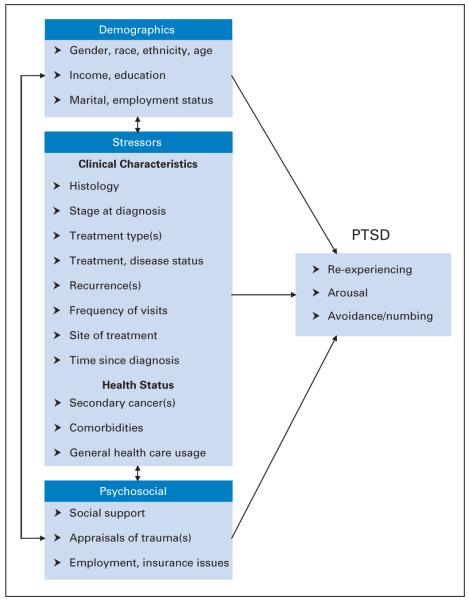
Results: Participants averaged 10.2 years postdiagnosis, and most (61%) reported no PTSD symptoms. The adjusted prevalence for full PTSD was 7.9%, with an additional 9.1% meeting criteria for partial PTSD. Modifiable risk factors that were independently associated with PTSD in multiple linear regression included less social support, negative appraisals of life threat and treatment intensity, and more employment and insurance issues. Additionally, several demographic characteristics (nonwhite race, less education, and younger age) and clinical or health-related factors (active disease, more recent diagnosis, and more comorbidity) were independently associated with PTSD.
Conclusion: Although only 8% of survivors met PTSD diagnostic criteria, the impact of a cancer diagnosis and treatment persists for many survivors, as evidenced in 39% of this sample. Early identification of those at risk could enable treatment to minimize PTSD symptomatology.
Figures
References
-
- American Cancer Society What are the key statistics about non-Hodgkin’s lymphoma? http://www.cancer.org/docroot/CRI/content/CRI_2_4_1X_What_are_the_key_st...
-
- Cordova MJ, Andrykowski MA, Kenady DE, et al. Frequency and correlates of posttraumatic stress disorder-like symptoms after treatment for breast cancer. J Consult Clin Psychol. 1995;63:981–986. - PubMed
-
- Kornblith AB, Herndon JE, Weiss RB, et al. Long-term adjustment of survivors of early-stage breast carcinoma, 20 years after adjuvant chemotherapy. Cancer. 2003;98:679–689. - PubMed
-
- Andrykowski MA, Cordova MJ. Factors associated with PTSD symptoms following treatment for breast cancer: Test of the Andersen model. J Trauma Stress. 1998;11:189–203. - PubMed
-
- Pittman RK, Lanes DM, Williston SK, et al. Psychophysiologic assessment of posttraumatic stress disorder in breast cancer patients. Psychosomatics. 2001;42:133–140. - PubMed
Publication types
MeSH terms
Grants and funding
LinkOut - more resources
Full Text Sources
Medical
Miscellaneous
