


Mining metadata from unidentified ITS sequences in GenBank: a case study in Inocybe (Basidiomycota)
- PMID: 18282272
- PMCID: PMC2275786
- DOI: 10.1186/1471-2148-8-50
Mining metadata from unidentified ITS sequences in GenBank: a case study in Inocybe (Basidiomycota)
Abstract
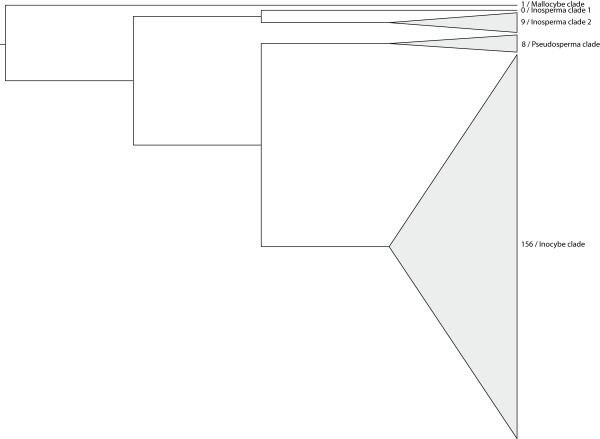
Background: The lack of reference sequences from well-identified mycorrhizal fungi often poses a challenge to the inference of taxonomic affiliation of sequences from environmental samples, and many environmental sequences are thus left unidentified. Such unidentified sequences belonging to the widely distributed ectomycorrhizal fungal genus Inocybe (Basidiomycota) were retrieved from GenBank and divided into species that were identified in a phylogenetic context using a reference dataset from an ongoing study of the genus. The sequence metadata of the unidentified Inocybe sequences stored in GenBank, as well as data from the corresponding original papers, were compiled and used to explore the ecology and distribution of the genus. In addition, the relative occurrence of Inocybe was contrasted to that of other mycorrhizal genera.
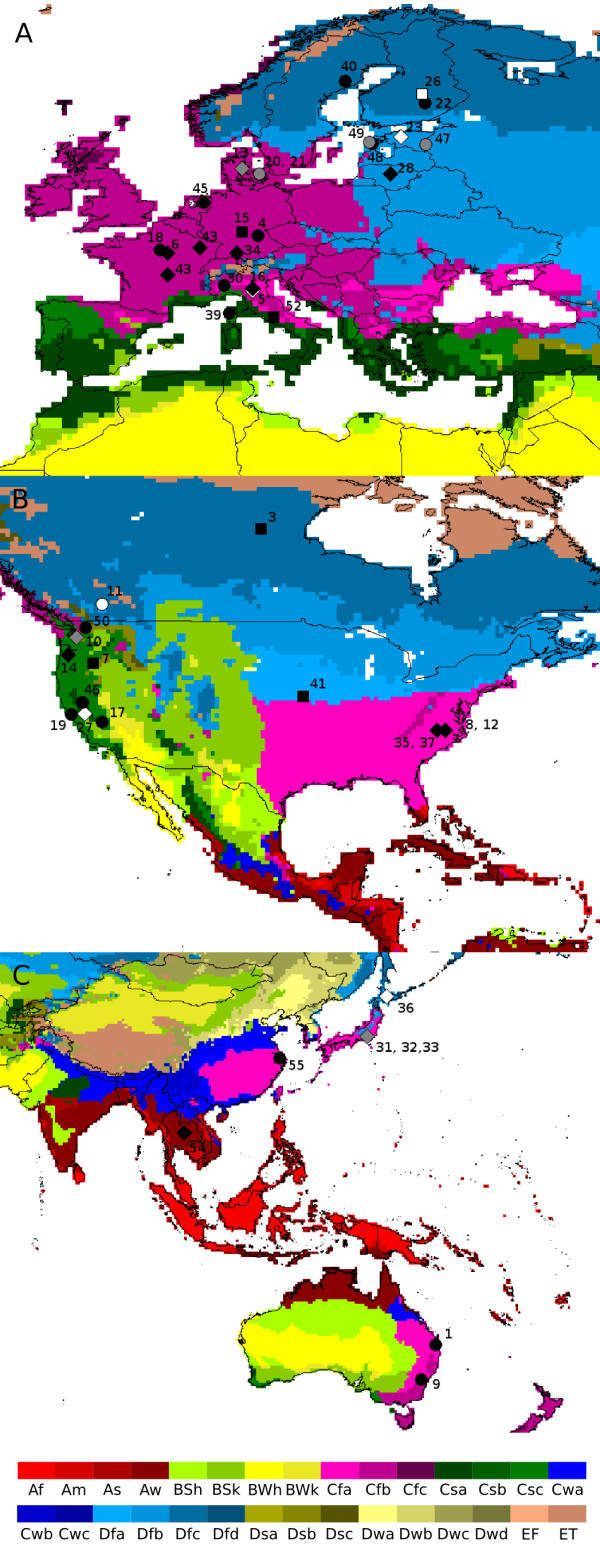
Results: Most species of Inocybe were found to have less than 3% intraspecific variability in the ITS2 region of the nuclear ribosomal DNA. This cut-off value was used jointly with phylogenetic analysis to delimit and identify unidentified Inocybe sequences to species level. A total of 177 unidentified Inocybe ITS sequences corresponding to 98 species were recovered, 32% of which were successfully identified to species level in this study. These sequences account for an unexpectedly large proportion of the publicly available unidentified fungal ITS sequences when compared with other mycorrhizal genera. Eight Inocybe species were reported from multiple hosts and some even from hosts forming arbutoid or orchid mycorrhizae. Furthermore, Inocybe sequences have been reported from four continents and in climate zones ranging from cold temperate to equatorial climate. Out of the 19 species found in more than one study, six were found in both Europe and North America and one was found in both Europe and Japan, indicating that at least many north temperate species have a wide distribution.
Conclusion: Although DNA-based species identification and circumscription are associated with practical and conceptual difficulties, they also offer new possibilities and avenues for research. Metadata assembly holds great potential to synthesize valuable information from community studies for use in a species and taxonomy-oriented framework.
Figures


References
-
- Bruns TD, Szaro TM, Gardes M, Cullings KW, Pan JJ, Taylor DL, Horton TR, Kretzer A, Garbelotto M, Li Y. A sequence database for the identification of ectomycorrhizal basidiomycetes by phylogenetic analysis. Mol Ecol. 1998;7:257–272. doi: 10.1046/j.1365-294X.1998.00337.x. - DOI
-
- Bruns TD, Shefferson RP. Evolutionary studies of ectomycorrhizal fungi: recent advances and future directions. Can J Bot. 2004;82:1122–1132. doi: 10.1139/b04-021. - DOI
-
- Hershkovitz MA, Lewis LA. Deep-level diagnostic value of the rDNA-ITS region. Mol Biol Evol. 1996;13:1276–1295. - PubMed
Publication types
MeSH terms
Substances
LinkOut - more resources
Full Text Sources
Molecular Biology Databases
