


Visual hemispatial neglect, re-assessed
- PMID: 18282322
- PMCID: PMC2573467
- DOI: 10.1017/S1355617708080284
Visual hemispatial neglect, re-assessed
Erratum in
- J Int Neuropsychol Soc. 2008 May;14(3):509-10
Abstract
Increased computer use in clinical settings offers an opportunity to develop new neuropsychological tests that exploit the control computers have over stimulus dimensions and timing. However, before adopting new tools, empirical validation is necessary. In the current study, our aims were twofold: to describe a computerized adaptive procedure with broad potential for neuropsychological investigations, and to demonstrate its implementation in testing for visual hemispatial neglect. Visual search results from adaptive psychophysical procedures are reported from 12 healthy individuals and 23 individuals with unilateral brain injury. Healthy individuals reveal spatially symmetric performance on adaptive search measures. In patients, psychophysical outcomes (as well as those from standard paper-and-pencil search tasks) reveal visual hemispatial neglect. Consistent with previous empirical studies of hemispatial neglect, lateralized impairments in adaptive conjunction search are greater than in adaptive feature search tasks. Furthermore, those with right hemisphere damage show greater lateralized deficits in conjunction search than do those with left hemisphere damage. We argue that adaptive tests, which automatically adjust to each individual's performance level, are efficient methods for both clinical evaluations and neuropsychological investigations and have the potential to detect subtle deficits even in chronic stages, when flagrant clinical signs have frequently resolved.
Figures
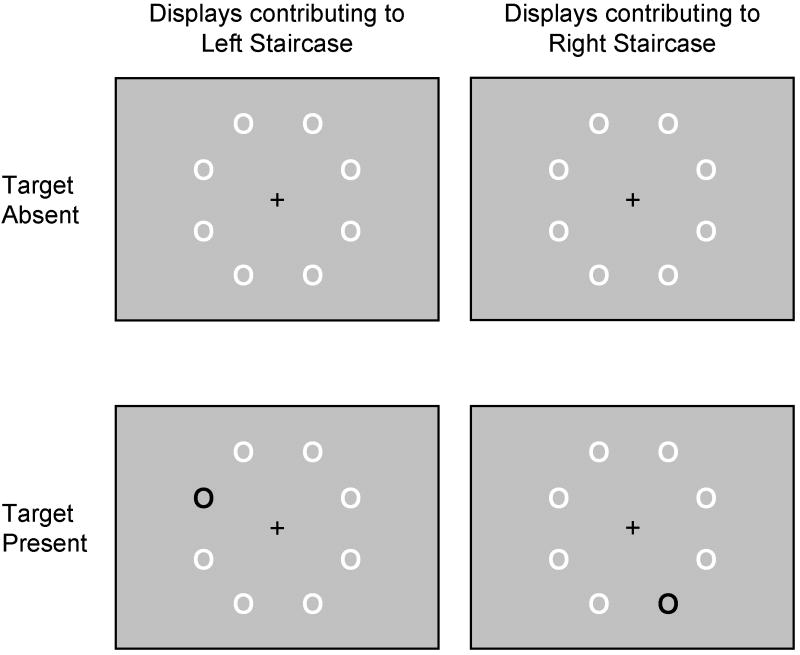


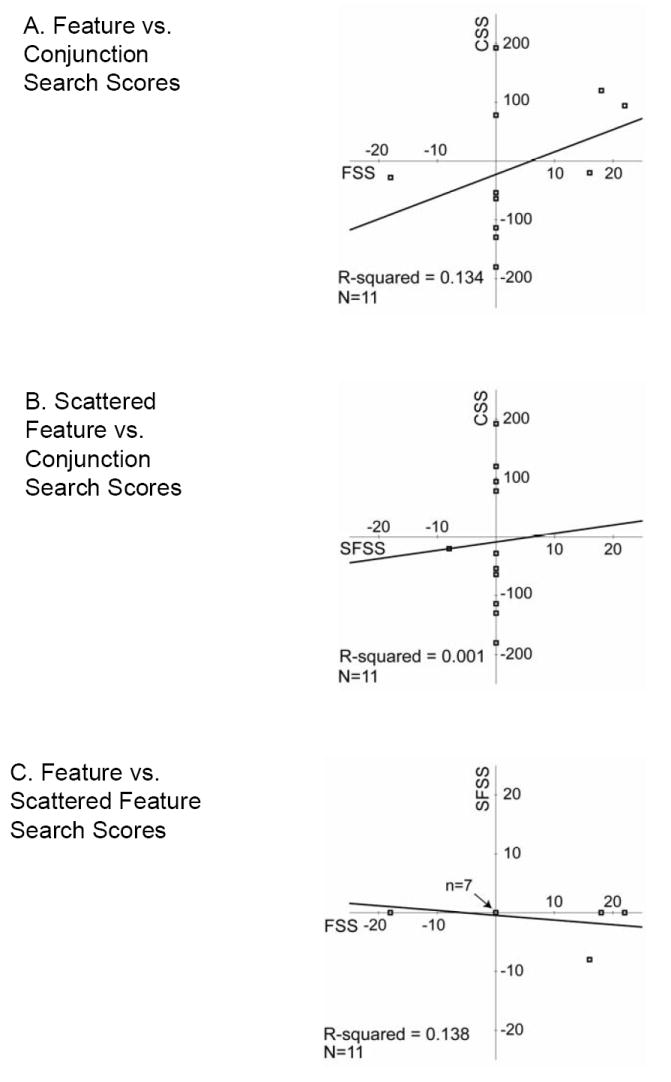

 s) in (C) the symbol search task. As is shown, lines were “cancelled,” i.e., marked with a pen stroke, whereas target letters and symbols were circled. Three different patients’ performance is shown, and marked with the side of their lesion (RHD=right hemisphere damage, LHD=left hemisphere damage). Asymptomatic performance is illustrated in (A) the line cancellation task, i.e., no lines were missed. Right-sided neglect (i.e., more right- than left-sided misses) is illustrated in (B) the letter search task. Note that the patient omitted one target on the right side, and three on the left side. This patient’s score for the letter search task would be 2 (3 contralesional misses minus 1 ipsilesional miss). Left-sided neglect (i.e., more than left- than right-sided misses) is illustrated in (C) the symbol search task. Note that the patient omitted six targets on the left side and two on the right side. This patient’s score for the symbol search would be 4 (6 contralesional misses minus 2 ipsilesional misses).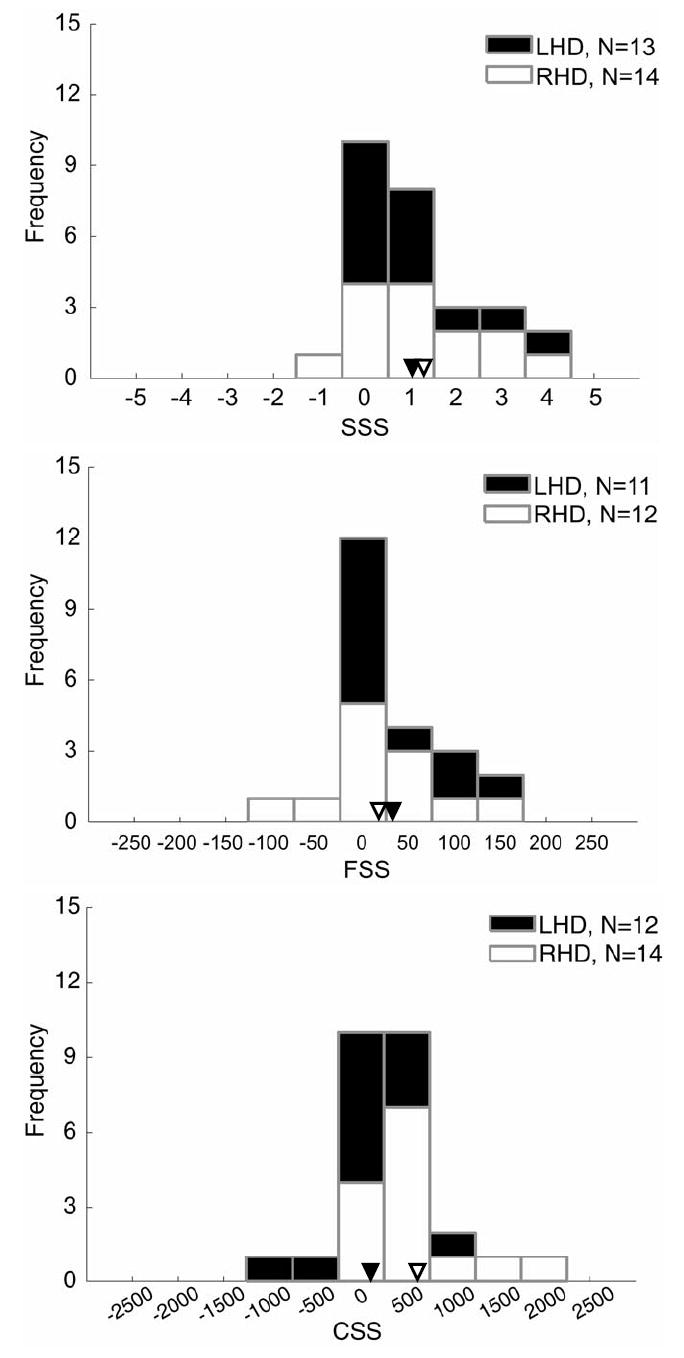

References
-
- Albert ML. A simple test of visual neglect. Neurology. 1973;23:658–64. - PubMed
-
- Barrett AN, Buxbaum LJ, Costlett HB, Edwards E, Heilman KM, Hillis AE, Milberg WP, Robertson IH. Cognitive rehabilitation interventions for neglect and related disorders: Moving from bench to bedside in stroke patients. Journal of Cognitive Neuroscience. 2006;18:1223–1236. - PubMed
-
- Behrmann M, Ebert P, Black SE. Hemispatial neglect and visual search: a large scale analysis. Cortex. 2004;40:247–63. - PubMed
-
- Brooks JL, Wong YY, Robertson LC. Crossing the midline: Reducing attentional deficits via interhemispheric interactions. Neuropsychologia. 2005;43:572–582. - PubMed
-
- Butter CM, Rapcsak S, Watson RT, Heilman KM. Changes in sensory inattention, directional motor neglect and “release” of the fixation reflex following a unilateral frontal lesion: a case report. Neuropsychologia. 1988;26:533–545. - PubMed
Publication types
MeSH terms
Grants and funding
LinkOut - more resources
Full Text Sources
