


Evolution of pleiotropic alleles for maturation and size as a consequence of predation
- PMID: 18285277
- PMCID: PMC2429942
- DOI: 10.1098/rsbl.2007.0638
Evolution of pleiotropic alleles for maturation and size as a consequence of predation
Abstract
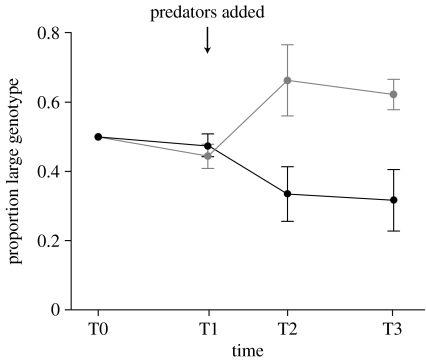
Understanding life-history evolution requires knowledge about genetic interactions, physiological mechanisms and the nature of selection. For platyfish, Xiphophorus maculatus, extensive information is available about genetic and physiological mechanisms influencing life-history traits. In particular, alleles at the pituitary locus have large and antagonistic effects on age and size at sexual maturation. To examine how predation affects the evolution of these antagonistic traits, I examined pituitary allele evolution in experimental populations differing in predation risk. A smaller size, earlier maturation allele increased in frequency when predators were absent, while a larger size, later maturation allele increased in frequency when predators were present. Thus, predation favours alleles for larger size, at the cost of later maturation and reproduction. These findings are interesting for several reasons. First, predation is often predicted to favour early reproduction at smaller sizes. Second, few studies have shown how selection acts on alleles that affect age and size at sexual maturation. Finally, many studies assume that trade-offs between these life-history traits result from antagonistic pleiotropy, with alleles that positively affect one trait negatively affecting another, yet this is rarely known. This study unequivocally demonstrates that genetically based trade-offs affect life-history evolution in platyfish.
Figures
References
-
- Bao I.Y, Kallman K.D. Genetic control of the hypothalamic–pituitary axis and the effect of hybridization on sexual maturation. J. Exp. Zool. 1982;220:297–309. doi:10.1002/jez.1402200305 - DOI
-
- Basolo A.L. The dynamics of Fisherian sex ratio evolution: theoretical and experimental investigations. Am. Nat. 1994;144:471–487. doi:10.1086/285687 - DOI
-
- Basolo A.L. Shift of investment in sexually selected traits: tarnishing of the silver spoon. Anim. Behav. 1998;55:665–671. doi:10.1006/anbe.1997.0634 - DOI - PubMed
-
- Basolo A.L, Wagner W.E. Covariation between predation risk, body size and fin elaboration in the green swordtail. Biol. J. Linn. Soc. 2004;83:87–100. doi:10.1111/j.1095-8312.2004.00369.x - DOI
-
- Charlesworth B. Cambridge University Press; Cambridge, UK: 1994. Evolution in age-structured populations.
Publication types
MeSH terms
LinkOut - more resources
Full Text Sources
