Factors related to declining luteal function in women during the menopausal transition
- PMID: 18285413
- PMCID: PMC2386686
- DOI: 10.1210/jc.2007-2165
Factors related to declining luteal function in women during the menopausal transition
Abstract
Context: Reproductive hormones are incompletely characterized during the menopause transition (MT).
Hypothesis: Increased anovulation and decreased progesterone accompany progress through the MT.
Design: The Daily Hormone Study (DHS) of the Study of Women's Health Across the Nation (SWAN) included 848 women aged 43-53 yr at baseline who collected daily urine for one cycle or up to 50 d annually for 3 yr.
Main outcome measures: LH, FSH, estrone conjugates, and pregnanediol glucuronide levels were assessed. Cycles were classified by presumed luteal (ovulatory) status and bleeding. Hormones were related to time in study, age, menopausal status, and selected variables.
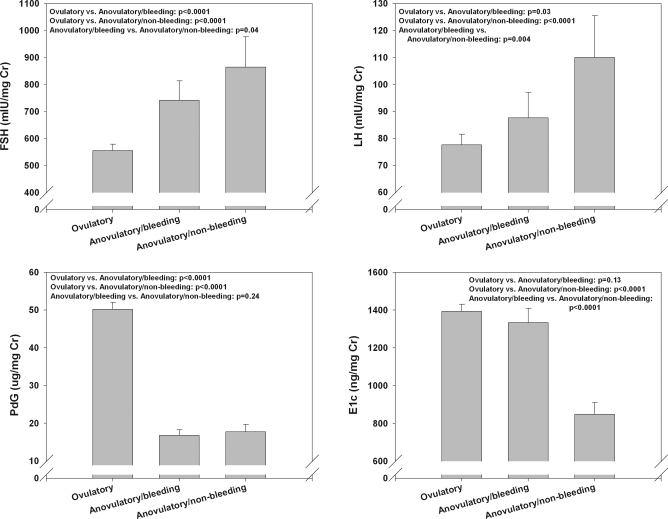
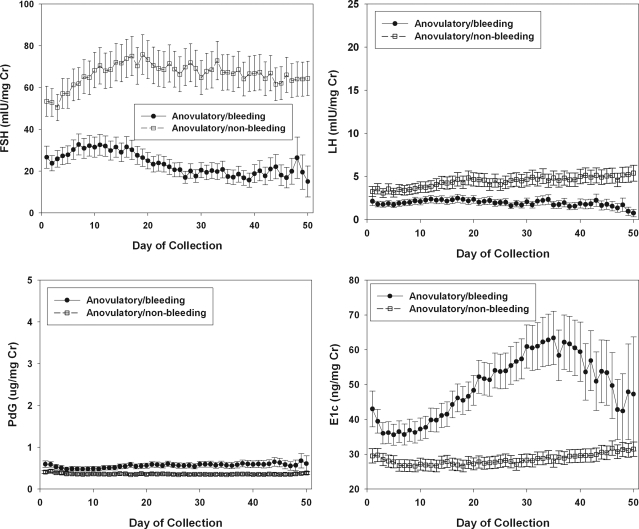
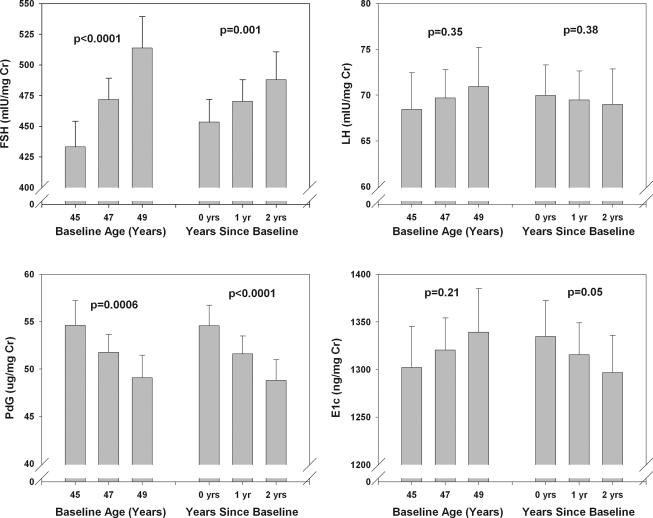
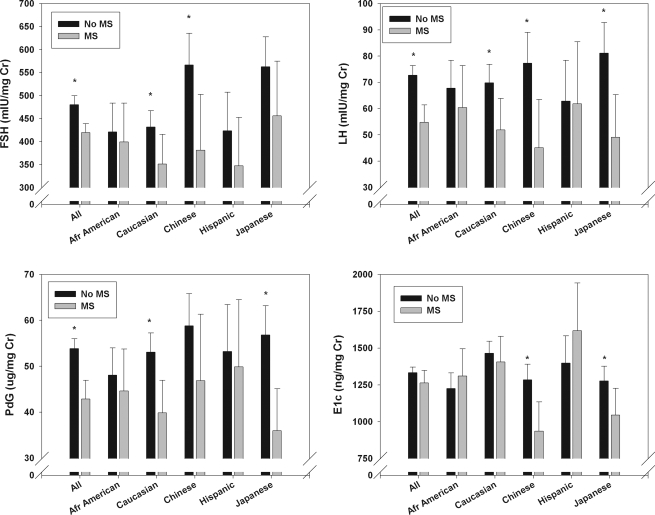
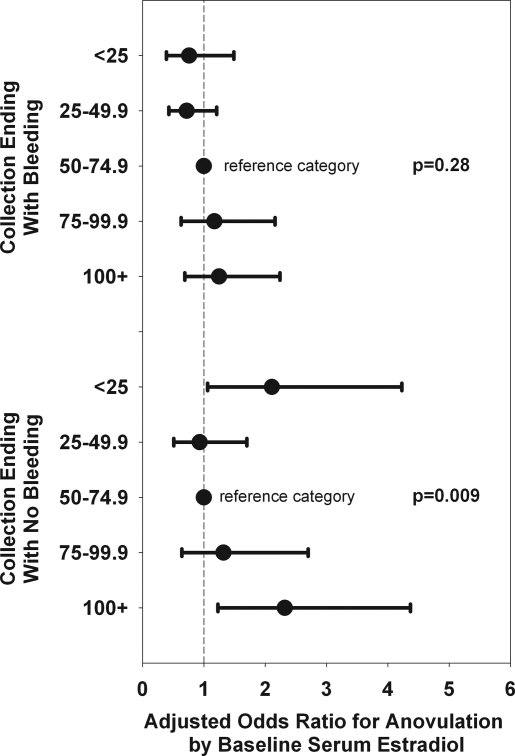
Results: Ovulatory-appearing cycles declined from 80.9% at baseline to 64.7% by the third assessment (H3). Cycles presumed anovulatory and not ending with bleeding by 50 d (anovulatory/nonbleeding) increased from 8.4 to 24% by H3 and were associated with progress to early perimenopause [odds ratio (OR) = 2.66; confidence interval (CI) = 1.17-6.04] or late perimenopause (OR = 56.21; CI = 18.79-168.12; P < 0.0001), African-American ethnicity (OR = 1.91; CI = 1.06-3.43), and less than high school education (OR = 3.51; CI = 1.62-7.62). Anovulatory cycles ending with bleeding remained at about 10% from baseline to H3; compared with ovulatory cycles, they were associated with obesity (OR = 4.68; CI = 1.33-16.52) and more than high school education (OR = 2.12; CI = 1.22-3.69; P = 0.02). Serum estradiol in both the highest and lowest categories was associated with anovulatory/nonbleeding collections. Pregnanediol glucuronide decreased 6.6% for each year on study. Insulin sensitivity measures did not relate strongly to menstrual cycle hormones.
Conclusions: Anovulation without bleeding represents progression of the MT. A small but detectable decrease in luteal progesterone excretion occurs as women progress through the MT.
Figures
References
-
- Burger HG, Dudley EC, Hopper JL, Groome N, Guthrie JR, Green A, Dennerstein L 1999 Prospectively measured levels of serum follicle-stimulating hormone, estradiol, and the dimeric inhibins during the menopausal transition in a population-based cohort of women. J Clin Endocrinol Metab 84:4025–4030 - PubMed
-
- Freeman EW, Sammel MD, Gracia CR, Kapoor S, Lin H, Liu L, Nelson DB 2005 Follicular phase hormone levels and menstrual bleeding status in the approach to menopause. Fertil Steril 83:383–392 - PubMed
-
- Ferrell RJ, O’Connor KA, Rodriguez G, Gorrindo T, Holman DJ, Brindle E, Miller RC, Schechter DE, Korshalla L, Simon JA, Mansfield PK, Wood JW, Weinstein M 2005 Monitoring reproductive aging in a 5-year prospective study: aggregate and individual changes in steroid hormones and menstrual cycle lengths with age. Menopause 12:567–577 - PubMed
-
- Metcalf MG, Livesey JH 1985 Gonadotrophin excretion in fertile women: effect of age and the onset of the menopausal transition. J Endocrinol 105:357–362 - PubMed
Publication types
MeSH terms
Substances
Grants and funding
- AG 012546/AG/NIA NIH HHS/United States
- U01 AG012554/AG/NIA NIH HHS/United States
- AG 012553/AG/NIA NIH HHS/United States
- AG 012495/AG/NIA NIH HHS/United States
- AG 012554/AG/NIA NIH HHS/United States
- AG 012505/AG/NIA NIH HHS/United States
- U01 AG012495/AG/NIA NIH HHS/United States
- U01 AG012505/AG/NIA NIH HHS/United States
- AG 012539/AG/NIA NIH HHS/United States
- AG 012531/AG/NIA NIH HHS/United States
- AG 012535/AG/NIA NIH HHS/United States
- U01 AG012535/AG/NIA NIH HHS/United States
- U01 AG012553/AG/NIA NIH HHS/United States
- U01 NR004061/NR/NINR NIH HHS/United States
- U01 AG012539/AG/NIA NIH HHS/United States
- U01 AG012546/AG/NIA NIH HHS/United States
- U01 AG012531/AG/NIA NIH HHS/United States
- NR 004061/NR/NINR NIH HHS/United States
LinkOut - more resources
Full Text Sources
Medical