. 2008 Jun;7(6):1099-110.
doi: 10.1074/mcp.M700303-MCP200. Epub 2008 Feb 19.

Chemical rescue of deltaF508-CFTR mimics genetic repair in cystic fibrosis bronchial epithelial cells

Affiliations

Chemical rescue of deltaF508-CFTR mimics genetic repair in cystic fibrosis bronchial epithelial cells

Om V Singh et al. Mol Cell Proteomics. 2008 Jun.

Abstract

In a previous study of sodium 4-phenylbutyrate (4-PBA)-responsive proteins in cystic fibrosis (CF) IB3-1 bronchial epithelial cells, we identified 85 differentially expressed high abundance proteins from whole cellular lysate (Singh, O. V., Vij, N., Mogayzel, P. J., Jr., Jozwik, C., Pollard, H. B., and Zeitlin, P. L. (2006) Pharmacoproteomics of 4-phenylbutyrate-treated IB3-1 cystic fibrosis bronchial epithelial cells. J. Proteome Res. 5, 562-571). In the present work we hypothesize that a subset of heat shock proteins that interact with cystic fibrosis transmembrane conductance regulator (CFTR) in common during chemical rescue and genetic repair will identify therapeutic networks for targeted intervention. Immunocomplexes were generated from total cellular lysates, and three subcellular fractions (endoplasmic reticulum (ER), cytosol, and plasma membrane) with anti-CFTR polyclonal antibody from CF (IB3-1), chemically rescued CF (4-PBA-treated IB3-1), and genetically repaired CF (IB3-1/S9 daughter cells repaired by gene transfer with adeno-associated virus-(wild type) CFTR). CFTR-interacting proteins were analyzed on two-dimensional gels and identified by mass spectrometry. A set of 16 proteins known to act in ER-associated degradation were regulated in common and functionally connected to the protein processing, protein folding, and inflammatory response. Some of these proteins were modulated exclusively in ER, cytosol, or plasma membrane. A subset of 4-PBA-modulated ER-associated degradation chaperones (GRP94, HSP84, GRP78, GRP75, and GRP58) was observed to associate with the immature B form of CFTR in ER. HSP70 and HSC70 interacted with the C band (mature form) of CFTR at the cell surface. We conclude that chemically rescued CFTR associates with a specific set of HSP70 family proteins that mark therapeutic interactions and can be useful to correct both ion transport and inflammatory phenotypes in CF subjects.


Figures
F<sc>ig</sc>. 1.
Fig. 1.
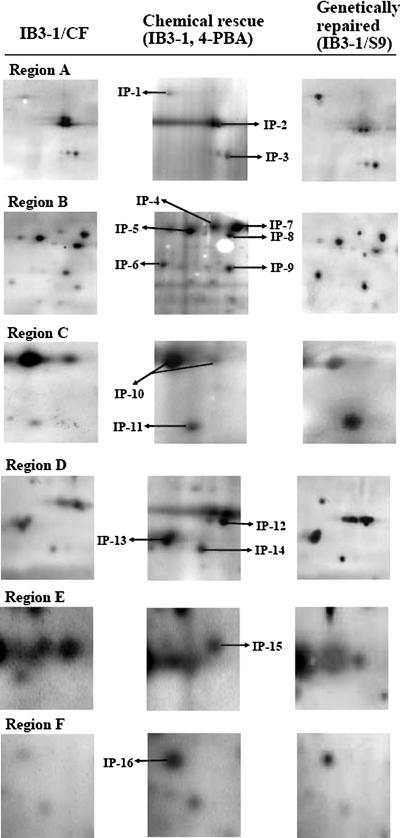
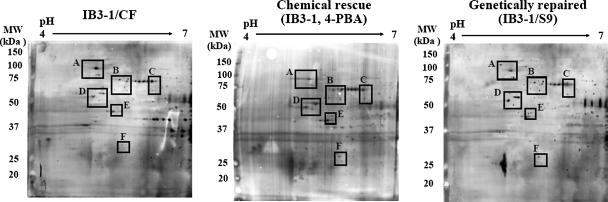
2-D gel silver images of CFTR immunocomplexes captured by CFTR-169 polyclonal antibody. Immunocomplexes were generated with anti-CFTR antibodies from CF (IB3-1), chemically rescued CF (IB3-1, 5 mm 4-PBA for 48 h), and genetically repaired CF cells (S9, IB3-1 corrected by wtCFTR) and resolved on 10% SDS-PAGE 2-DE gels as described under “Experimental Procedures.” Six regions were selected (A–F) based on differential expression in common between rescue and non-CF conditions.
F<sc>ig</sc>. 2.
Fig. 2.
Higher resolution map of six selected regions of Fig. 1. Left, center, and right panels of each region (A–F) contain proteins from CF (IB3-1), chemically rescued CF (5 mm 4-PBA-treated IB3-1 cells), and genetically repaired CF cells (IB3-1/S9 cells), respectively. Proteins labeled IP-1 through IP-16 were excised and identified as described under “Experimental Procedures.” The identified proteins are characterized in Table I.
F<sc>ig</sc>. 3.
Fig. 3.
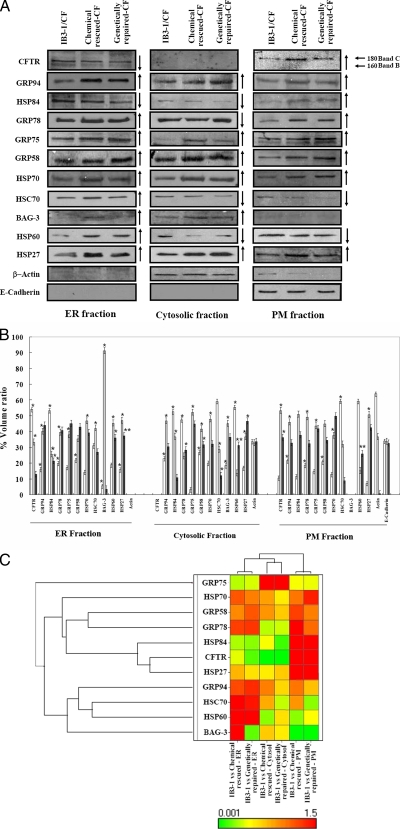
Protein components in subcellular fractions from CF, rescued CF, and genetically repaired CF cells. A, total proteins from CF (IB3-1/CF), chemically rescued CF (IB3-1 treated with 4-PBA), and genetically repaired CF (IB3-1/S9 cells) were subfractionated into ER, cytosol, and PM and analyzed by immunoblot as described under “Experimental Procedures.” Representative blots are shown. B, densitometric analysis. The hollow bar represents CF, the light bar represents chemically rescued CF, and the solid bar represents the corresponding genetically repaired CF cellular lysates. Each data point is the mean ± S.E. of the density of gel bands relative to the average band density of control (IB3-1/CF) cells. The one-way ANOVA followed by least significant differences was calculated; a p value <0.05 was considered significant (*). C, hierarchical clustering of a chemical-modulated and genetically mimicked set of HSP70 system proteins in subcellular protein fractions.
F<sc>ig</sc>. 4.
Fig. 4.
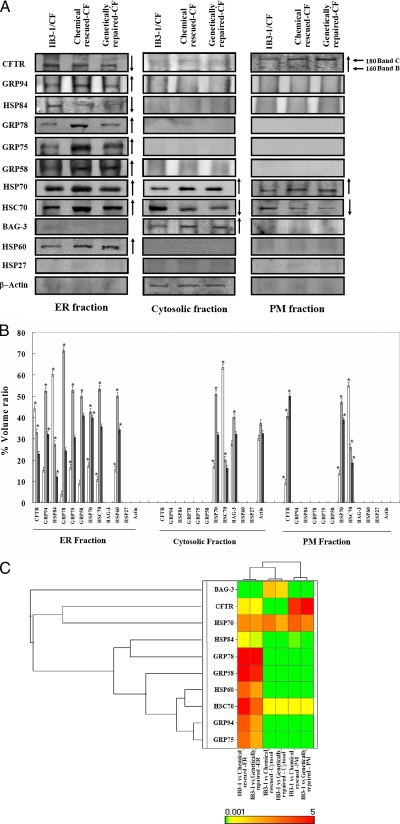
Differential expression of multiple molecular chaperones interacting with ΔF and rescued and genetically repaired wtCFTR from subcellular fractions. A, total protein from three different cellular compartments, viz. ER, cytosol, and PM, was immunoprecipitated using CFTR-169 polyclonal antibody from CF (IB3-1), chemically rescued CF (4-PBA-treated IB3-1), and genetically rescued CF (wtCFTR, S9 cells). Immunoblotting was performed as described under “Experimental Procedures.” B, densitometric analysis was performed. The hollow bar represents CF, the light bar represents rescued CF, and the solid bar represents the corresponding non-CF. Each data point is the mean ± S.E. of the density of gel bands relative to the average band density of control (IB3-1/CF) cells. The one-way ANOVA followed by least significant differences was calculated; a p value <0.05 was considered significant (*). C, hierarchical clustering and dendrograms demonstrate functional drug relationships based on the indicated drug targets during ΔF508-CFTR trafficking.
F<sc>ig</sc>. 5.
Fig. 5.
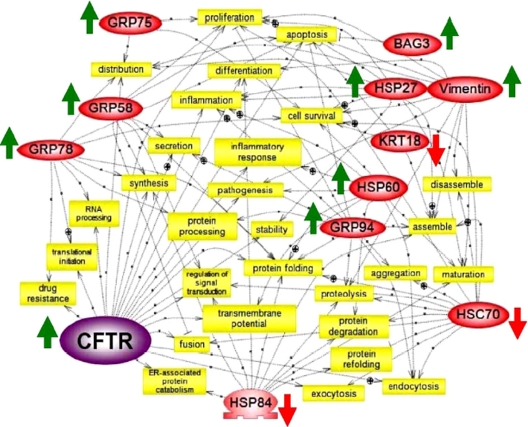
Functional connectivity of chemically rescued CFTR-interacting proteins. Proteins highlighted in red were differentially expressed in chemically rescued IB3-1 cells and correlated with genetically repaired S9 cells. Pathways were created using the software Pathway Studio version 4.0. The biological function pathway shows common cellular targets (4-PBA-modulated proteins (red ovals) during cellular processing (yellow rectangles). ⊕, positive regulation; ▭, negative regulation; ○, regulation of protein expression.
F<sc>ig</sc>. 6.
Fig. 6.
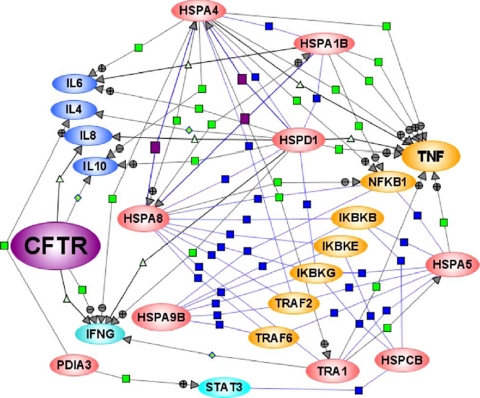
CFTR-interacting HSP70 chaperones regulate cytokine expression. Literature-based HSP70 system protein-regulated expression of cytokine connectivity map was created using Pathway Architect software by customizing software tools for regulatory pathway specific for cytokine regulation. Blue squares, protein-protein interactions; purple squares, protein expression; green squares, regulation with positive/negative signs; green triangles, transport mechanism of cytokines; red ovals, specific set of HSP70 system proteins modulated by 4-PBA; blue ovals, multiple cytokines; and yellow ovals, receptor-associated factors regulated by 4-PBA-modulated proteins. The entire map is documented by 88 literature citations. TRAF, TNF receptor-associated factor; IKB, inhibitor of κ light polypeptide gene enhancer in B cells; NFKB, nuclear factor of κ light polypeptide gene enhancer in B cells; IFNG, interferon γ; STAT3, signal transducer and activator of transcription 3).

References

    1. Tsui, L. C. ( 1992) Mutations and sequence variations detected in the cystic fibrosis transmembrane conductance regulator (CFTR) gene: a report from the Cystic Fibrosis Genetic Analysis Consortium. Hum. Mutat. 1, 197–203 - PubMed
    1. Ward, C. L., Omura, S., and Kopito, R. R. ( 1995) Degradation of CFTR by the ubiquitin-proteasome pathway. Cell 83, 121–127 - PubMed
    1. Gabriel, S. E., Clarke, L. L., Boucher, R. C., and Stutts, M. J. ( 1993) CFTR and outward rectifying chloride channels are distinct proteins with a regulatory relationship. Nature 363, 263–268 - PubMed
    1. Stutts, M. J., Canessa, C. M., Olsen, J. C., Hamrick, M., Cohn, J. A., Rossier, B. C., and Boucher, R. C. ( 1995) CFTR as a cAMP-dependent regulator of sodium channels. Science 269, 847–850 - PubMed
    1. Amaral, M. D. ( 2004) CFTR and chaperones: processing and degradation. J. Mol. Neurosci. 23, 41–48 - PubMed

Publication types

MeSH terms

Substances