Comparative Study
. 2008 Feb 26;105(8):3163-8.
doi: 10.1073/pnas.0712190105. Epub 2008 Feb 19.

Allelic mutant series reveal distinct functions for Arabidopsis cycloartenol synthase 1 in cell viability and plastid biogenesis

Affiliations
Comparative Study

Allelic mutant series reveal distinct functions for Arabidopsis cycloartenol synthase 1 in cell viability and plastid biogenesis

Elena Babiychuk et al. Proc Natl Acad Sci U S A. .

Abstract

Sterols have multiple functions in all eukaryotes. In plants, sterol biosynthesis is initiated by the enzymatic conversion of 2,3-oxidosqualene to cycloartenol. This reaction is catalyzed by cycloartenol synthase 1 (CAS1), which belongs to a family of 13 2,3-oxidosqualene cyclases in Arabidopsis thaliana. To understand the full scope of sterol biological functions in plants, we characterized allelic series of cas1 mutations. Plants carrying the weak mutant allele cas1-1 were viable but developed albino inflorescence shoots because of photooxidation of plastids in stems that contained low amounts of carotenoids and chlorophylls. Consistent with the CAS1 catalyzed reaction, mutant tissues accumulated 2,3-oxidosqualene. This triterpenoid precursor did not increase at the expense of the pathway end products. Two strong mutations, cas1-2 and cas1-3, were not transmissible through the male gametes, suggesting a role for CAS1 in male gametophyte function. To validate these findings, we analyzed a conditional CRE/loxP recombination-dependent cas1-2 mutant allele. The albino phenotype of growing leaf tissues was a typical defect observed shortly after the CRE/loxP-induced onset of CAS1 loss of function. In the induced cas1-2 seedlings, terminal phenotypes included arrest of meristematic activity, followed by necrotic death. Mutant tissues accumulated 2,3-oxidosqualene and contained low amounts of sterols. The vital role of sterols in membrane functioning most probably explains the requirement of CAS1 for plant cell viability. The observed impact of cas1 mutations on a chloroplastic function implies a previously unrecognized role of sterols or triterpenoid metabolites in plastid biogenesis.


Conflict of interest statement

The authors declare no conflict of interest.

Figures
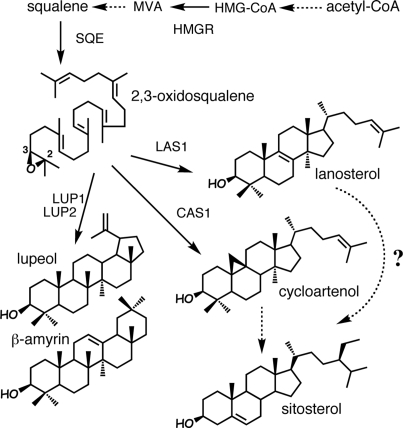
Fig. 1.
Fig. 1.
Sterol and nonsteroidal triterpene biosynthetic pathways in plants. HMG-CoA, 3-hydroxy-3-methylglutaryl-CoA; MVA, mevalonate; SQE, squalene epoxidase; LAS1, lanosterol synthase; LUP1 and LUP2, pentacyclic triterpene alcohol synthases.
Fig. 2.
Fig. 2.
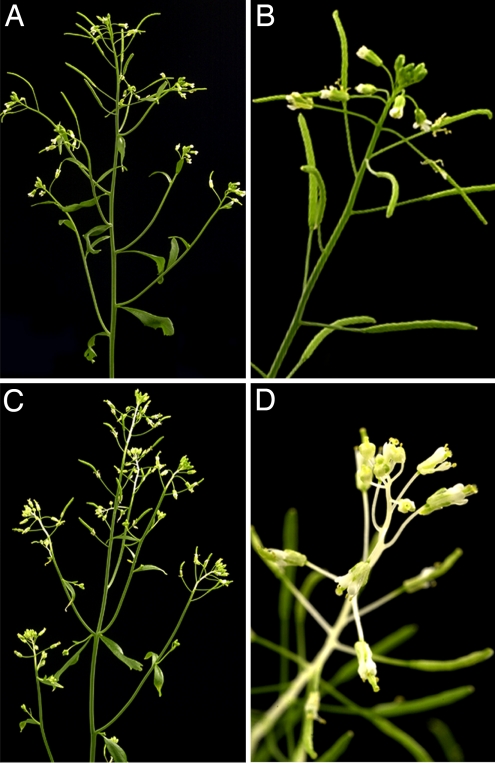
Morphological phenotype of the cas1–1 mutant. (A) Wild-type inflorescence shoot of Arabidopsis ecotype C24. (C) Inflorescence shoot of the cas1–1 mutant. (B and D) Close-ups of inflorescence shoots of wild-type and mutant plants shown in A and C, respectively.
Fig. 3.
Fig. 3.
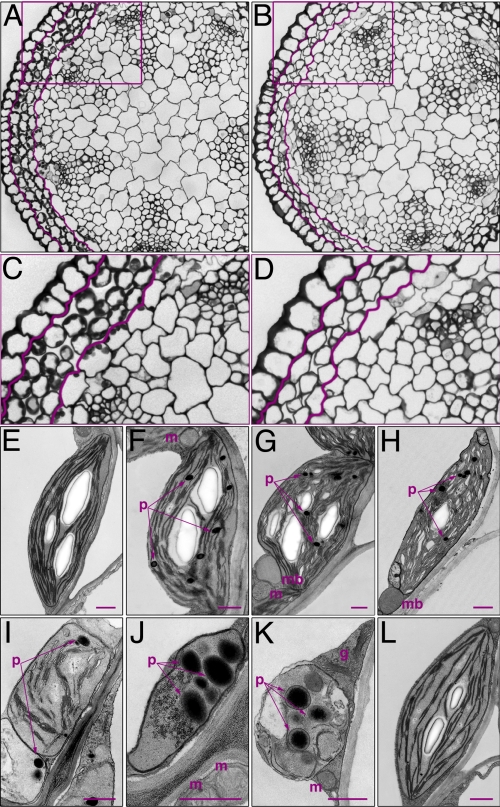
Cellular phenotype of the cas1–1 mutant. (A and B) Toluidine blue-stained transverse cross-section of wild-type (A) and albino cas1–1 (B) stems. (C and D) Enlarged parts of images in A and B. Highlighted are the chlorenchyma subepidermal cell layers with chloroplasts (C) and without well differentiated chloroplasts (D). (E) Plastid morphology in cells from the lower part of wild-type stems, ≈3–5 cm above the rosette. The corresponding stem region in the cas1–1 mutant is green as well. (F–K) Progressive acropetal bleaching of stems correlated with plastid morphology. Thin sections of cas1–1 stems collected at ≈2-cm intervals showed plastid types in the developmentally oldest cell positioned at the base of the stem, ≈3.5 cm above the rosette (F), and the youngest albino cell at the top of the shoot (K). Mutant plastids (I–K) lack thylakoid membrane system and starch granules and accumulate electron-dense vesicles that may correspond to plastoglobuli. (L) Chloroplast in wild-type chlorenchyma cell from distal parts of the stem. g, Golgi apparatus; m, mitochondria; mb, microbody; p, plastoglobuli. (Scale bars, 0.5 μm.)
Fig. 4.
Fig. 4.
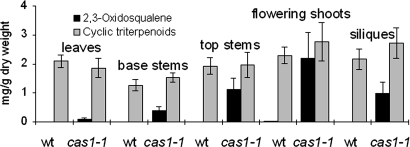
Triterpenoid content of wild-type and cas1–1 tissues. Samples prepared from tissues of at least 15 individual plants with ≈20 siliques were analyzed. The layout for material collection is detailed in SI Fig. 8. Cyclic triterpenoids are metabolites derived from 2,3-oxidosqualene (see SI Table 1 for details). The data are from three independent experiments.
Fig. 5.
Fig. 5.
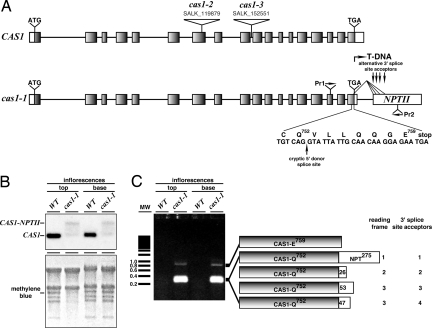
CAS1 mutant alleles. (A) Wild-type (CAS1) and mutated loci cas1–1, cas1–2, and cas1–3. Exon-labeled NPTII encodes a reading frame for neomycin phosphotransferase that lacks the translation initiation codon (ATG). Heterologous splicing events use the cryptic 5′ splice site donor within CAS1 exon 18, as indicated, and any one of the four alternative 3′ splice site acceptors from the T-DNA. The T-DNA insertion mutant alleles cas1–2 (SALK_119879) and cas1–3 (SALK_152551) were reconfirmed by DNA sequencing (SI Fig. 10). (B) RNA gel blot analysis. To verify equal loading and transfer efficiency of RNA, the membrane was stained with methylene blue (Lower). The hybridization signal with a radioactively labeled probe prepared with CAS1 cDNA is presented (Upper). Positions of the wild-type mRNA and chimeric CAS1-NPTII transcript expressed from the cas1–1 locus are indicated. (C) RT-PCR analysis. cDNAs were synthesized with reverse transcriptase and RNA from samples analyzed in B. These cDNAs served as templates in the PCRs with Pr1 and Pr2 shown in A. CAS1 isoforms encoded by alternatively spliced transcripts in the cas1–1 mutant are shown on the right (SI Table 2).
Fig. 6.
Fig. 6.
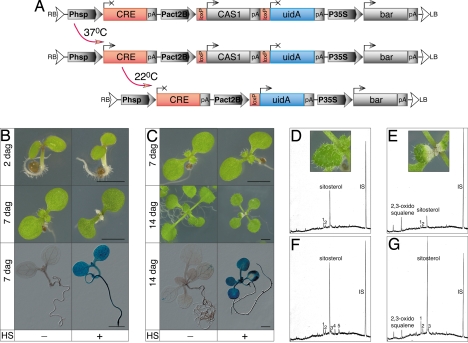
Generation and analysis of the conditional cas1–2 mutant allele. (A) Design of the cas1–2 mutation-complementing vector pCRECAS1 and sequence of events in planta after heat shock. Elements are promoters (Phsp, Pact2B, P35S), protein-coding regions (CRE, CAS1, uidA, bar), mRNA polyadenylation sequences (pA), and loxP sites (loxP); LB and RB are border sequences delineating the DNA transferred (T-DNA) into plant cells from Agrobacterium tumefaciens. Arrows or crosses indicate expression or lack of expression of gene(s). (B) Requirement of CAS1 for plastid differentiation and leaf growth. Two days after germination on a standard synthetic medium, seedlings were heat stressed (HS) at 37°C for 6 h (+) and then grown under standard conditions. Non-HS seedlings (−) are on the left. Phenotypes of seedlings and GUS-staining patterns 7 days after germination (dag) are shown. (C) Assessment of the role of CAS1 in cells with differentiated plastids. Seedlings bearing visible first leaf pairs were HS (+), photographed at 14 dag, and stained for GUS activity, along with control (−) plants. (D–G) Sterol analysis. Post-HS neoformed tissues (i.e., distal half of root, second leaf pair, and proximal half of leaves from first pair) and HS-preformed tissues (i.e., proximal half of root, cotyledons and hypocotyls, and distal half of leaves from first pair) were sampled from 25 seedlings of the wild-type and of the cas1–2 conditional allele in three independent experiments. GC of crude hexanic extracts of nonsaponifiable lipids gave profiles typical of plants with CAS1 (D) and cas1–2 (E) phenotypes in the case of neoformed tissues and profiles typical of plants with CAS1 (F) and cas1–2 phenotypes (G) in the case of preformed tissues. The Insets in D and E demonstrate that HS (+) wild-type and cas1–2 conditional allele had the same growth stage. Chromatograms obtained with the Agilent 6890 GC device show data acquisition after 20 min and until 52 min of the runs. Major peaks are sitosterol and 2,3-oxidosqualene (Fig. 1). Other sterol compounds identified by their mass spectrum are: 1, campesterol; 2, stigmasterol; 3, isofucosterol; 4, cycloartenol; and 5, 24-methylene cycloartenol. IS, internal standard (lupenyl-diacetate) present in identical amount in each sample. (Scale bars, 2 mm.)

References

    1. Benveniste P. Sterol biosynthesis. Annu Rev Plant Physiol. 1986;37:275–308.
    1. Benveniste P. Biosynthesis and accumulation of sterols. Annu Rev Plant Biol. 2004;55:429–457. - PubMed
    1. Corey EJ, Matsuda SPT, Bartel B. Isolation of an Arabidopsis thaliana gene encoding cycloartenol synthase by functional expression in a yeast mutant lacking lanosterol synthase by the use of a chromatographic screen. Proc Natl Acad Sci USA. 1993;90:11628–11632. - PMC - PubMed
    1. Husselstein-Muller T, Schaller H, Benveniste P. Molecular cloning and expression in yeast of 2,3-oxidosqualene-triterpenoid cyclases from Arabidopsis thaliana. Plant Mol Biol. 2001;45:75–92. - PubMed
    1. Kolesnikova MD, Xiong Q, Lodeiro S, Hua L, Matsuda SPT. Lanosterol biosynthesis in plants. Arch Biochem Biophys. 2006;447:87–95. - PubMed

Publication types

MeSH terms