Comparative Study
. 2008 Feb 26;105(8):3053-8.
doi: 10.1073/pnas.0712229105. Epub 2008 Feb 19.

HLA alleles determine differences in human natural killer cell responsiveness and potency

Affiliations
Comparative Study

HLA alleles determine differences in human natural killer cell responsiveness and potency

Sungjin Kim et al. Proc Natl Acad Sci U S A. .

Abstract

Epidemiological studies have associated certain human disease outcomes with particular killer cell Ig-like receptor (KIR) and HLA genotypes. However, the functional explanation for these associations is poorly understood, because the KIRs were initially described as natural killer (NK) cell inhibitory receptors with specificity for HLA molecules on their cellular targets. Yet resolution of infections is often associated with genotypic pairing of inhibitory KIRs with their cognate HLA ligands. Recent studies in mice indicate a second role for MHC-specific inhibitory receptors, i.e., self-MHC recognition confers functional competence on the NK cell to be triggered through their activation receptors, a process termed licensing. As a result, licensed NK cells with self-MHC-specific receptors are more readily activated as compared with unlicensed NK cells without self-MHC-specific receptors. Such results predict that human NK cells may undergo a similar process. Here, we examined the human NK cell subset expressing KIR3DL1, the only known KIR specific for HLA-Bw4 alleles. The KIR3DL1(+) subset in normal donors with two HLA-B-Bw4 genes displayed increased responsiveness to tumor stimulation compared with the KIR3DL1(+) subset from individuals with only one or no Bw4 genes. By contrast, NK cells lacking KIR3DL1 showed no differences. Therefore, these data indicate that particular KIR and HLA alleles are associated with more responsive NK cells, strongly suggesting that human NK cells are also subjected to NK cell licensing, and providing a potential functional explanation for the influence of KIR and HLA genes in disease as well as interindividual differences in NK cell potency.


Conflict of interest statement

The authors declare no conflict of interest.

Figures
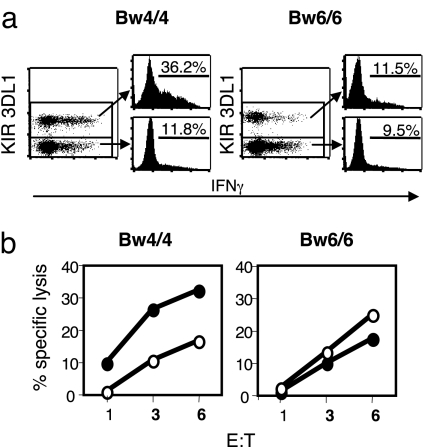
Fig. 1.
Fig. 1.
Enhanced potency of KIR3DL1+ NK cells in individuals with HLA-Bw4. (a) Freshly isolated PBMC from the indicated donors were incubated with MHC-deficient 721.221 tumor cells and analyzed for intracellular IFN-γ. Gated NK (CD3 CD56+) cells are shown, and the numbers represent the percentages of IFN-γ+ cells among the KIR3DL1+ or KIR3DL1 NK cell populations. In the dot plots, note that the KIR3DL1 subset is much larger than the KIR3DL1+ subset, giving the illusion of more response by the KIR3DL1 cells. The histograms more accurately show the responses by the different subsets. (b) KIR3DL1+ (solid circles) and KIR3DL1 (open circles) NK cells were sorted from freshly isolated PBMC of the indicated donors and used in standard 4-h killing assays against 721.221 target cells. Effector-to-target (E:T) ratios are indicated on the x axis. This panel is representative of two Bw4/Bw4 and five Bw6/Bw6 donors. One donor from each group was retested, and the killing patterns were essentially identical in these two independent experiments. For the donors tested for both assays, IFN-γ production generally correlated with killing activity (data not shown).
Fig. 2.
Fig. 2.
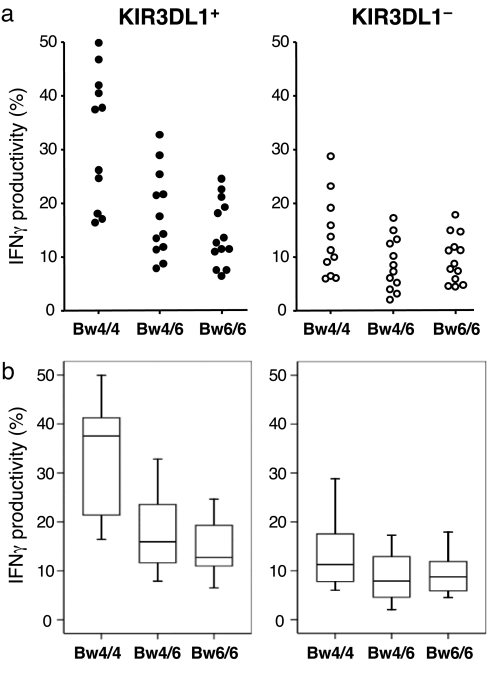
Interindividual heterogeneity in the potency of KIR3DL1+ NK cells is determined by HLA-B alleles. Freshly isolated PBMC were incubated with 721.221 tumor cells and analyzed for intracellular IFN-γ. On the basis of HLA-B genotypes, donors were divided into three groups (Bw4/4 homozygotes, n = 11; Bw4/6 heterozygotes, n = 12; Bw6/6 homozygotes, n = 13) as indicated on the x axis. The y axis reflects the percentage of cells expressing IFN-γ among the KIR3DL1+ (Left) or KIR3DL1 (Right) NK cell populations. (a) Individual results from each donor are shown. (b) Statistical representation of results. Individual results from a are shown as boxes representing the interquartile (25th to 75th percentile) group. The horizontal bar within the box represents the median value, and whiskers represent the range of values. For the KIR3DL1+ subset (Left), statistically significant differences were seen between the Bw4/4 group and the Bw4/6 group (U = 22.0, P = 0.007) and between the Bw4/4 group and the Bw6/6 group (U = 15.0, P = 0.001). A statistically significant trend was observed across the three groups (τ = −0.471, P < 0.0001).
Fig. 3.
Fig. 3.
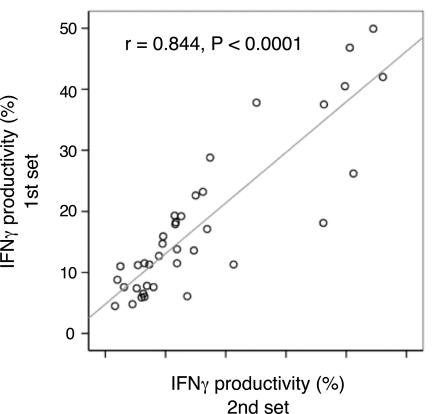
Consistency of KIR3DL1+ NK cell potency in HLA-Bw4 individuals. Nineteen of the original donors were retested at least 6 months after the initial set of assays for IFN-γ production after tumor target stimulation. These donors were either Bw4/4 homozygotes (n = 9) or Bw6/6 homozygotes (n = 10). Both KIR3DL1+ and KIR3DL1 subsets are represented on the graph. Spearman's rank correlation coefficient was calculated to assess similarity between the first and second set of data. Raw data are available in SI Fig. 5.
Fig. 4.
Fig. 4.
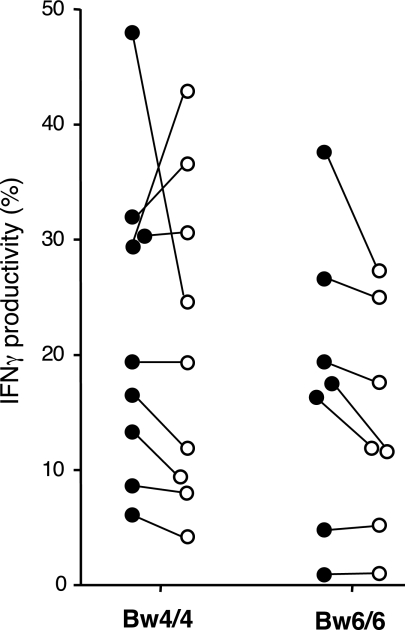
Responsiveness of KIR3DL1+ NK cells to CD16 cross-linking is not affected by host HLA-B genes. Freshly isolated PBMC from the indicated donors (Bw4/4 homozygotes, n = 9; Bw6/6 homozygotes, n = 7) were stimulated with plate-bound anti-CD16 and analyzed for intracellular IFN-γ production by KIR3DL1+ (solid circles) or by KIR3DL1 (open circles) NK cell population. Each dot represents the percentage of IFN-γ+ cells among the KIR3DL1+ or KIR3DL1 NK cell population from each individual; the percentages from the same individual are connected by a line. The IFN-γ production by KIR3DL1+ subsets between HLA-B groups was not significantly different (Bw4/4 vs. Bw6/6, U = 24.5, P = 0.470); the IFN-γ production by KIR3DL1 subsets between HLA-B groups was also not significantly different (Bw4/4 vs. Bw6/6, U = 23.5, P = 0.408). Comparison of KIR3DL1+ vs. KIR3DL1 cells in Bw4/4 homozygotes showed no significant difference in IFN-γ production (P = 0.477). Comparison of KIR3DL1+ vs. KIR3DL1 cells in Bw6/6 homozygotes also showed no significant difference in IFN-γ production (P = 0.063).

References

    1. Karlhofer FM, Ribaudo RK, Yokoyama WM. MHC class I alloantigen specificity of Ly-49+ IL-2-activated natural killer cells. Nature. 1992;358:66–70. - PubMed
    1. Lanier LL. NK cell recognition. Annu Rev Immunol. 2005;23:225–274. - PubMed
    1. Long EO, Rajagopalan S. HLA class I recognition by killer cell Ig-like receptors. Semin Immunol. 2000;12:101–108. - PubMed
    1. Parham P. MHC class I molecules and KIRs in human history, health and survival. Nat Rev Immunol. 2005;5:201–214. - PubMed
    1. Kelley J, Walter L, Trowsdale J. Comparative genomics of natural killer cell receptor gene clusters. PLoS Genet. 2005;1:129–139. - PMC - PubMed

Publication types