


Clinical heterogeneity among people with high functioning autism spectrum conditions: evidence favouring a continuous severity gradient
- PMID: 18289376
- PMCID: PMC2265729
- DOI: 10.1186/1744-9081-4-11
Clinical heterogeneity among people with high functioning autism spectrum conditions: evidence favouring a continuous severity gradient
Abstract
Background: Autism Spectrum Conditions (ASCs) are characterized by a high degree of clinical heterogeneity, but the extent to which this variation represents a severity gradient versus discrete phenotypes is unclear. This issue has complicated genetic studies seeking to investigate the genetic basis of the high hereditability observed clinically in those with an ASC. The aim of this study was to examine the possible clustering of symptoms associated with ASCs to determine whether the observed distribution of symptom type and severity supported either a severity or a symptom subgroup model to account for the phenotypic variation observed within the ASCs.
Methods: We investigated the responses of a group of adults with higher functioning ASCs on the fifty clinical features examined in the Autism Spectrum Quotient, a screening questionnaire used in the diagnosis of higher functioning ASCs. In contrast to previous studies we have used this instrument with no a priori assumptions about any underlying factor structure of constituent items. The responses obtained were analyzed using complete linkage hierarchical cluster analysis. For the members of each cluster identified the mean score on each Autism Spectrum Quotient question was calculated.
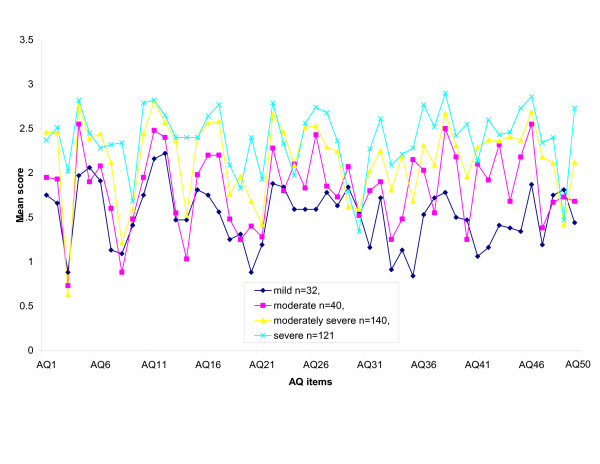
Results: Autism Spectrum Quotient responses from a total of 333 individuals between the ages of 16.6 and 78.0 years were entered into the hierarchical cluster analysis. The four cluster solution was the one that generated the largest number of clusters that did not also include very small cluster sizes, defined as a membership comprising 10 individuals or fewer. Examination of these clusters demonstrated that they varied in total Autism Spectrum Quotient but that the profiles across the symptoms comprising the Autism Spectrum Quotient did not differ independently of this severity factor.
Conclusion: These results are consistent with a unitary spectrum model, suggesting that the clinical heterogeneity observed in those with an autistic spectrum condition at the higher-IQ end of the spectrum is associated with a gradient in the overall severity of the ASC rather than with the presence of different specific symptom profiles in different individuals. The implications of this for genetic research are considered.
Figures
References
-
- Volkmar F, Klin A, Rutter M. Issues in classification of autism and related conditions . In: Volkmar F, Klin , Paul R, Cohen D, editor. Handbook of Autism and Pervasive Developmental Disorders. 3rd. New York , Wiley;
-
- Bailey T, Le Couteur A, Gottesman I, Bolton P, Simonoff E, Yuzda E, Rutter M. Autism as a strongly genetic disorder: evidence from a British twin study. Psychological Medicine. 1995;25:63–77. - PubMed
Grants and funding
LinkOut - more resources
Full Text Sources
Miscellaneous
