


Detection of filamentous tau inclusions by the fluorescent Congo red derivative FSB [(trans,trans)-1-fluoro-2,5-bis(3-hydroxycarbonyl-4-hydroxy)styrylbenzene]
- PMID: 18291106
- PMCID: PMC2726283
- DOI: 10.1016/j.febslet.2008.02.025
Detection of filamentous tau inclusions by the fluorescent Congo red derivative FSB [(trans,trans)-1-fluoro-2,5-bis(3-hydroxycarbonyl-4-hydroxy)styrylbenzene]
Abstract
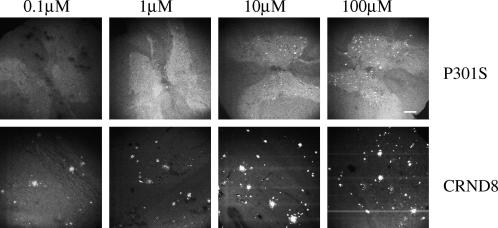
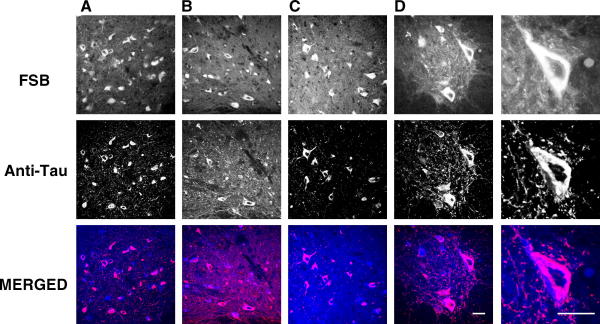
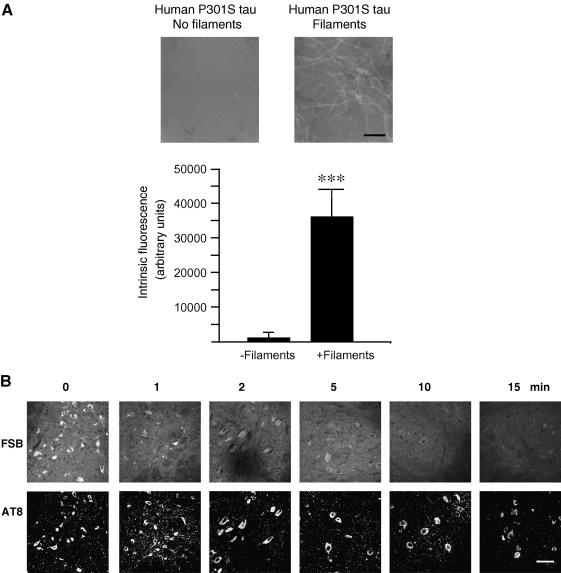
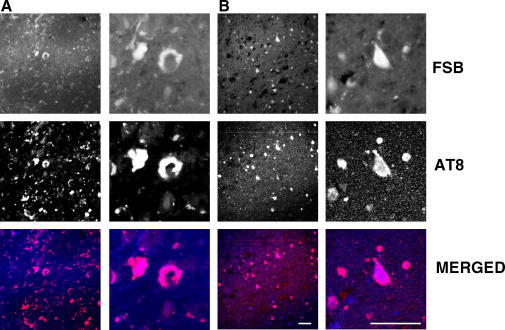
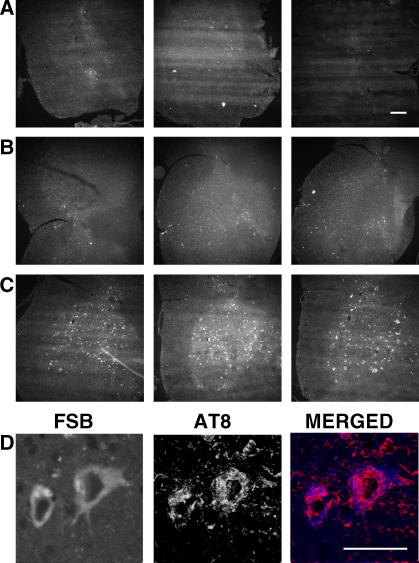
Filamentous inclusions made of the microtubule-associated protein tau in a hyperphosphorylated state are a defining feature of a large number of human neurodegenerative diseases. Here we show that (trans,trans)-1-fluoro-2,5-bis(3-hydroxycarbonyl-4-hydroxy)styrylbenzene (FSB), a fluorescent Congo red derivative, labels tau inclusions in tissue sections from a mouse line transgenic for human P301S tau and in cases of familial frontotemporal dementia and sporadic Pick's disease. Labelling by FSB required the presence of tau filaments. More importantly, tau inclusions in the spinal cord of human P301S tau transgenic mice were labelled following a single intravenous injection of FSB. These findings indicate that FSB can be used to detect filamentous tau in vivo.
Figures
References
-
- Goedert M., Spillantini M.G., Davies S.W. Filamentous nerve cell inclusions in neurodegenerative diseases. Curr. Opin. Neurobiol. 1998;8:619–632. - PubMed
-
- Goedert M., Spillantini M.G. A century of Alzheimer’s disease. Science. 2006;314:777–781. - PubMed
-
- Lee V.M.-Y., Goedert M., Trojanowski J.Q. Neurodegenerative tauopathies. Annu. Rev. Neurosci. 2001;24:1121–1159. - PubMed
-
- Poorkaj P., Bird T.D., Wijsman E., Nemens E., Garruto R.M., Anderson L., Andreadis A., Wiederholt W.C., Raskind M., Schellenberg G.D. Tau is a candidate gene for chromosome 17 frontotemporal dementia. Ann. Neurol. 1998;43:815–825. - PubMed
-
- Hutton M., Lendon C.L., Rizzu P., Baker M., Froelich S., Houlden H., Pickering-Brown S., Chakraverty S., Isaacs A., Grover A., Hackett J., Adamson J., Lincoln S., Dickson D., Davies P., Petersen R.C., Stevens M., de Graaff E., Wauters E., van Baren J., Hillebrand M., Joosse M., Kwon J.M., Nowotny P., Che L.K., Norton J., Morris J.C., Reed L.A., Trojanowski J., Basun H., Lannfelt L., Neystat M., Fahn S., Dark F., Tannenberg T., Dodd P.R., Hayward N., Kwok J.B., Schofield P.R., Andreadis A., Snowden J., Craufurd D., Neary D., Owen F., Oostra B.A., Hardy J., Goate A., van Swieten J., Mann D., Lynch T., Heutink P. Association of missense and 5′-splice-site mutations in tau with the inherited dementia FTDP-17. Nature. 1998;393:702–705. - PubMed
Publication types
MeSH terms
Substances
Grants and funding
LinkOut - more resources
Full Text Sources
Miscellaneous
