. 2008 Feb 26;18(4):297-302.
doi: 10.1016/j.cub.2008.01.054.

Oscillatory transepithelial H(+) flux regulates a rhythmic behavior in C. elegans

Affiliations

Oscillatory transepithelial H(+) flux regulates a rhythmic behavior in C. elegans

Jason Pfeiffer et al. Curr Biol. .

Abstract

In C. elegans, rhythmic defecation is timed by oscillatory Ca(2+) signaling in the intestine [1-5]. Here, by using fluorescent biosensors in live, unrestrained worms, we show that intestinal pH also oscillates during defecation and that transepithelial proton movement is essential for defecation signaling. The intestinal cytoplasm is acidified by proton influx from the lumen during defecation. Acidification is predicted to trigger Na(+)/H(+) exchange activity and subsequent proton efflux. The Na(+)/H(+) exchanger NHX-7 (PBO-4) extrudes protons across the basolateral membrane and is necessary for both acute acidification of the pseudocoelom and for strong contractions of the posterior body wall muscles during defecation. This suggests that secreted protons transmit a signal between the intestine and muscle. NHX-2 is a second Na(+)/H(+) exchanger whose distribution is limited to the apical membranes facing the intestinal lumen. RNA interference of nhx-2 reduces the basal pH of the intestinal cells, reduces the rate of proton movement between the lumen and the cytoplasm during defecation, and extends the defecation period. Thus, the cell may integrate both pH and calcium signals to regulate defecation timing. Overall, these results establish the defecation cycle as a model system for studying transepithelial proton flux in tissues that maintain systemic acid-base balance.


Figures
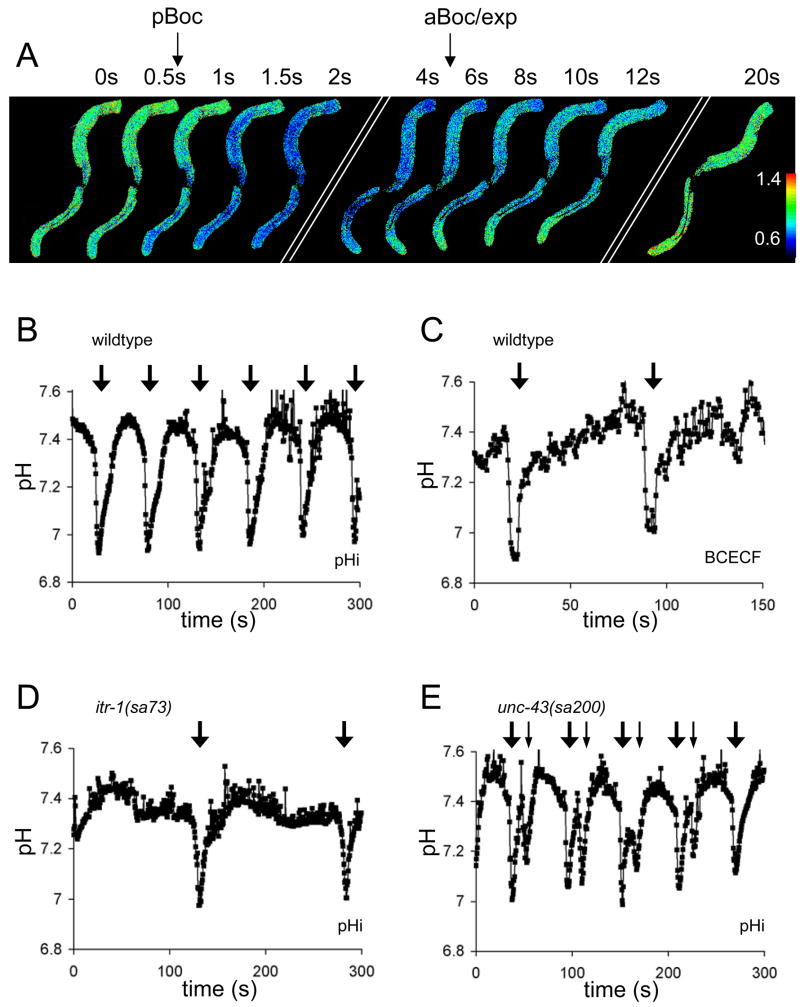
Figure 1
Figure 1. Intestinal pHi Dynamics in Wildtype, itr-1(sa73) and unc-43(sa200) Adult Animals
(A) is a composite of individual frames extracted from a time-lapse acquisition of intestinal pHi in a transgenic worm expressing Pnhx-2::pHluorin during a single round of defecation. The frames are not consecutive and the times at which they were extracted are indicated (in seconds), as are the execution of pBoc and aBoc. The posterior end of the intestine is oriented toward the bottom of each frame and the anterior end toward the top. The fluorescent ratios obtained imaging live worms (410-nm/470-nm dual excitation, 535-nm emission) have been mapped to a rainbow palette, as shown to the right. Blue corresponds to a more acidic pHi (ratio of 0.6) and red to a more alkaline pHi (ratio of 1.4). (B–E) show representative traces of intestinal pHi oscillations derived from fluorescent imaging of live, behaving worms. The pHluorin emission ratio was converted to pH using a high K+/nigericin calibration technique [21]. The large arrows at the top of the traces represent execution of the DMP. (B) is from a control worm imaged over 300s. Table S1 contains the mean period, resting pHi, and amplitude of these oscillations from multiple worms. (C) is from a wildtype worm fed the pH-sensitive vital dye BCECF (490-nm/440-nm excitation, 535-nm emission), which was taken up mainly by the anterior cells of the intestine. Similar results were obtained from three separate worms. (D, E) are from itr-1(sa73) and unc-43(sa200) mutant worms, respectively. The small arrows in (E) denote where a reiteration of the principle defecation motor program occurs that result in tandem muscle contractions. All worms were imaged live and unrestrained on seeded agarose plates.
Figure 2
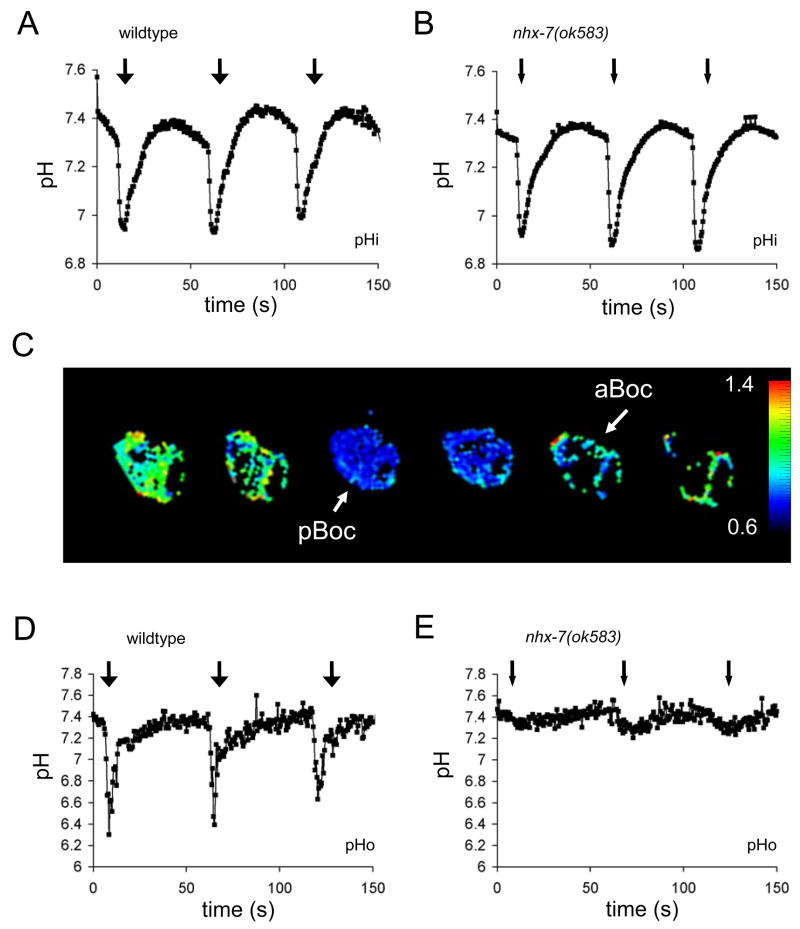
Figure 2. NHX-7 regulates Extracellular, but not Intracellular, pH dynamics
(A, C, D) are wildtype and (B, E) are nhx-7(ok585) mutants. (A, B) show representative traces of intestinal pHi oscillations during defecation obtained using the Pnhx-2::pHluorin biosensor in live, behaving worms. (C) is a composite of individual frames extracted from an acquisition series of ratiometric images (non-confocal) obtained in live worms expressing an extracellular pHo Pnhx-7::PAT-3::pHluorin biosensor (410-nm/470-nm dual excitation, 535 emission, every 1.5s) in the posterior-most intestinal cells. The ratiometric images were pseudocolored using a rainbow palette, as shown, with blue representing low pH (ratio of 0.6) and red representing high pH (ratio of 1.4). The changes in color reflect pHo oscillations in the pseudocoelom surrounding the posterior-most intestinal ring. The arrow depicting pBoc is pointed from the posterior toward the anterior of the intestine. The arrow depicting aBoc is pointed from the anterior toward the posterior. These arrows reflect the movement of the contents of the intestinal lumen that occur during the respective muscle contractions. (D, E) show representative traces of pHo oscillations during defecation in control and nhx-7(ok583) mutants, respectively. Weak pBoc are denoted by small arrows, while normal pBoc are indicated by larger arrows above the traces. Please see Table S1 for average values and statistical significance.
Figure 3
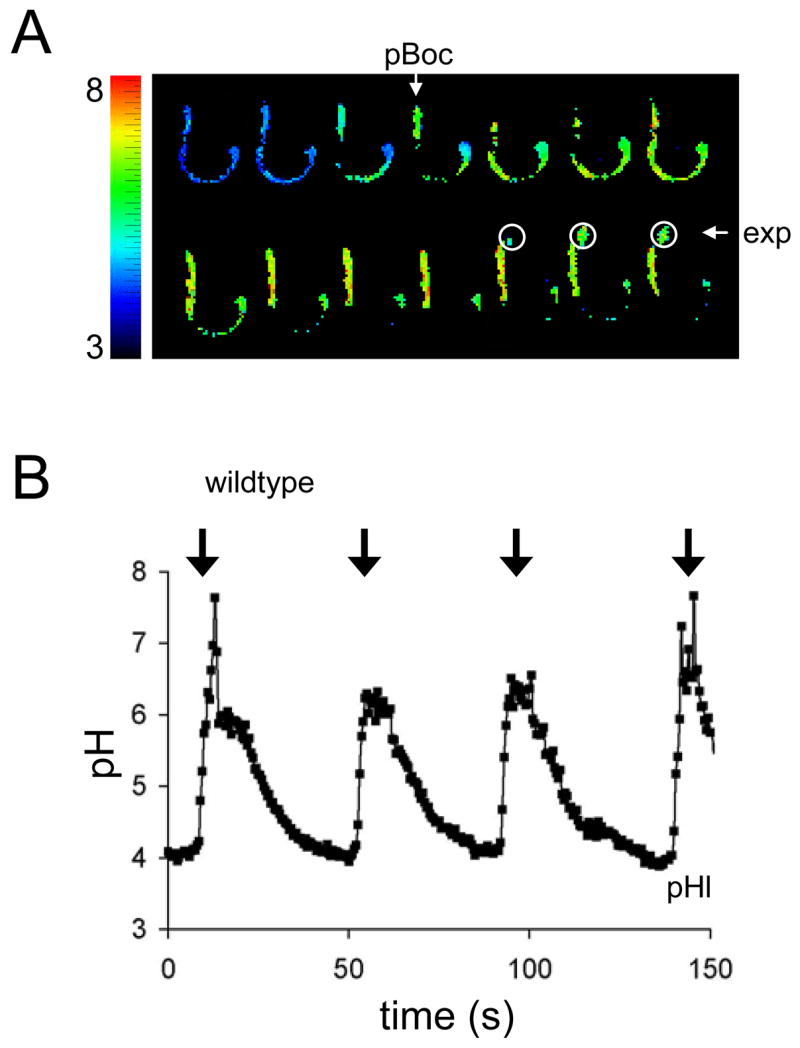
Figure 3. Luminal Alkalinization During Defecation
(A) Representative frames extracted from a time lapse acquisition of luminal pH (pHl) oscillations during defecation. Consecutive frames obtained at 2Hz are shown. Wildtype worms were fed dextran coupled to the pH sensitive vital dye Oregon Green-488. The fluorescent ratios (490-nm/440-nm dual excitation, 535-nm emission) obtained by imaging live worms during defecation were mapped to a rainbow palette, as indicated. The execution of pBoc and explusion are denoted. For orientation, the posterior end of the intestine is near the expelled luminal contents, encompassed by white circles. The plate is ~pH 6. In general, due to loading efficiency and retention of the dye, the worms used to obtain pHl measurements were larval rather than adult animals. (B) Representative trace of pHl oscillations during defecation in wildtype worms. The arrows denote pBoc. The ratios obtained from Oregon Green-488 imaging were converted to pH. Transient spikes in pHl above 6 are likely artifacts; as the ratio increases beyond the linear dynamic range of the calibration curve, small changes in ratio lead to progressively larger apparent changes in pH. A full description of this data can be found in Table S1.
Figure 4
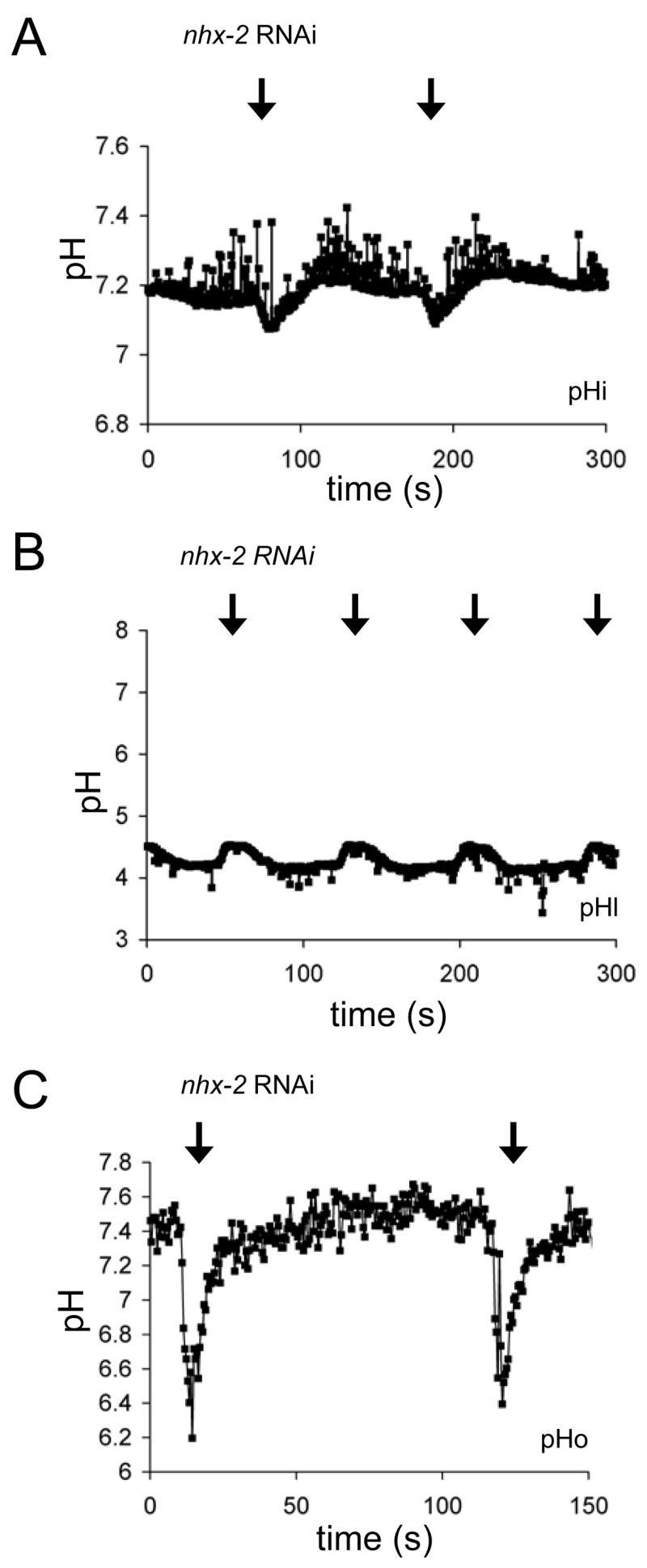
Figure 4. pH Dynamics in Worms Treated with nhx-2 RNAi
Representative traces following the loss of NHX-2 show (A) intestinal pHi oscillations in a live worm expressing a Pnhx-2::pHluorin biosensor, (B) pHl oscillations in a live worm fed Oregon Green-488, and (C) intestinal pHo oscillations in a live worm expressing a Pnhx-7::PAT-3::pHluorin biosensor. Table S1 contains average values and a statistical analysis of significance.

References

    1. Dal Santo P, Logan M, Chisholm A, Jorgensen E. The inositol triphosphate receptor regulates a 50-second behavioral rhythm in C. elegans. Cell. 1999;98:757–767. - PubMed
    1. Espelt M, Estevez A, Yin X, Strange K. Oscillatory Ca2+ Signaling in the Isolated Caenorhabditis elegans Intestine: Role of the Inositol-1,4,5-trisphosphate Receptor and Phospholipases C {beta} and {gamma} J Gen Physiol. 2005;126:379–392. - PMC - PubMed
    1. Teramoto T, Iwasaki K. Intestinal calcium waves coordinate a behavioral motor program in C. elegans. Cell Calcium. 2006;40:319–327. - PubMed
    1. Nehrke K, Denton J, Mowrey W. Intestinal Ca2+ wave dynamics in freely moving C. elegans coordinate execution of a rhythmic motor program. Am J Physiol Cell Physiol. 2007 doi: 10.1152/ajpcell.00303.02007. - DOI - PubMed
    1. Peters MA, Teramoto T, White JQ, Iwasaki K, Jorgensen EM. A Gap-Junction-Mediated Calcium Wave Coordinates a Rhythmic Behavior in C. elegans. Current Biology . 2007 doi: 10.1016/j.cub.2007.08.031. - DOI - PubMed

Publication types

MeSH terms

Substances