. 2008 Jan;35(1):301-9.
doi: 10.1118/1.2821702.

Endovascular image-guided interventions (EIGIs)

Affiliations

Endovascular image-guided interventions (EIGIs)

Stephen Rudin et al. Med Phys. 2008 Jan.

Abstract

Minimally invasive interventions are rapidly replacing invasive surgical procedures for the most prevalent human disease conditions. X-ray image-guided interventions carried out using the insertion and navigation of catheters through the vasculature are increasing in number and sophistication. In this article, we offer our vision for the future of this dynamic field of endovascular image-guided interventions in the form of predictions about (1) improvements in high-resolution detectors for more accurate guidance, (2) the implementation of high-resolution region of interest computed tomography for evaluation and planning, (3) the implementation of dose tracking systems to control patient radiation risk, (4) the development of increasingly sophisticated interventional devices, (5) the use of quantitative treatment planning with patient-specific computer fluid dynamic simulations, and (6) the new expanding role of the medical physicist. We discuss how we envision our predictions will come to fruition and result in the universal goal of improved patient care.


Figures
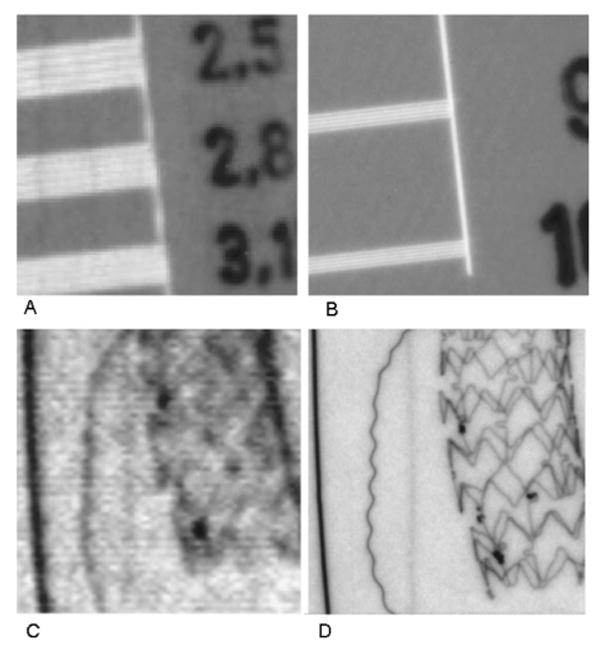
Fig. 1
Fig. 1
Improved resolution with new SSXII (right) compared with XII (left). (A) and (B) Bar pattern images taken at 70 kVp with 2 in. PMMA filtration added with the same exposure for each detector. (C) and (D) Images of a neurovascular phantom containing thin wires (left to right: 100 μm Au, 25 μm Cu, 50 μm Pt), 100 μm iodine contrast media-filled tube and a new asymmetric vascular stent having a blood flow diverting low-porosity polyurethane patch (indicated by four Pt markers) designed for closing off flow into an aneurysm were taken at 74 kVp with 21.4 mm Al added filtration (RQA 5 Spectrum) with the same exposure. (A) Bar pattern with only 3.1 Lp/mm visible for XII in 5 in. magnification mode. (B) Bar pattern with 10 Lp/mm clearly visible for SSXII. (C) With the XII, wires are less clear: Cu wire and Pt wire bends are unseen and stent struts and patch markers are not clearly visible. (D) With the SSXII, Cu wire is barely visualized but Pt wire bends and stent struts and patch markers are clearly visible.
Fig. 2
Fig. 2
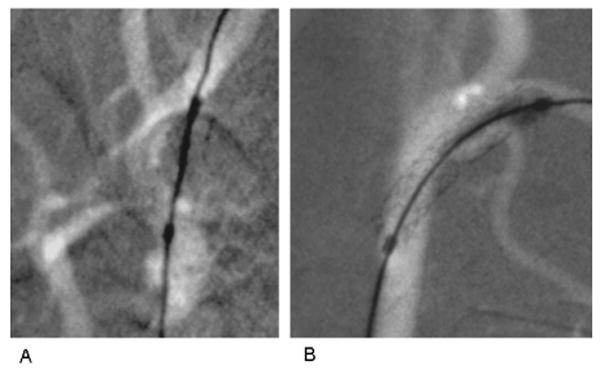
Fluoroscopic road-mapped frames done at 74 kVp and 50 mA of 3 mm diameter and 15 mm long coronary stent systems (Multi-link Vision, Guidant Corp, Santa Clara, CA). End markers indicate extent of expanded balloon on delivery catheter. Stents are deployed in carotid arteries of the same rabbit. (A) Using 2 ms pulsed XII imaging with temporal filtering (standard on commercial systems), stent deployed in right carotid. (B) Using 8 ms pulsed HSMAF imaging with no temporal filtering, stent deployed in left carotid showing improved visualization of details of stent struts and vessel edges.
Fig. 3
Fig. 3
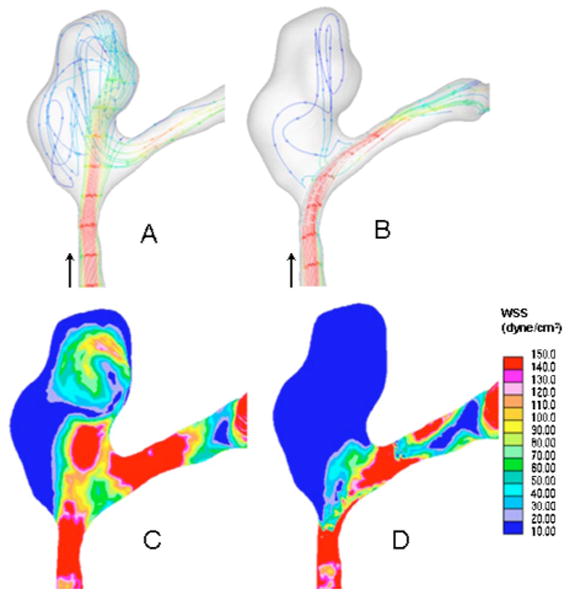
CFD result showing streamlines and local shear stress distributions for a patient-specific aneurysm untreated and treated with an asymmetric vascular stent (Ref. 87). Notice effect of flow diversion on streamlines and wall shear stress (WSS) distribution. (A) Streamlines, untreated; (B) streamlines, treated; (C) wall shear stress, untreated; (D) wall shear stress, treated.

References

    1. Higashida RT, Lahue BJ, Torbey MT, Hopkins LN, Leip E, Hanley DF. Treatment of unruptured intracranial aneurysms: A nationwide assessment of effectiveness. AJNR Am J Neuroradiol. 2007;28:146–151. - PMC - PubMed
    1. Koebbe CJ, Veznedaroglu E, Jabbour P, Rosenwasser RH. Endovascular management of intracranial aneurysms: current experience and future advances. Neurosurgery. 2006;59:S3-93–S3-102. - PubMed
    1. Koebbe CJ, Pandey A, Veznedaroglu E, Rosenwasser RH. The evolution and future directions of endovascular therapy. Clin Neurosurg. 2006;53:191–195. review. - PubMed
    1. Fiorella D, Woo HH. Emerging endovascular therapies for symptomatic intracranial atherosclerotic disease. Stroke. 2007;38:2391–2396. - PubMed
    1. Saborowski O, Saeed M. An overview on the advances in cardiovascular interventional MR imaging. Magn Reson Mater Phys Biol Med. 2007;20:117–127. - PubMed

Publication types

MeSH terms

LinkOut - more resources