. 2008 Apr;21(4):936-43.
doi: 10.1021/tx700434v. Epub 2008 Feb 23.

(-)-Epigallocatechin gallate, a major constituent of green tea, poisons human type II topoisomerases

Affiliations

(-)-Epigallocatechin gallate, a major constituent of green tea, poisons human type II topoisomerases

Omari J Bandele et al. Chem Res Toxicol. 2008 Apr.

Abstract

(-)-Epigallocatechin gallate (EGCG) is the most abundant and biologically active polyphenol in green tea, and many of the therapeutic benefits of the beverage have been attributed to this compound. High concentrations of EGCG are cytotoxic and trigger genotoxic events in mammalian cells. Although this catechin affects a number of cellular systems, the genotoxic effects of several bioflavonoid-based dietary polyphenols are believed to be mediated, at least in part, by their actions on topoisomerase II. Therefore, the effects of green tea extract and EGCG on DNA cleavage mediated by human topoisomerase IIalpha and beta were characterized. The extract and EGCG increased levels of DNA strand breaks generated by both enzyme isoforms. However, EGCG acted by a mechanism that was distinctly different from those of genistein, a dietary polyphenol, and etoposide, a widely prescribed anticancer drug. In contrast to these agents, EGCG exhibited all of the characteristics of a redox-dependent topoisomerase II poison that acts by covalently adducting to the enzyme. First, EGCG stimulated DNA scission mediated by both isoforms primarily at sites that were cleaved in the absence of compounds. Second, exposure of EGCG to the reducing agent dithiothreitol (DTT) prior to its addition to DNA cleavage assays abrogated the effects of the catechin on DNA scission. Third, once EGCG stimulated topoisomerase II-mediated DNA cleavage, exposure to DTT did not effect levels of DNA strand breaks. Finally, EGCG inhibited the DNA cleavage activities of topoisomerase IIalpha and beta when incubated with either enzyme prior to the addition of DNA. Taken together, these results provide strong evidence that EGCG is a redox-dependent topoisomerase II poison and utilizes a mechanism similar to that of 1,4-benzoquinone.


Figures
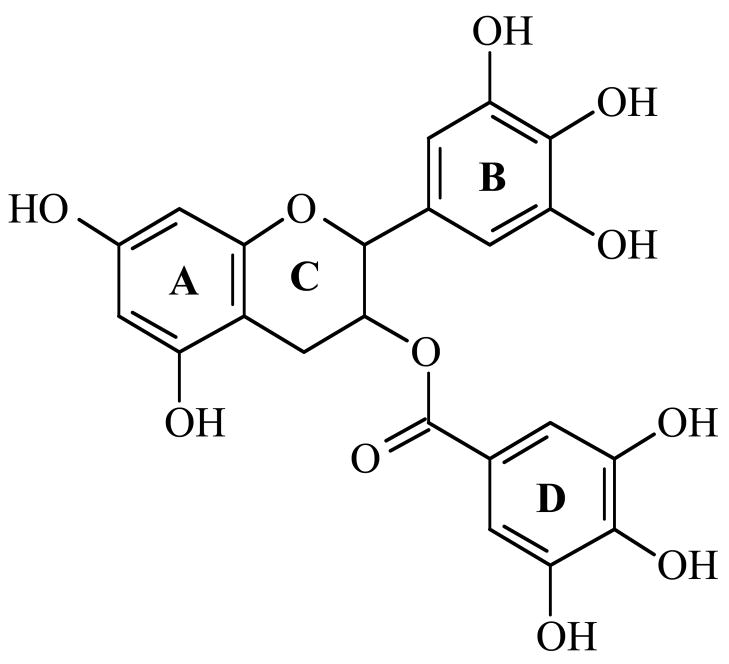
Figure 1
Figure 1
Structure of (−)-epigallocatechin gallate.
Figure 2
Figure 2
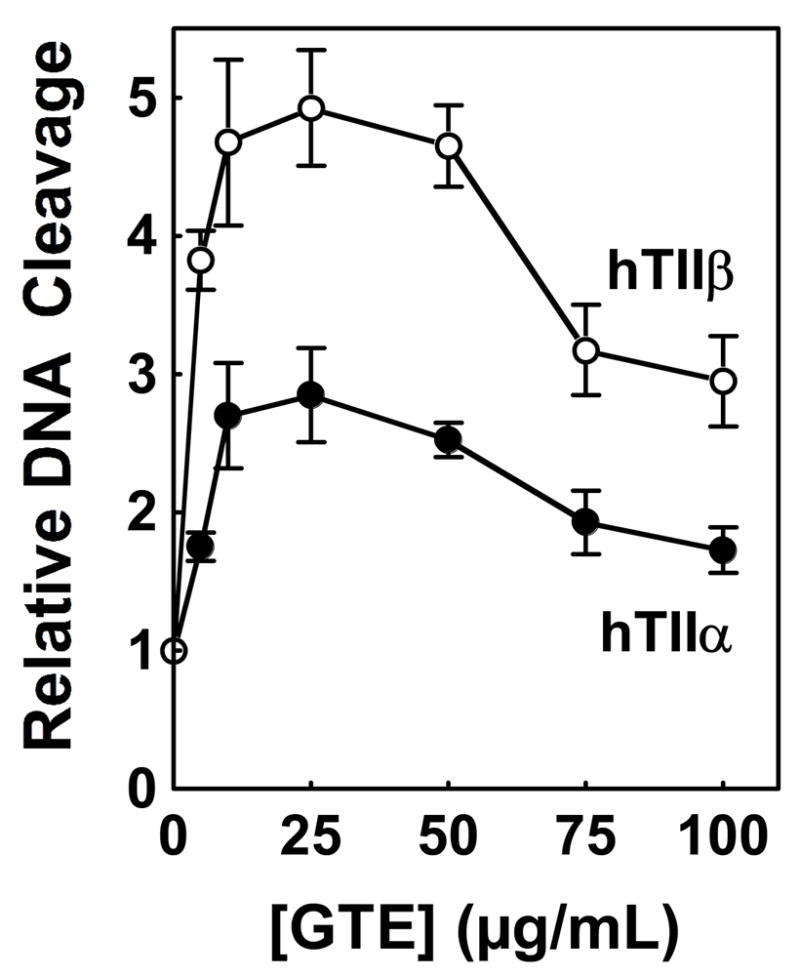
Effects of green tea extract on double-stranded DNA cleavage mediated by human topoisomerase IIα and β. Data for DNA cleavage mediated by topoisomerase IIα (hTIIα; closed circles) and topoisomerase IIβ (hTIIβ; open circles) in the presence of 0–100 μg/mL green tea extract (GTE) are shown. Levels of cleavage were compared to those in the absence of compounds (set to 1.0). Error bars represent standard deviations for three independent experiments.
Figure 3
Figure 3
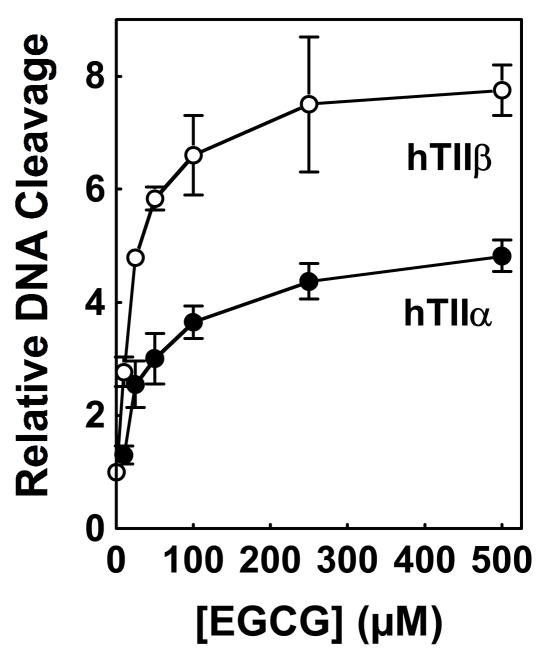
Effects of EGCG on double-stranded DNA cleavage mediated by human topoisomerase IIα and β. Data for DNA cleavage mediated by topoisomerase IIα (hTIIα; closed circles) and topoisomerase IIβ (hTIIβ; open circles) in the presence of 0–500 μM EGCG are shown. Levels of cleavage were compared to those in the absence of compounds (set to 1.0). Error bars represent standard deviations for three independent experiments.
Figure 4
Figure 4
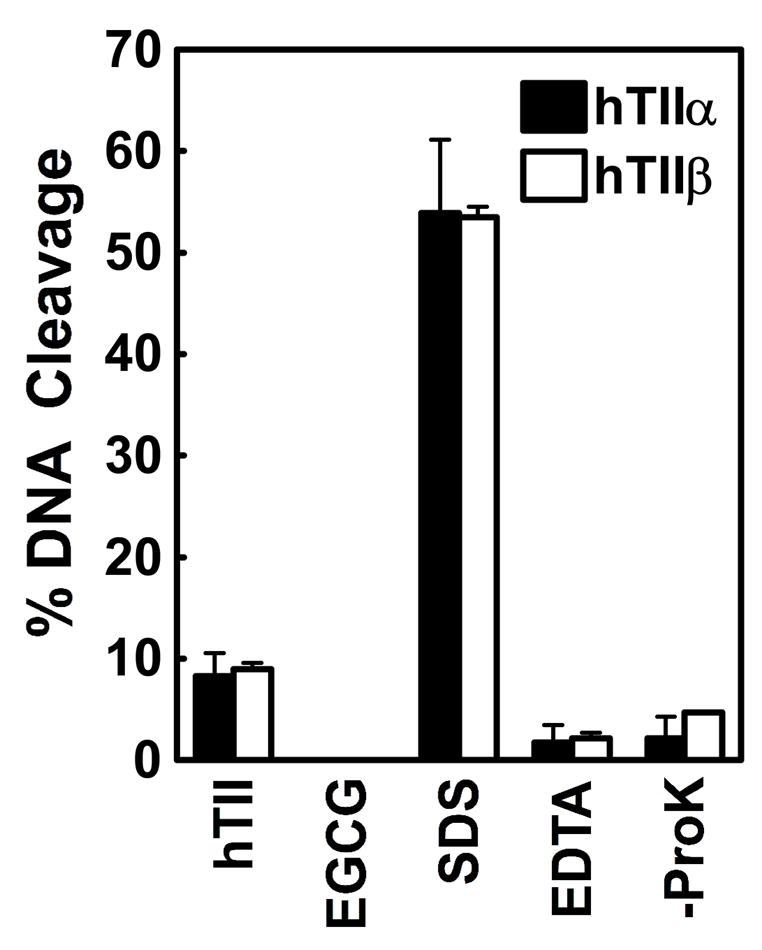
EGCG-induced DNA cleavage is mediated by topoisomerase II. Data for human topoisomerase IIα (hTIIα; closed bars) and topoisomerase IIβ (hTIIβ; open bars) are shown. Control reactions contained DNA and enzyme in the absence of EGCG (hTII), DNA and 500 μM EGCG in the absence of enzyme (EGCG), or complete reaction mixtures treated with SDS prior to adding EDTA (SDS). The reversibility of DNA cleavage induced by 500 μM EGCG was determined by incubating reactions with EDTA prior to trapping cleavage complexes with SDS (EDTA). To determine whether DNA cleavage induced by EGCG was protein-linked, proteinase K treatment was omitted (-ProK). Error bars represent standard deviations for three independent experiments.
Figure 5
Figure 5
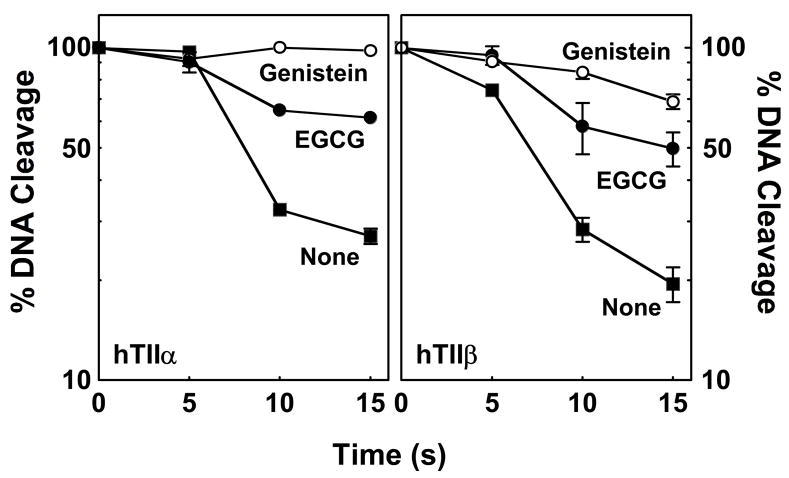
Effects of EGCG on topoisomerase II-mediated DNA ligation. Data for human topoisomerase IIα (hTIIα; left panel) and topoisomerase IIβ (hTIIβ; right panel) are shown. DNA ligation was examined in the absence of compounds (None; closed squares) or in the presence of 500 μM EGCG (closed circles) or 50 μM genistein (open circles). Samples were incubated at 37 °C to establish DNA cleavage/ligation equilibria and were shifted to 0 °C to initiate the ligation reaction. Equilibrium levels of DNA cleavage were set to 100% at time zero. Ligation was quantified by the loss of linear molecules. Errors bars represent standard deviations for three independent experiments.
Figure 6
Figure 6
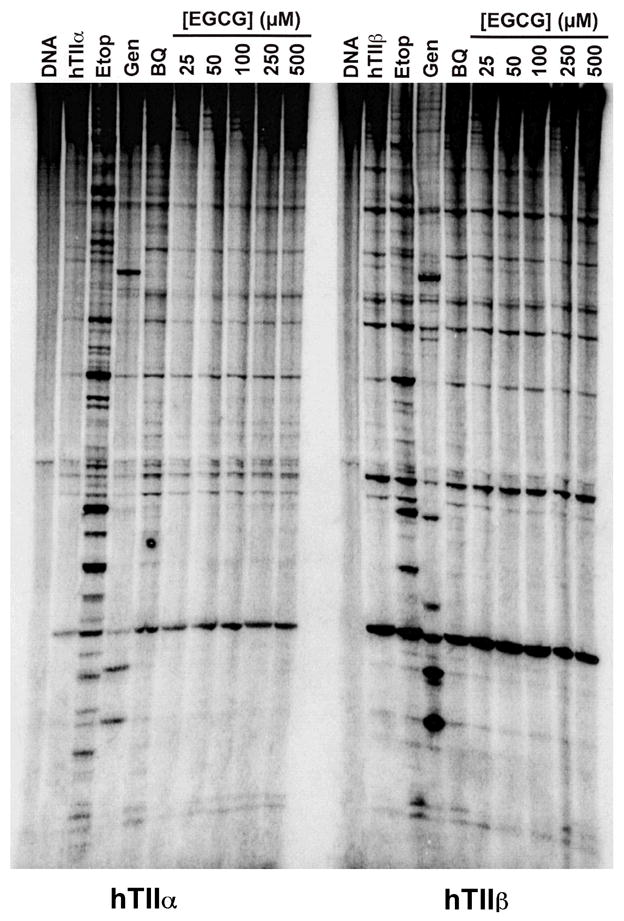
Effects of EGCG on DNA cleavage site utilization by topoisomerase II. Data for human topoisomerase IIα (hTIIα; left) and topoisomerase IIβ (hTIIβ; right) are shown. Autoradiograms of polyacrylamide gels are shown. DNA cleavage reactions contained enzyme in the absence of compounds (hTIIα or hTIIβ), or in the presence of 12.5 μM etoposide (Etop), 50 μM genistein (Gen), 25 μM 1,4-benzoquinone (BQ), or 25–500 μM EGCG. A DNA control is shown in the far left lane of each autoradiogram (DNA). Data are representative of three independent experiments.
Figure 7
Figure 7
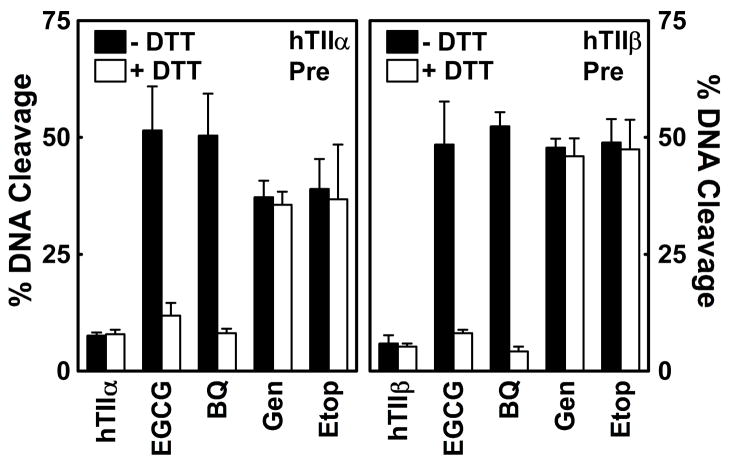
Effects of DTT on the ability of EGCG to enhance DNA cleavage mediated by topoisomerase II. Data for human topoisomerase IIα (hTIIα; left panel) and topoisomerase IIβ (hTIIβ; right panel) are shown. EGCG (500 μM) was incubated without DTT (−DTT; closed bars) or with 500 μM DTT (+DTT; open bars) prior to its addition to topoisomerase II-DNA complexes. Control reactions contained DNA and enzyme in the absence of compounds (hTIIα or hTIIβ), or in the presence of 25 μM 1,4-benzoquinone (BQ), 50 μM genistein (Gen), or 50 μM etoposide (Etop). Error bars represent standard deviations for three independent experiments.
Figure 8
Figure 8
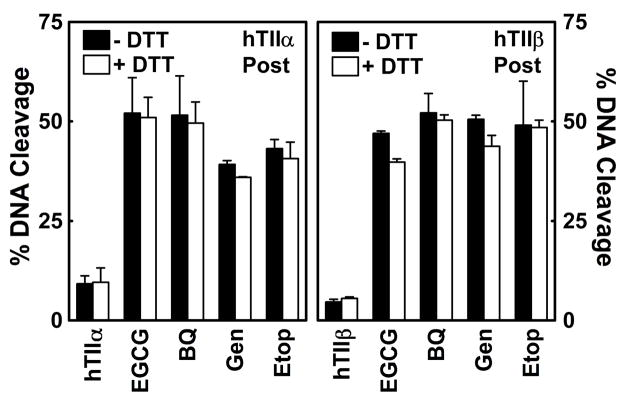
Effects of DTT on EGCG activity toward topoisomerase II after DNA cleavage complexes are established. Data for human topoisomerase IIα (hTIIα; left panel) and topoisomerase IIβ (hTIIβ; right panel) are shown. Following DNA cleavage enhancement in the presence of 500 μM EGCG, topoisomerase II-DNA cleavage complexes were further incubated without DTT (−DTT; closed bars) or with 500 μM DTT (+DTT; open bars). Control reactions contained DNA and enzyme in the absence of compounds (hTIIα or hTIIβ), or cleavage complexes established in the presence of 25 μM 1,4-benzoquinone (BQ), 50 μM genistein (Gen), or 50 μM etoposide (Etop). Error bars represent standard deviations for three independent experiments.
Figure 9
Figure 9
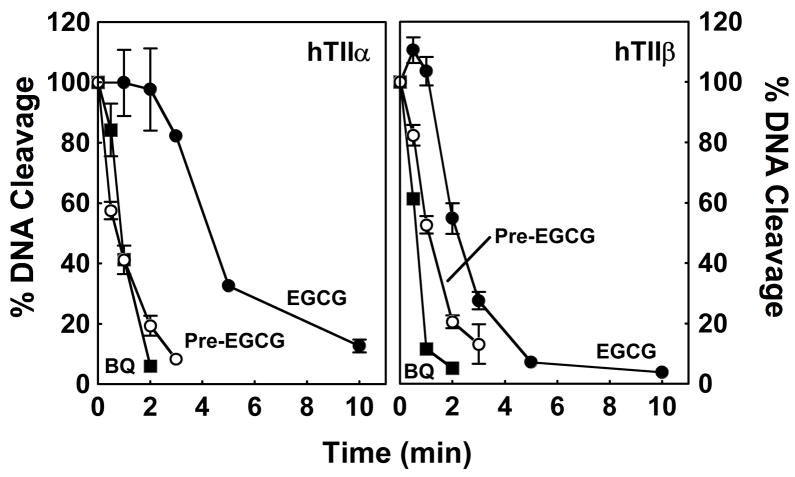
Time-dependence of EGCG-induced inhibition of topoisomerase II-mediated DNA cleavage when incubated with the enzyme prior to the addition of DNA. Data for human topoisomerase IIα (hTIIα; left panel) and topoisomerase IIβ (hTIIβ; right panel) are shown. Enzymes were treated with the following compounds for 0–10 min prior to the addition of DNA: 500 μM EGCG (closed circles), 25 μM 1,4-benzoquinone (BQ; closed squares), or 500 μM EGCG that was incubated in cleavage buffer for 3 min before its addition to reactions (Pre-EGCG; open circles). Levels of cleavage were compared to those when compounds were added to the enzyme-DNA complex (set to 100%). Error bars represent standard deviations for three independent experiments.
Figure 10
Figure 10
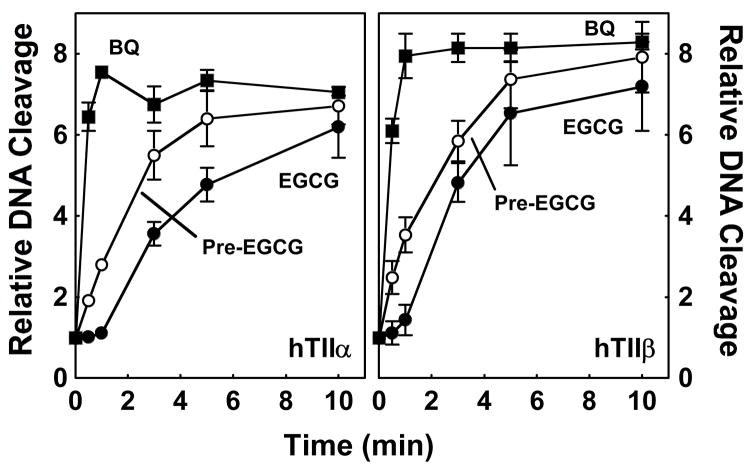
Time-dependence of EGCG-induced stimulation of topoisomerase II-mediated DNA cleavage when incubated with the enzyme-DNA complex. Data for human topoisomerase IIα (hTIIα; left panel) and topoisomerase IIβ (hTIIβ; right panel) are shown. Enzymes were treated with 500 μM EGCG (closed circles), 25 μM 1,4-benzoquinone (BQ; closed squares), or 500 μM EGCG that was incubated in cleavage buffer for 3 min before its addition to reactions (Pre-EGCG; open circles), and a 10-min time course for DNA cleavage was examined. Levels of cleavage were compared to those in the absence of compounds (set to 1.0). Error bars represent standard deviations for three independent experiments.

References

    1. Isbrucker RA, Bausch J, Edwards JA, Wolz E. Safety studies on epigallocatechin gallate (EGCG) preparations. Part 1: genotoxicity. Food and Chem Toxicol. 2006;44:626–635. - PubMed
    1. Isbrucker RA, Edwards JA, Wolz E, Davidovich A, Bausch J. Safety studies on epigallocatechin gallate (EGCG) preparations. Part 2: Dermal, acute and short-term toxicity studies. Food and Chem Toxicol. 2006;44:636–650. - PubMed
    1. Yang CS, Lambert JD, Ju J, Lu G, Sang S. Tea and cancer prevention: molecular mechanisms and human relevance. Tox Appl Pharmacol. 2007;224:265–273. - PMC - PubMed
    1. Sang S, Hou Z, Lambert JD, Yang CS. Redox properties of tea polyphenols and related biological activities. Antioxid Redox Signal. 2005;7:1704–1714. - PubMed
    1. Bertram B, Bollow U, Rajaee-Behbahani N, Burkle A, Schmezer P. Induction of poly(ADP-ribosyl)ation and DNA damage in human peripheral lymphocytes after treatment with (−)-epigallocatechin-gallate. Mutat Res. 2003;534:77–84. - PubMed

Publication types

MeSH terms