Review
. 2008 May 15;123(1-2):65-80.
doi: 10.1016/j.vetimm.2008.01.030. Epub 2008 Jan 20.

Advances in FIV vaccine technology

Affiliations
Review

Advances in FIV vaccine technology

Elizabeth W Uhl et al. Vet Immunol Immunopathol. .

Abstract

Advances in vaccine technology are occurring in the molecular techniques used to develop vaccines and in the assessment of vaccine efficacy, allowing more complete characterization of vaccine-induced immunity correlating to protection. FIV vaccine development has closely mirrored and occasionally surpassed the development of HIV-1 vaccine, leading to first licensed technology. This review will discuss technological advances in vaccine designs, challenge infection assessment, and characterization of vaccine immunity in the context of the protection detected with prototype and commercial dual-subtype FIV vaccines and in relation to HIV-1.


Conflict of interest statement

Conflict of Interest Statement None of the authors has a financial or personal relationship with other people or organizations that could inappropriately influence or bias the paper entitled “Advances in FIV vaccine technology”.

Conflict of interest statement required by NIH to be placed in acknowledgment: Dr. Yamamoto is the inventor of record on a University of Florida patent and may be entitled to royalties from companies that are developing commercial products that are related to the research described in this paper.

Figures
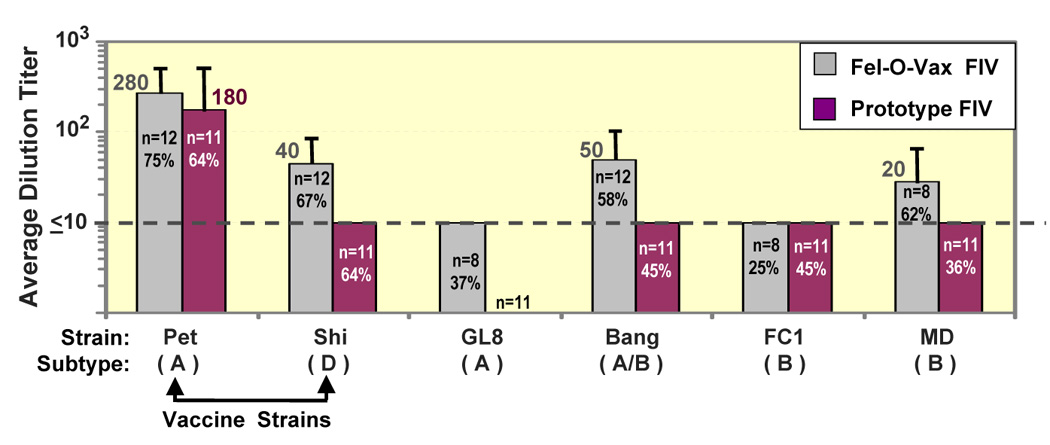
Fig. 1
Fig. 1
Vaccine-induced VNAs to heterologous and homologous subtype strains. SPF cats, immunized 3X at 3–4 week intervals with Fel-O-Vax FIV vaccine, induced the most VNAs to vaccine strains, recombinant subtype-A/B strain (FIVBang), and heterologous subtype-B strain (FIVMD). FIVBang is a recombinant of subtype-A gag/pol/envV1–V2 and subtype-B envV3–V9. VNA assay was performed with mitogen-stimulated PBMC and at 100 mean tissue culture infectious dose of low-passage FIV strains grown in primary PBMC (Pu et al., 2001). VNA titers are based on end-point dilution, which resulted in 50% inhibition of viral reverse transcriptase activity. The bar represents average VNA titers for each strain. The numbers of vaccinated cats tested are shown in the bar with percentage of cats that responded with ≥10 VNA titers.
Fig. 2
Fig. 2
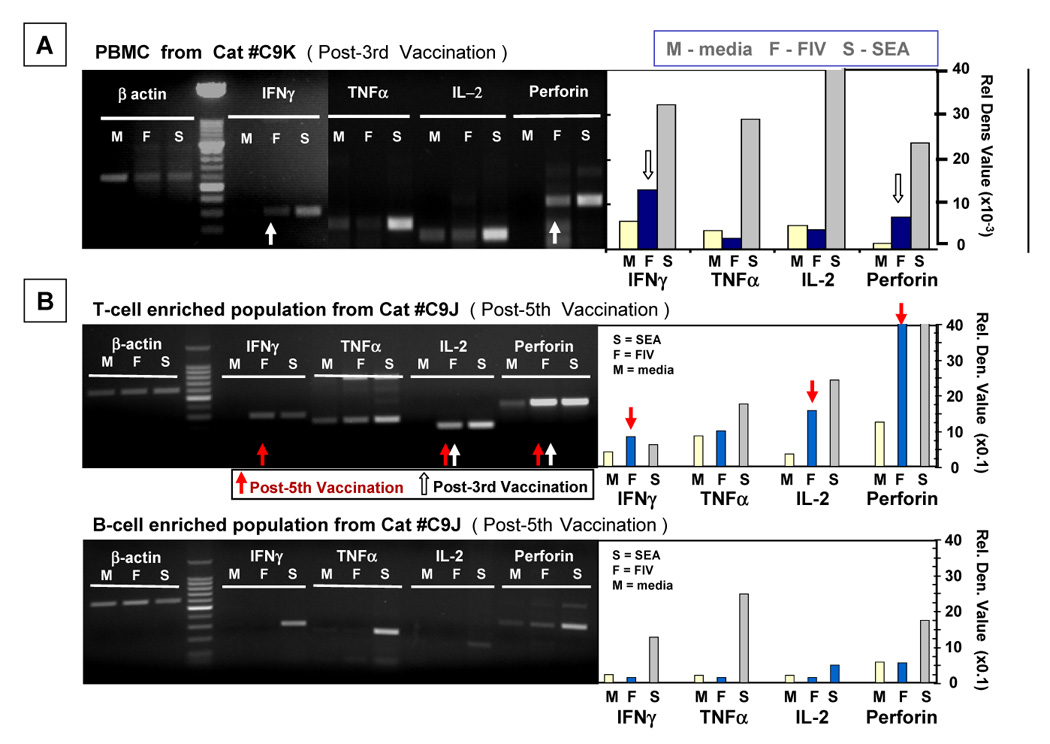
Monitoring vaccine-induced T-cell immunity by measuring mRNA for FIV-specific Th1 cytokines and CTL mediators. SPF cats were immunized 3X–5X with prototype dual-subtype FIV vaccine at 3–4 week intervals. PBMC from vaccinated cats at post-3rd vaccination (panel A) and post-5th vaccination (panel B) were cultured with inactivated FIV (F), T-cell mitogen staphylococcal enterotoxin A (S), or diluent media (M), and the cells were analyzed 18 hours later for mRNA. Th1 cytokine (IL-2 and IFNγ) mRNA, CTL mediator (TNFα, IFNγ, perforin) mRNA, and β-actin mRNA (housekeeping gene) were monitored. The mRNA was amplified by RT-PCR, and the amplified products were determined by agarose gel analysis. The intensity of the bands at predicted molecular weight sizes were determined by UV densitometry. The densitometric value representing each cytokine or CTL mediator mRNA was divided by the value for the β-actin mRNA to provide the relative densitometric value. The gel profiles and corresponding relative densitometirc value histograms of PBMC (panel A) from a cat post-3rd vaccination, and T-cell (panel B) and B-cell (panel C) enriched populations from a cat post-5th vaccination are shown with lanes for IFNγ, TNFα, IL-2, perforin, and β-actin. White and red arrows represent bands indicating high levels of cytokine or CTL mediator mRNAs present after 3rd vaccination and 5th vaccination, respectively.
Fig. 3
Fig. 3
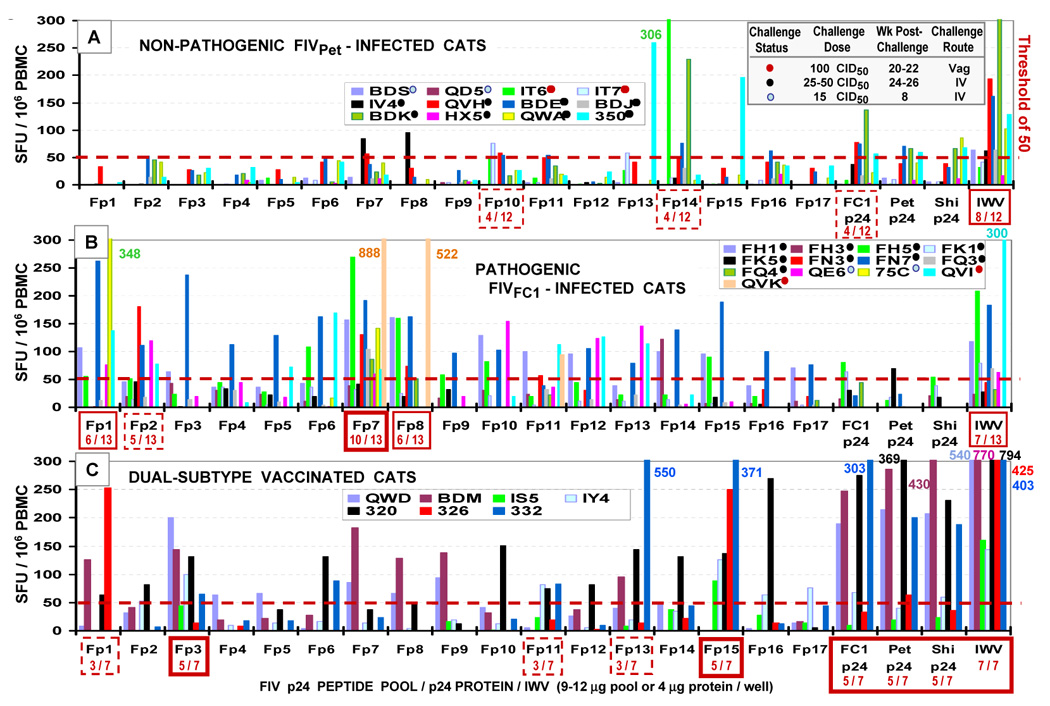
FIV p24-specific IFNγELISpot responses of PBMC from FIV-infected cats and dual-subtype vaccinated cats. Twelve and 13 SPF cats were inoculated with non-pathogenic FIVPet (panel A) and pathogenic FIVFC1 (panel B), respectively. The challenge dose, challenge route, and the time of blood collection for ELISpot analysis are shown in panel A (right top). All of these cats were positive for FIV by virus isolation and proviral PCR and by the development of FIV antibodies (Pu et al., 2001). These cats were divided into three groups according to the following challenge doses: 15 CID50 (light-blue dot next to the cat identification number), 25–50 CID50 (black dot), and 100 CID50 (red dot). Seven SPF cats were immunized 3X–4X at 3–4 week intervals with prototype dual-subtype FIV vaccine (panel C). PBMC from FIVPet-infected cats, FIVFC1-infected cats, and dual-subtype vaccinated cats were incubated with FIV p24 peptide pools, FIV p24 proteins, or IWV for 18 hour in ELISpot plates. Overlapping 15mer peptides with 11 aa overlap were synthesized based on subtype-A FIV p24 sequence and the 3–4 consecutive peptides were pooled to derive 17 FIV p24 peptide pools (Fp1–Fp17). Recombinant FIV p24 proteins were produced using E. coli expression system (Coleman et al., 2005). Feline IFNγELISpot development was performed according to manufacturer’s protocol (R&D Systems). ELISpot analyses were performed on PBMC from vaccinated cats at post-3rd (cats QWD, BDM, IS5) and 5th (cats IY4, 320, 326, 332) vaccinations and from infected cats at 8–26 weeks post-challenge. Those peptide pools, which induced responses in 33–43%, 46–67%, and ≥71% of the cats, are shown with dotted-line, solid-line, and bolded-line boxes, respectively. The ratio within the box is the number of responding cats over total number of cats tested. In general, PBMC from nonpathogenic FIVPet-infected cats had lower IFNγresponses to overlapping peptide pools than PBMC from pathogenic FIVFC1-infected cats. Furthermore, the peptide pools most frequently recognized above threshold were different between the PBMC from FIVPet-infected cats and those from FIVFC1-infected cats. The FIV doses or routes used for infection were most likely not the cause of the difference since the cats with different inoculation doses and routes were evenly distributed between the two strains. The PBMC from vaccinated cats had robust IFNγresponses to FIV p24 proteins, IWV, and to multiple peptide pools. Furthermore, the vaccinated cats recognized p24 peptide pools, which were generally different from the pools recognized by the infected cats.
Fig. 4
Fig. 4
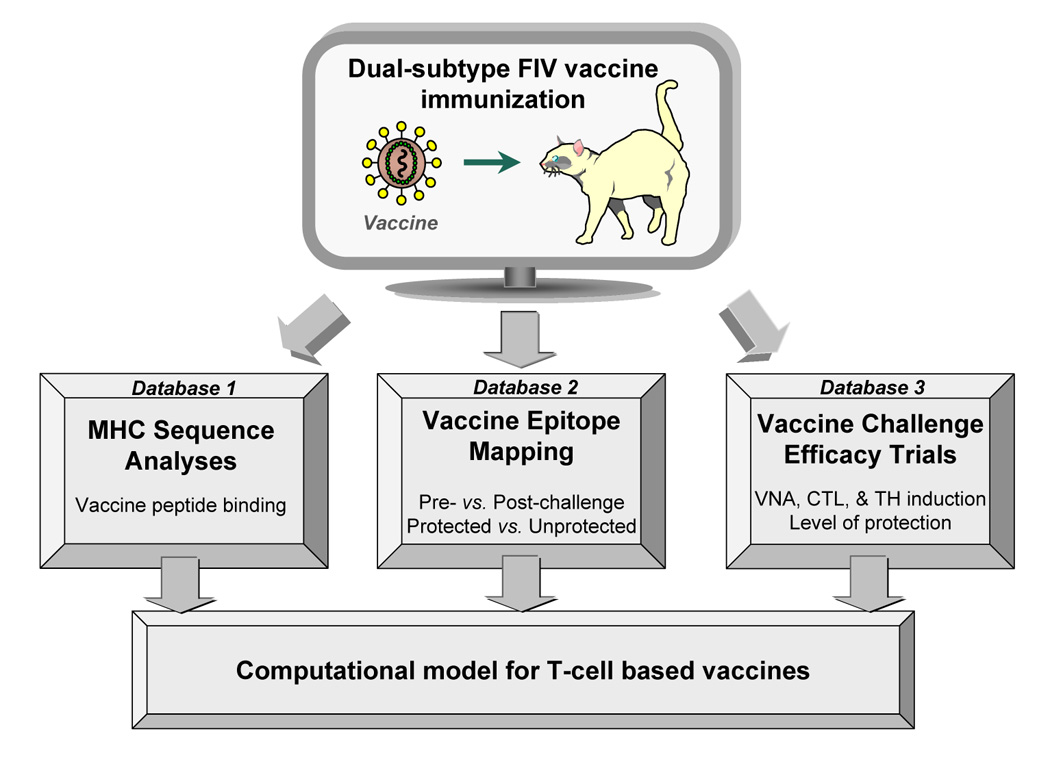
Computational modeling for T-cell immunity-based FIV vaccines. Propred-I and Propred-II epitope prediction tools are few of the known databases for identifying peptides binding to HLA class-I and class-II, respectively (De Groot et al., 2002). Los Alamos National Laboratory (LANL) database provides antibody, TH, and CTL epitope mapping for HIV-1 mainly derived from infected humans or vaccinated humans or animals (LANL, 2006). Similar epitope prediction tools based on feline MHC-I and –II can be produced concurrent to the sequencing of MHC alleles in domestic cat population (database 1) and to the epitope mapping generated by T-cell assays using semi-inbred cats (database 2). Vaccine epitope analysis can be performed directly in the natural host by immunizing potential protective peptides and evaluating the protective efficacy of these peptides against FIV challenge (database 3).

References

    1. Addo MM, Yu XG, Rathod A, Cohen D, Eldridge RL, Strick D, Johnston MN, Corcoran C, Wurcel AG, Fitzpatrick CA, Feeney ME, Rodriguez WR, Basgoz N, Draenert R, Stone DR, Brander C, Goulder PJ, Rosenberg ES, Altfeld M, Walker BD. Comprehensive epitope analysis of human immunodeficiency virus type 1 (HIV-1)-specific T-cell responses directed against the entire expressed HIV-1 genome demonstrate broadly directed responses, but no correlation to viral load. J. Virol. 2003;77:2081–2092. - PMC - PubMed
    1. Ahmed A, Ahmad R. HIV’s evasion of host’s NK cell response and novel ways of its countering and boosting anti-HIV immunity. Curr. HIV Res. 2003;1:295–307. - PubMed
    1. Bachmann MH, Mathiason-Dubard C, Learn GH, Rodrigo AG, Sodora DL, Mazzetti P, Hoover EA, Mullins JI. Genetic diversity of feline immunodeficiency virus: Dual infection, recombination, and distinct evolutionary rates among envelope sequence clades. J. Virol. 1997;71:4241–4253. - PMC - PubMed
    1. Blackard JT, Cohen DE, Mayer KH. Human immunodeficiency virus superinfection and recombination: current state of knowledge and potential clinical consequences. Clin. Infect. Dis. 2002;34:1108–1114. - PubMed
    1. Broche-Pierre S, Richardson J, Moraillon A, Sonigo P. Evaluation of live feline immunodeficiency virus vaccines with modified antigenic properties. J. Gen. Virol. 2005;86:2495–2506. - PubMed

Publication types

MeSH terms

LinkOut - more resources