. 2008 May 1;95(1-2):115-28.
doi: 10.1016/j.drugalcdep.2007.12.014. Epub 2008 Mar 4.

Reduced posterior mesofrontal cortex activation by risky rewards in substance-dependent patients

Affiliations

Reduced posterior mesofrontal cortex activation by risky rewards in substance-dependent patients

James M Bjork et al. Drug Alcohol Depend. .

Abstract

Substance-dependent individuals show disadvantageous decision-making, as well as alterated frontocortical recruitment when performing experimental tasks. We investigated whether substance-dependent patients (SDP) would show blunted recruitment of posterior mesofrontal cortex (PMC) by a conflict between concurrently increasing reward and risk of penalty in a monetary game of "chicken." SDP and controls performed: motor control (no reward) trials, guaranteed reward trials in which reward was not at risk, and risky trials where subjects were required to terminate their reward accrual before a secret varying time limit or else "bust" and forfeit that trial's winnings (low penalty) or the current trial's winnings plus an equal amount of previous winnings (high penalty). Reward accrual duration at risk of "busting" correlated negatively with trait neuroticism. The contrast between winning guaranteed reward versus non-reward activated the caudate head bilaterally in SDP but not controls. Accumulation of money at risk of low- or high-penalty (contrasted with accumulating guaranteed money) activated the PMC in both groups, but with a greater magnitude and more anterior extent in controls. Pre-decision signal increase in a PMC volume of interest negatively correlated with risk-taking in low-penalty trials, and was blunted in SDP relative to controls under both penalty conditions after controlling for individual differences in actual risk-taking and the higher neuroticism of SDP. These data suggest that SDP are characterized by a combination of: (a) striatal hypersensitivity to reward, and (b) under-recruitment of the specialized conflict-monitoring circuitry of the PMC when reward entails potential penalties.


Figures
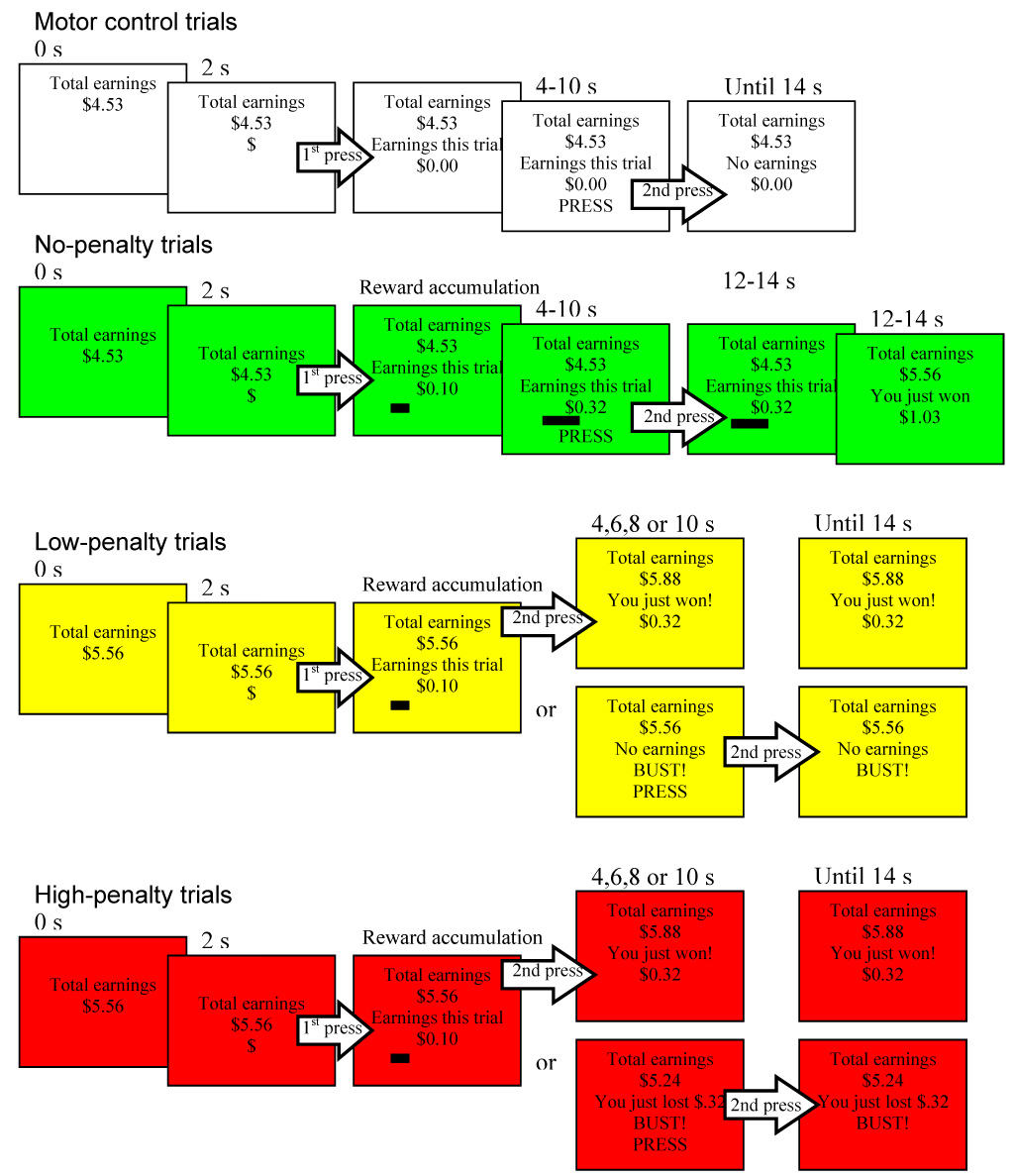
Figure 1
Figure 1
The risk taking task presented subjects with four types of pseudorandomly-presented trials (duration 14 s, n = 24 ea). In motor control trials, subjects pressed on cue twice (to the “$” and to the word “press”) for no incentive. In no-penalty trials, subjects began accruing money after pressing in response to the “$” cue, and accumulated winnings throughout the trial with no chance of penalty. In low-penalty trials, each trial was assigned a secret time limit of either 4, 6, 8, or 10 seconds after the $ cue, during which the subject was allowed to accumulate money. If the subject voluntarily stopped reward accrual before the secret time limit (top bifurcated outcome) he or she added accrued trial winnings to total winnings. If he or she failed to stop reward accrual before the secret time limit (bottom bifurcated outcome), he or she “busted” and forfeited all winnings that trial, and was instructed to press a second time. In high-penalty trials, subjects were also required to terminate reward accrual before the secret varying time limit, but busts resulted in subtraction of trial-accumulated winnings from previous winnings.
Figure 2
Figure 2
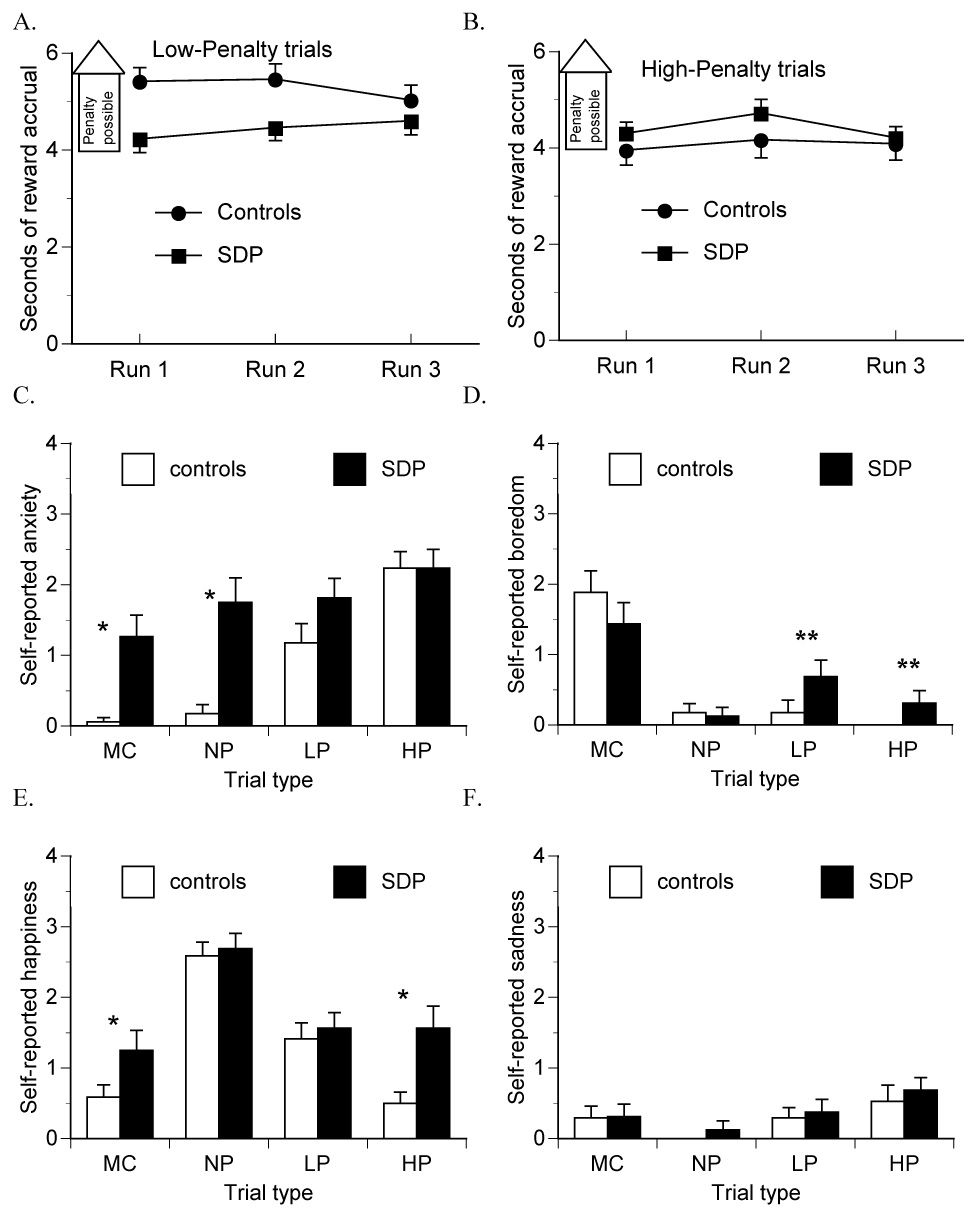
Controls showed significantly longer mean reward accrual duration (in non-busted trials) than substance-dependent patients (SDP) in low- (A) not high- (B) penalty trials. In a post-scan questionnaire, subjects rated their mood responses to motor control (MC), no-penalty (NP), low-penalty (LP) and high-penalty (HP) trials of task. Self-reported anxiety (C) and boredom (D) differed as a function of trial type more in controls than in SDP (group X trial type P < .05). Self-reported happiness (E) also tended to be more trial type-sensitive in controls compared to SDP (group X trial type P < .10). Self-reported sadness was minimal in both groups (F). * denotes P < .05; ** P < .10.
Figure 3
Figure 3
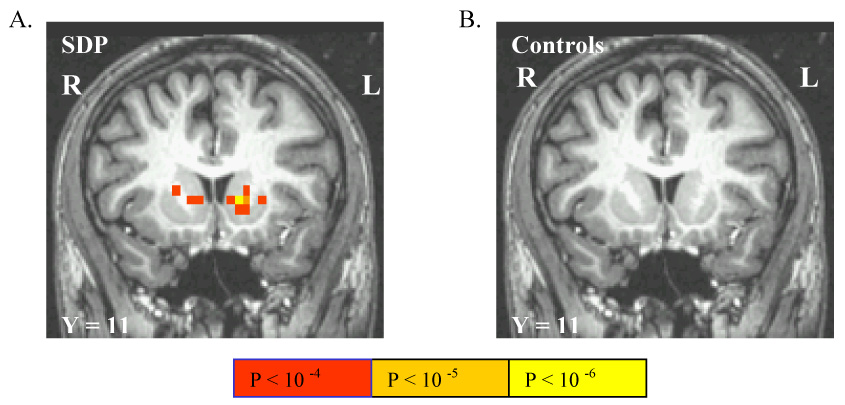
The linear contrast between reward accrual in non-penalty trials versus cue-elicited responses for no incentive in motor control trials activated the caudate head bilaterally in SDP (A) but not controls (B). Image reversed per radiological convention.
Figure 4
Figure 4
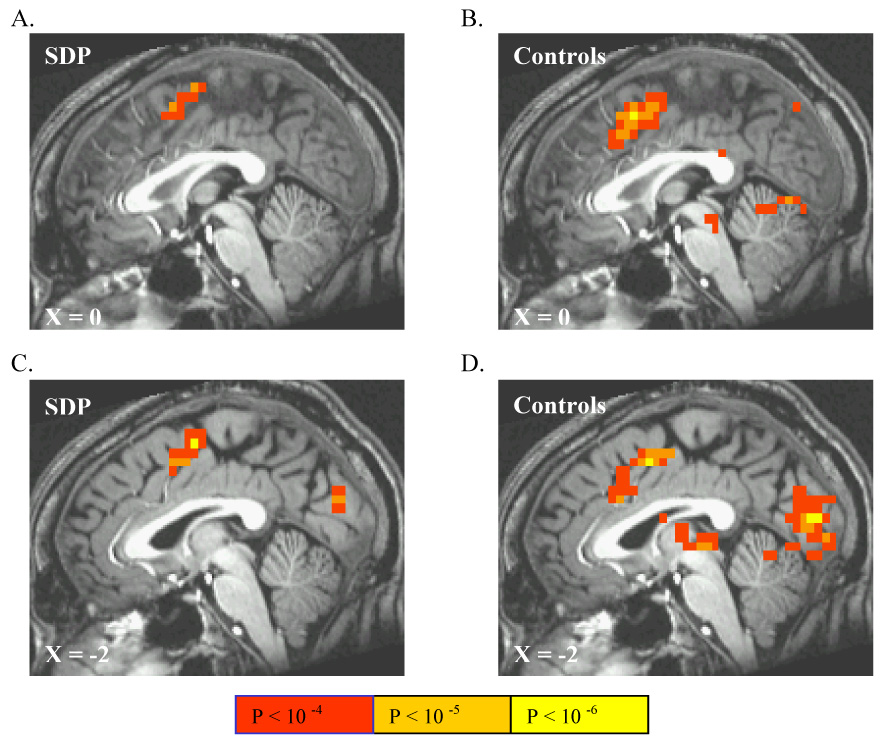
The linear contrast between reward accrual at risk of winning nothing in low-penalty trials versus winning guaranteed reward in non-penalty trials activated portions of posterior mesofrontal cortex (PMC) in SDP (A) and controls (B). Similarly, the linear contrast between reward accrual at risk of losing previous winnings in high-penalty trials versus winning guaranteed reward in no-penalty trials also activated MPC in SDP (C) and controls (D), with additional activation of mesial occipital cortex in both groups.
Figure 5
Figure 5
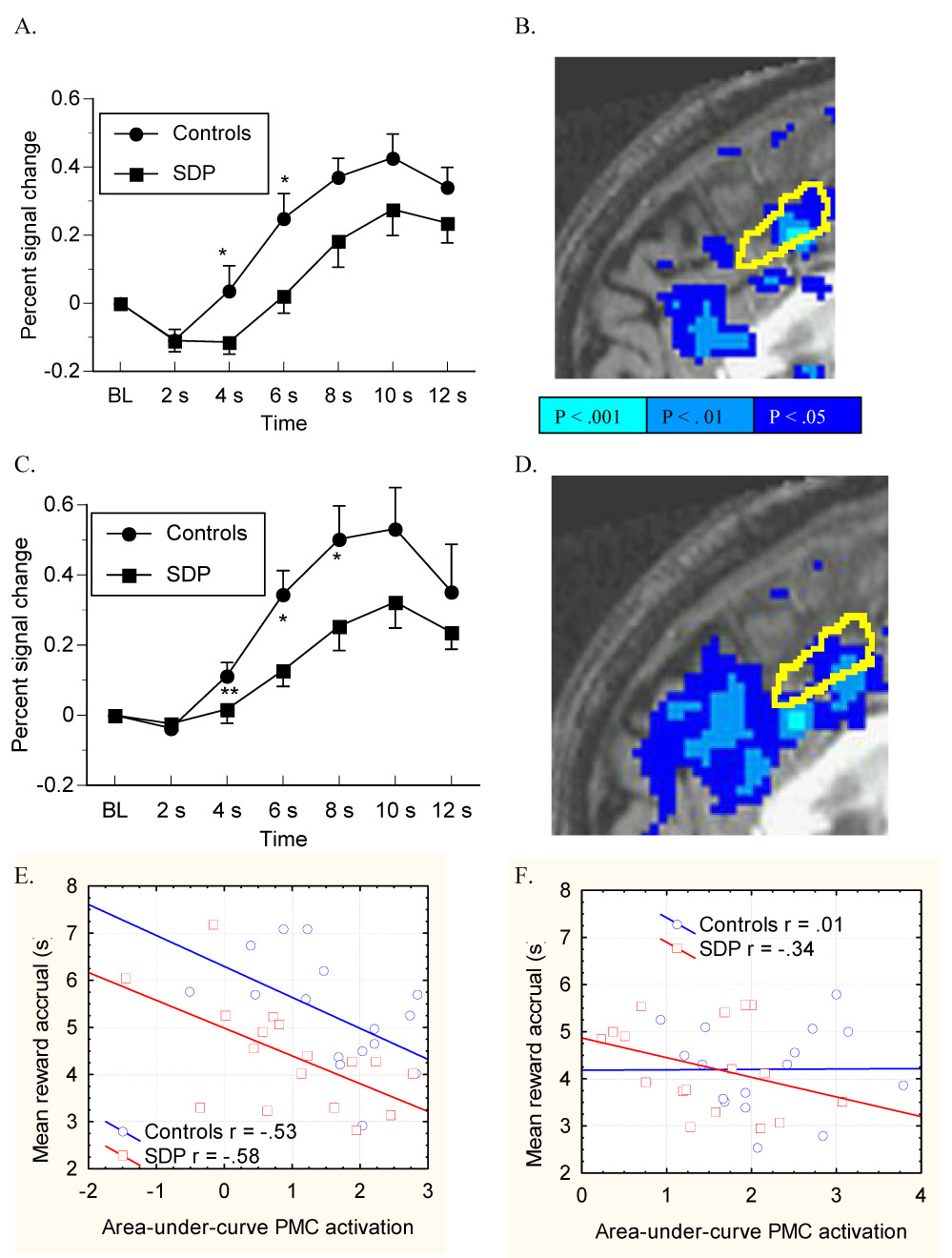
Trial-type-averaged BOLD signal was extracted from PMC in a midsagittal volume of interest mask (yellow outline) drawn to encompass the activation maxima previously reported in several experiments on pre-decision conflict (see ref. (Ridderinkhof et al., 2004)). In low-penalty trials, SDP showed blunted BOLD signal change in PMC relative to controls following the onset of risky reward accrual (the 2 s timepoint) as seen in the hemodynamic response itself (A) and in a voxel-wise t-test of the group difference in activation by the low-penalty versus no-penalty contrast, where reduced activation in SDP is depicted in blue (B). In high-penalty trials, SDP also showed a blunted hemodynamic response to risky reward (C), with significantly lower anterior cingulate activation (per voxel-wise t-test) by high-penalty trials contrasted with no-penalty trials (D). Area-under-curve activation of the PMC by risky reward accrual correlated negatively with risk-taking behavior in both SDP and controls in low-penalty trials (E), but not in high-penalty trials (F).

References

    1. Barnes GM, Welte JW, Hoffman JH, Dintcheff BA. Gambling and alcohol use among youth: influences of demographic, socialization, and individual factors. Addict Behav. 1999;24:749–767. - PubMed
    1. Bartzokis G, Beckson M, Lu PH, Edwards N, Bridge P, Mintz J. Brain maturation may be arrested in chronic cocaine addicts. Biol Psychiatry. 2002;51:605–611. - PubMed
    1. Bechara A, Damasio AR, Damasio H, Anderson SW. Insensitivity to future consequences following damage to human prefrontal cortex. Cognition. 1994;50:7–15. - PubMed
    1. Bechara A, Dolan S, Denburg N, Hindes A, Anderson SW, Nathan PE. Decision-making deficits, linked to a dysfunctional ventromedial prefrontal cortex, revealed in alcohol and stimulant abusers. Neuropsychologia. 2001;39:376–389. - PubMed
    1. Bechara A, Dolan S, Hindes A. Decision-making and addiction (part II): myopia for the future or hypersensitivity to reward? Neuropsychologia. 2002;40:1690–1705. - PubMed

Publication types

MeSH terms