


Applicability of current staging/categorization of alpha-synuclein pathology and their clinical relevance
- PMID: 18297293
- PMCID: PMC2270355
- DOI: 10.1007/s00401-008-0346-6
Applicability of current staging/categorization of alpha-synuclein pathology and their clinical relevance
Abstract
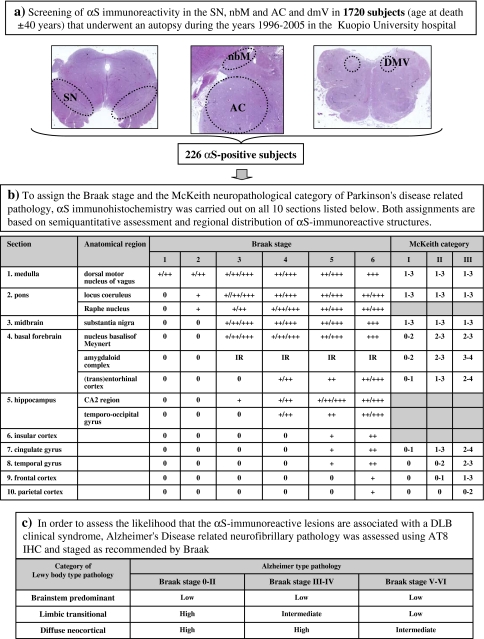
In Parkinson's disease (PD) and dementia with Lewy bodies (DLB) alpha-synuclein (alphaS) pathology is seen that displays a predictable topographic distribution. There are two staging/categorization systems, i.e. Braak's and McKeith's, currently in use for the assessment of alphaS pathology. The aim of these diagnostic strategies in pathology is, in addition to assess the stage/severity of pathology, to assess the probabilities of the related clinical symptomatology i.e. dementia and extrapyramidal symptoms (EPS). Herein, we assessed the applicability of these two staging/categorization systems and the frequency of dementia and EPS in a cohort of 226 alphaS-positive-subjects. These subject were selected from a large autopsy sample (n = 1,720), irrespective of the clinical presentation, based on the detection of alphaS-immunoreactivity (IR) in one of the most vulnerable nuclei; in the dorsal motor nucleus of vagus, substantia nigra and basal forebrain. The frequency of alphaS-IR lesions in this large cohort was 14% (248 out of 1,720). If applicable, each of the 226 subjects with all required material available was assigned a neuropathological stage/category of PD/DLB and finally the neuropathological data was analyzed in relation to dementia and EPS. 83% of subjects showed a distribution pattern of alphaS-IR that was compatible with the current staging/categorization systems. Around 55% of subjects with widespread alphaS pathology (Braak's PD stages 5-6) lacked clinical signs of dementia or EPS. Similarly, in respect to those subjects that fulfilled the McKeith criteria for diffuse neocortical category and displaying only mild concomitant Alzheimer's disease-related pathology, only 48% were demented and 54% displayed EPS. It is noteworthy that some subjects (17%) deviated from the suggested caudo-rostral propagation suggesting alternative routes of progression, perhaps due to concomitant diseases and genetic predisposition. In conclusion, our results do indeed confirm that current staging/categorization systems can readily be applied to most of the subjects with alphaS pathology. However, finding that around half of the subjects with abundant alphaS pathology remain neurologically intact is intriguing and raises the question whether we do assess the actual disease process.
Figures
Comment in
-
Controversies over the staging of alpha-synuclein pathology in Parkinson's disease.Acta Neuropathol. 2008 Jul;116(1):125-8; author reply 129-31. doi: 10.1007/s00401-008-0381-3. Epub 2008 Apr 30. Acta Neuropathol. 2008. PMID: 18446352 No abstract available.
References
-
- {'text': '', 'ref_index': 1, 'ids': [{'type': 'DOI', 'value': '10.1001/archneur.59.1.102', 'is_inner': False, 'url': 'https://doi.org/10.1001/archneur.59.1.102'}, {'type': 'PubMed', 'value': '11790237', 'is_inner': True, 'url': 'https://pubmed.ncbi.nlm.nih.gov/11790237/'}]}
- Apaydin H, Ahlskog JE, Parisi JE, Boeve BF, Dickson DW (2002) Parkinson disease neuropathology: later-developing dementia and loss of the levodopa response. Arch Neurol 59:102–112 - PubMed
-
- {'text': '', 'ref_index': 1, 'ids': [{'type': 'DOI', 'value': '10.1111/j.1365-2990.2006.00727.x', 'is_inner': False, 'url': 'https://doi.org/10.1111/j.1365-2990.2006.00727.x'}, {'type': 'PubMed', 'value': '16640647', 'is_inner': True, 'url': 'https://pubmed.ncbi.nlm.nih.gov/16640647/'}]}
- Bloch A, Probst A, Bissig H, Adams H, Tolnay M (2006) Alpha-synuclein pathology of the spinal cord and peripheral autonomic nervous system in neurologically unimpaired elderly. Neuropathol Appl Neurobiol 32:284–295 - PubMed
-
- {'text': '', 'ref_index': 1, 'ids': [{'type': 'PMC', 'value': 'PMC1449678', 'is_inner': False, 'url': 'https://pmc.ncbi.nlm.nih.gov/articles/PMC1449678/'}, {'type': 'PubMed', 'value': '16537516', 'is_inner': True, 'url': 'https://pubmed.ncbi.nlm.nih.gov/16537516/'}]}
- Bodner RA, Outeiro TF, Altmann A, Maxwell MM, Cho SH, Hyman BT, Mc Lean PJ, young AB, Housman DE, Kazantsev AG (2007) Pharmacological promotion of inclusion formation: a therapeutic approach fro Huntington’s and Parkinson’s diseases. PNAS 14(103):4246–4251 - PMC - PubMed
-
- {'text': '', 'ref_index': 1, 'ids': [{'type': 'DOI', 'value': '10.1016/S0197-4580(02)00065-9', 'is_inner': False, 'url': 'https://doi.org/10.1016/s0197-4580(02)00065-9'}, {'type': 'PubMed', 'value': '12498954', 'is_inner': True, 'url': 'https://pubmed.ncbi.nlm.nih.gov/12498954/'}]}
- Braak H, Del Tredici K, Rub U, de Vos RA, Jansen Steur EN, Braak E (2003) Staging of brain pathology related to sporadic Parkinson’s disease. Neurobiol Aging 24:197–211 - PubMed
-
- {'text': '', 'ref_index': 1, 'ids': [{'type': 'PubMed', 'value': '15851731', 'is_inner': True, 'url': 'https://pubmed.ncbi.nlm.nih.gov/15851731/'}]}
- Braak H, Rub U, Del Tredici K, Jansen Steur EN, de Vos RA (2005) Cognitive status with neuropathologic stage in Parkinson disease. Neurology 64:1404–1410 - PubMed
Publication types
MeSH terms
Substances
LinkOut - more resources
Full Text Sources
Other Literature Sources
Medical
