


Isobolographic analysis of pharmacodynamic interactions between antifungal agents and ciprofloxacin against Candida albicans and Aspergillus fumigatus
- PMID: 18299413
- PMCID: PMC2415767
- DOI: 10.1128/AAC.00735-07
Isobolographic analysis of pharmacodynamic interactions between antifungal agents and ciprofloxacin against Candida albicans and Aspergillus fumigatus
Abstract
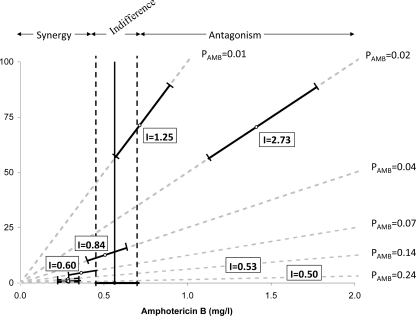
Patients suffering from invasive mycoses often receive concomitant antifungal therapy and antibacterial agents. Assessment of pharmacodynamic interactions between antifungal and antibacterial agents is complicated by the absence of a common antifungal end point for both agents. Ciprofloxacin has no intrinsic antifungal activity but may interact with antifungal agents, since it inhibits DNA gyrase (topoisomerase II), which is abundant in fungi. We therefore employed isobolographic analysis adapted to incorporate a nonactive agent in order to analyze the potential in vitro interaction between the fluoroquinolone ciprofloxacin and several representative antifungal agents against Candida albicans and Aspergillus fumigatus strains by using a microdilution checkerboard technique. In agreement with earlier in vitro studies, conventional fractional inhibitory concentration index analysis was unable to detect interactions between ciprofloxacin and antifungal agents. However, isobolographic analysis revealed significant pharmacodynamic interactions between antifungal agents and ciprofloxacin against C. albicans and A. fumigatus strains. Amphotericin B demonstrated concentration-dependent interactions for both species, with synergy (interaction indices, 0.14 to 0.81) observed at ciprofloxacin concentrations of <10.64 microg/ml. Synergy (interaction indices, 0.10 to 0.86) was also found for voriconazole and caspofungin against A. fumigatus. Isobolographic analysis may help to elucidate the pharmacodynamic interactions between antifungal and non-antifungal agents and to develop better management strategies against invasive candidiasis and aspergillosis.
Figures

References
-
- American Society for Microbiology. 2007. Instructions to authors. Antimicrob. Agents Chemother. 51:1-22.
-
- Antoniadou, A., and H. Giamarellou. 2007. Fever of unknown origin in febrile leukopenia. Infect. Dis. Clin. N. Am. 21:1055-1090. - PubMed
-
- Berenbaum, M. C. 1989. What is synergy? Pharmacol. Rev. 41:93-141. - PubMed
-
- Borowicz, K. K., M. Swiader, J. Luszczki, and S. J. Czuczwar. 2002. Effect of gabapentin on the anticonvulsant activity of antiepileptic drugs against electroconvulsions in mice: an isobolographic analysis. Epilepsia 43:956-963. - PubMed
-
- Faessel, H. M., L. M. Levasseur, H. K. Slocum, and W. R. Greco. 1999. Parabolic growth patterns in 96-well plate cell growth experiments. In Vitro Cell. Dev. Biol. Anim. 35:270-278. - PubMed
Publication types
MeSH terms
Substances
Grants and funding
LinkOut - more resources
Full Text Sources
Other Literature Sources
Medical
